
The New York Times Is Scared
 The New York Times Is Scared
 The power elite in this country is assigning huge importance to the Anthropic IPO.
We know this because the story made the front page of the print edition of today’s New York Times. Here’s the online treatment…
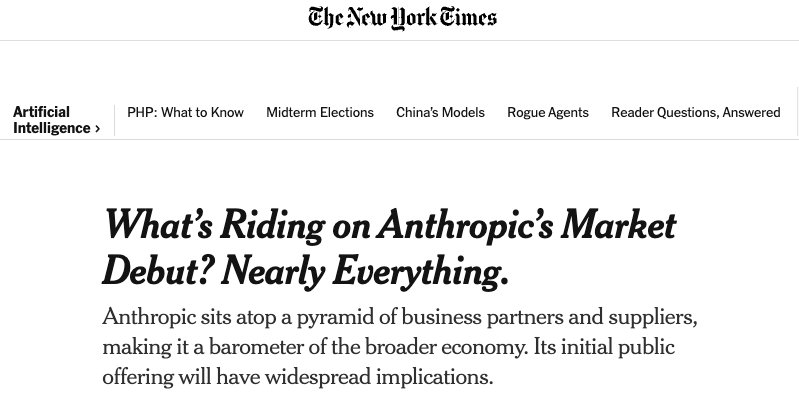
As we mentioned briefly yesterday, Anthropic — the company behind the Claude chatbot — will go public as soon as the week before Thanksgiving.
The Times’ assessment is that “Anthropic’s listing will provide the first in-depth look at the health of a key business underlying the AI boom — and will be a test of its durability. Is there unending appetite for AI services to justify the spending on chips, data centers and other infrastructure? Or will Anthropic’s performance show that there are limits?”
You can sense the nervousness among the movers and shakers who read the Times, no?
As promised yesterday, the Paradigm team has taken the time to review the company’s newly released IPO prospectus — to come up with our own assessment independent of the corporate media.
“Anthropic’s revenue grew over 1,300% in a year,” is the number that jumped out at Paradigm tech investing specialist Ray Blanco.
“Anthropic generated $16.3 billion in first-half revenue, up from $1.16 billion a year earlier.”
On paper, that compares with a net loss of $80.7 billion. But that figure is a function of arcane accounting rules. The more relevant number is the operating loss — which is a much more modest $693 million.
“Demand runs deep,” Ray continues: “More than 11,900 customers pay Anthropic $100,000 or more a year, and about 250 pay $10 million or more. Existing customers now spend roughly nine times what they did a year ago.”
And Ray says they’ve barely scratched the surface. “The S-1 filing pegs the global value of knowledge work at more than $40 trillion a year. Anthropic’s revenue is running at a tiny sliver of that.
“The revenues ripped, but the bills grew far slower. In the second quarter, revenue rose 1,368% from a year earlier while compute and infrastructure costs rose just 300%. Anthropic spent about $2.51 on compute per revenue dollar in early 2025, down to about $0.48 by mid-2026.
“Anthropic’s passing the savings along. Its newest model cut customers’ cost per task by about 40%, and cheaper work means more work.”
“This is where everything hangs in the balance,” Ray says: “the S-1 warns that Anthropic will make compute investments that ‘may seem irresponsibly large at first glance.’
“Its reasoning rests on the AI scaling laws, which the founders believe put AI’s economic value on an exponential curve.
“If they’re right, the products of the next few years will be worth far more than today’s, so Anthropic says it must ‘invest more aggressively than would a business that operates in a more slowly changing technological regime.’”
Their analogy is drug development, which happens to be Ray’s other speciality in our shop: “Giant research bills upfront that only make sense once the winners pay off, except Anthropic says its version runs ‘much faster and on a much larger scale.’
“Biotech investors know that model well. It pays off when the pipeline delivers, and Anthropic’s pipeline is already delivering.
“Will the scaling laws keep holding? That’s the big bet. Anybody who buys shares at the IPO is making that bet too.”
Of course, if you’ve been with us for longer than a few weeks, you know that it’s usually a terrible idea to buy shares of a company the day it goes public. Too much volatility in those first weeks and months.
Besides, there’s one number in Anthropic’s filing that’s conspicuous by its absence.
“This is a document with many details about their operations that they must publish in order to go public,” Paradigm trading pro Enrique Abeyta reminds us.
“The one item that was NOT in there? The valuation at which they will be selling the shares.
“The numbers and economics of their business are tremendous but the valuation being discussed ($1.5–2 trillion) means that it is unlikely investors will make money on the shares anytime soon. In fact, I think that the shares will be down 50–90% within just a few years.
“My advice? STAY AWAY. This is not SpaceX and will do much, much worse.”
Bad news for the readers of The New York Times — except of course for the lucky few at the top of the heap who already own a piece of Anthropic pre-IPO. They’ll make out like bandits.
 Two Signs of a Year-End Rally
As the euro currency goes, so goes the U.S. stock market?
That’s how it looks to JC Parets, the newest addition to the Paradigm team. He’s been eyeing the U.S. dollar index (DXY) — a basket of six developed-market currencies, of which the euro comprises 57%.
Based on his chart work, he sees the DXY trying to break out to new highs — and failing.
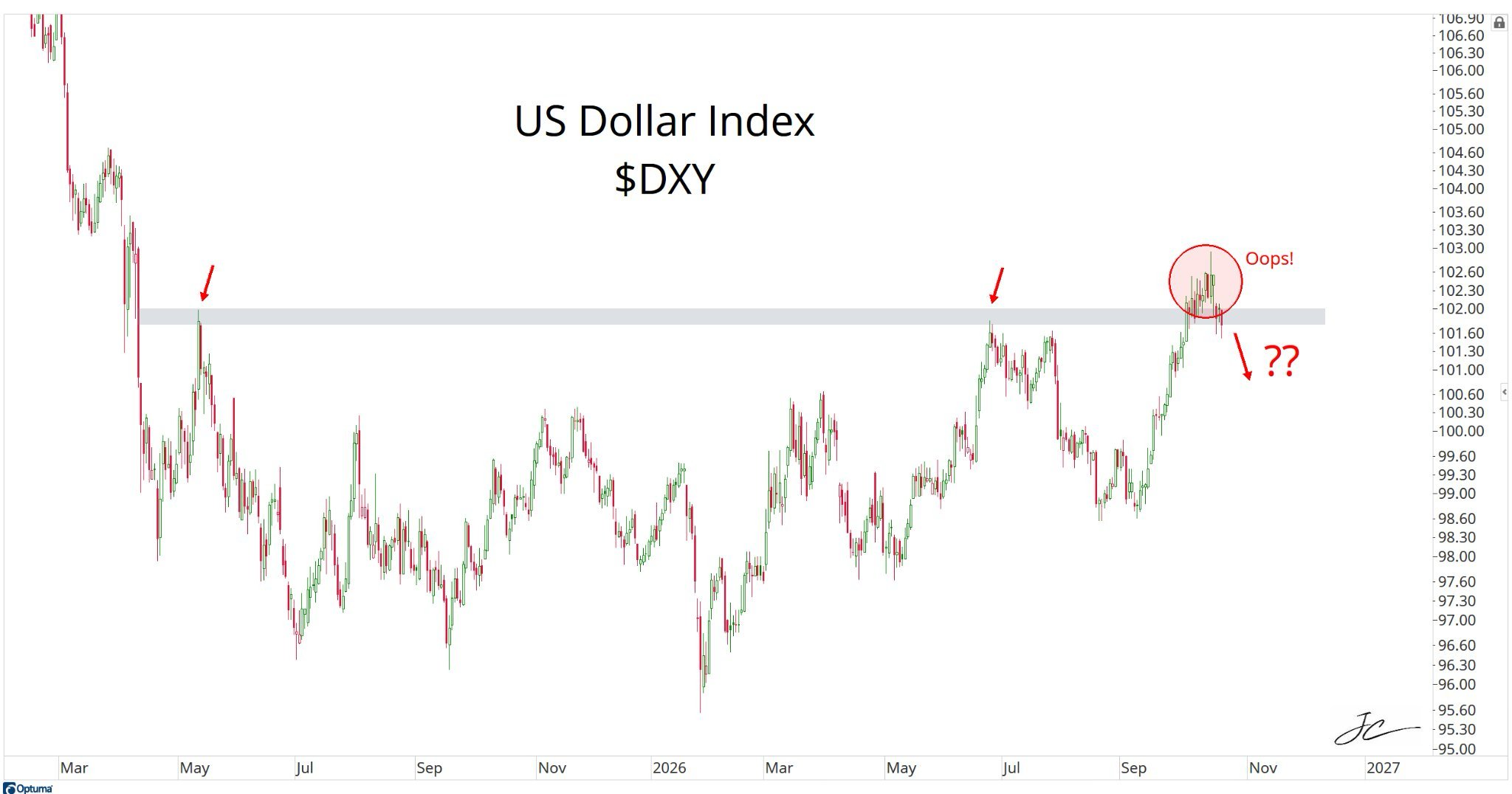
“If this is a failed breakout for the DXY, look out,” he says — “stocks are going to absolutely rip into the end of 2026…
“A failed breakout for the DXY could be the catalyst for that next move in equities.”
That’s because all else being equal, a weaker dollar translates to stronger stocks; foreigners have more purchasing power to buy goods from American multinationals.
At the moment, JC sees big potential for the euro to catch a bid: Rising euro → falling DXY —> rising stock market.
That’s one more tailwind for stocks — on top of what he’s previously identified as the strongest seven-month stretch for stocks in the four-year presidential election cycle.
Speaking of which… 10X Trade Club editor Chris Cimorelli has come across another bullish election tidbit: “Since the year 1946, the S&P 500 has gone up 100% of the time in the 12 months following the midterm election.
“This table shows the average returns over three periods: the 12 months before the election, the 12 months after, and the true average over all 12 month periods.
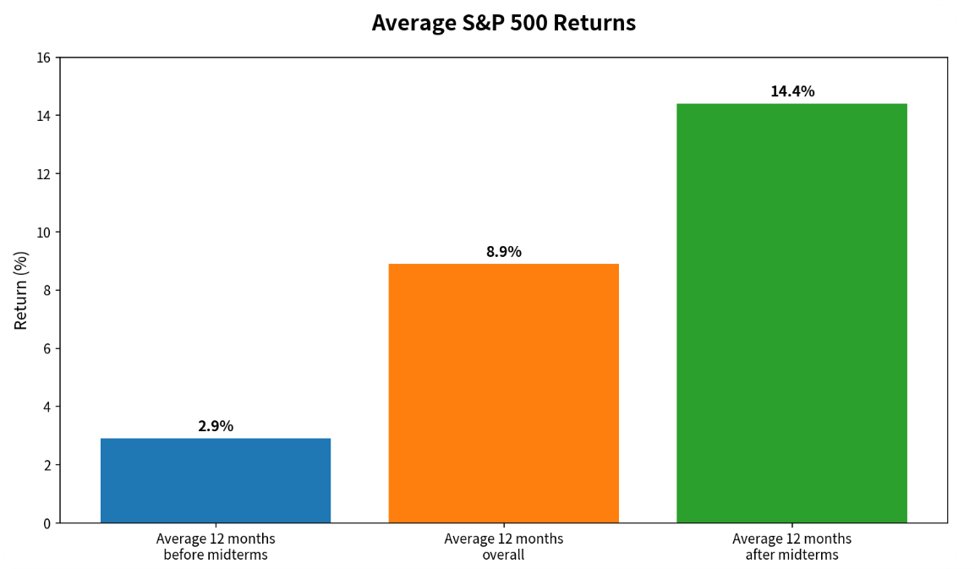
“Before midterms yields just 2.9%. That's a poor return. The true average is fine: 8.9%. But the average in the 12 months following is substantial: 14.4%.
“And most of those gains tend to come in the two months immediately following the election.”
As for today, the major U.S. indexes are in the green — adding to yesterday’s gains.
The S&P 500 is up more than a half percent to 7,720 — about 1.25% below its record close notched three weeks ago.
The Nasdaq is up 1% to 26,449 — but it has more work to do, sitting 4.2% below its high-water mark earlier this month.
The Dow is barely positive, dragged down by Boeing — down 10% after the company lowered its year-end target for aircraft deliveries.
Once again, gold has bounced back from under $4,000 an ounce — $4,055 at last check. Silver’s back over $54. U.S. oil futures are about to break beneath $100.
One economic number of note: Durable goods orders grew 1.8% from August to September. But this number is often skewed by orders for aircraft and military hardware, which are notoriously “lumpy” month to month. Back those out and you have a number called “core capital goods” — which grew 0.5%, less than expected.
 Market Miscellany: The Fed, Bitcoin
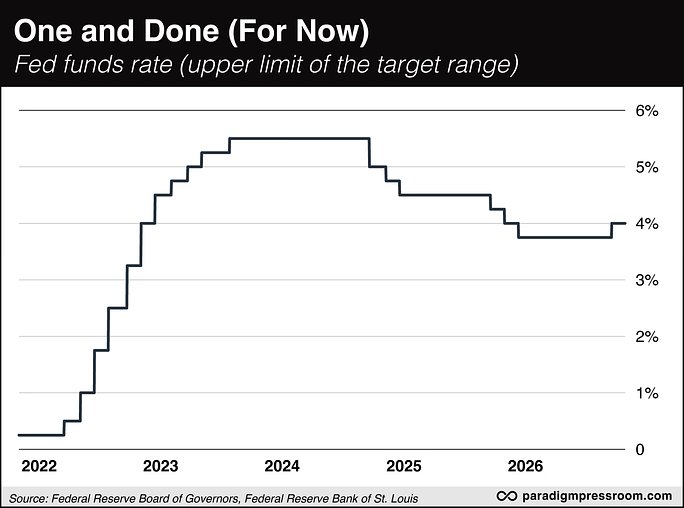
For the moment, it’s “one and done” for the Federal Reserve — after raising interest rates six weeks ago.
The Fed begins one of its periodic two-day meetings today. Looking at the action in the futures markets today, there’s a 91% likelihood that at the conclusion of the meeting tomorrow, the Fed will hold steady and keep the benchmark fed funds rate at 4.0%.
Paradigm macro maven Jim Rickards is in agreement. “The reason comes down to one word,” he says: “elections.
“The midterm elections are only seven days away. Many voters are voting now, depending on state law and the use of mail-in ballots. Kevin Warsh was appointed Fed chair by Donald Trump to cut rates. Warsh will not cut rates at this meeting because of inflation. But he won’t raise them either because of politics.
“It’s nonsense to say that the Fed is not political. The Fed is highly political and knows what the White House wants. The Fed will not bow to White House wishes by cutting rates, but it will do the White House a favor by doing nothing.”
Of course, Warsh could still deliver a surprise during the post-meeting news conference tomorrow afternoon. And then only a couple of hours later, we’ll get bellwether earnings reports from two of the AI hyperscalers — Google and Microsoft. Much potential for drama…
Nine years after JPMorgan Chase CEO Jamie Dimon called Bitcoin a “fraud,” his firm has found a place for Bitcoin in its forecasts.
For the first time, J.P. Morgan Asset Management included Bitcoin in its 2027 Long-Term Capital Market Assumptions.
Starting from $83,000 on Sept. 30, it spells out three potential scenarios over the next 10 years…
| Scenario | Annual compound return | BTC price in 2036 |
| Bear | −11.2% | $25,300 |
| Base | +10.0% | $215,300 |
| Bull | +16.6% | $385,500 |
Curiously, the base case implies a 10% compound annual return — ahead of JPMorgan’s projections for U.S. large-cap stocks (7.5%), aggregate bonds (5.6%) and gold (5.5%).
Yes, those potentially higher returns come with substantially more risk. By its calculations, Bitcoin has more than three times the volatility of large-cap stocks.
Maybe that’s why Bitcoin still doesn’t make the cut for JPM’s main strategic portfolio models. The forecast cites “unstable market correlations” as a reason not to treat Bitcoin as a dependable diversifier. Still it sees Bitcoin “as a speculative asset and a hedge against monetary easing.”
It’s a watershed for crypto. Matt Hougan, chief investment officer at Bitwise Asset Management, puts it like this: “First they ignore you, then they laugh at you, then they fight at you, then they add you to their Long-Term Capital Markets Assumptions paper and predict you’ll be the best-performing asset of the next decade.”
In the meantime, Bitcoin continues to consolidate a little over $83,000 while Ethereum oscillates around $2,350.
 Comic Relief
I have no idea whether this is new, but I’m pretty sure it violates several HOA guidelines at once…

And it also reminds me of colleague Matt Badiali’s recent rant against HOAs in our sister e-letter, The Rude Awakening. Recommended.
 Mailbag: AI Freeloaders
“I have read that over 95% of AI users have only free accounts, and at current usage levels, they are happy with that,” writes a member of our Omega Wealth Circle.
“However, as people use it more and more, I could easily see the AI companies causing the AI to return a response to a query with a reply such as, ‘I'm sorry, but your query requires more compute than can be accommodated on a free account. To provide a response will cost you $3, or if you subscribe at $20/month, you would be entitled to as many as 20 such queries per month.’
“There would be pushback, but to those who have become accustomed (or addicted) to the answers AI produces, I wonder how many would pay up rather than do without. Of course, they would seek different AIs, trying to keep the service for free, but if all of them put the really useful features behind a paywall, I suspect that their revenues would increase dramatically.
“Those that do not and try to capture more of the market by keeping their AI free will find that they go broke faster, and that customer loyalty is not high. For most users, the different AIs are pretty much interchangeable, unlike email or other services, where it is easier to get locked in.”
Dave responds: I stared at that very “pay up for more compute” message on Perplexity this morning as I was trying to troubleshoot the horrendous Apple Podcasts app.
(I refused to do so seeing as I could already sense its answers were getting me nowhere. Might as well have done a Google search for all the good it did.)
Earlier this month, colleague Chris Campbell at Altucher Confidential explored the AI freeloader phenomenon. As he sees it, a shift toward pay-to-play is inevitable — and it won’t necessarily wreck the industry.


