
The Problem With Prediction Markets
 The Problem With Prediction Markets
 If the prediction markets are any indication, Democrats stand a better-than-60% probability of winning both houses of Congress in 2026 midterm elections.
More and more, the pundit class is looking to prediction markets like Polymarket and Kalshi as a barometer of the political weather.
And why not, given the extent to which traditional pollsters have beclowned themselves in recent years?
As the thinking goes, the prediction markets have a “wisdom of crowds” ability to foretell the outcomes of everything from elections to the Oscars the World Series.
As of this morning, Kalshi gives the Democrats a 90% probability of winning the House; Polymarket 91%. The Senate is less of a sure thing — but Kalshi gives the Democrats 60% odds and Polymarket 64%.
To be clear, these are probabilities — not polling averages or predicted vote shares. The DeFi Rate website explains it like this…
Each market asks a yes-or-no question, such as “Will Democrats control the Senate?” A contract pays $1 if the answer is yes and $0 if it’s no, so its price works as a probability: 64¢ means traders collectively put the chance at about 64%.
Take the Texas Senate race. If James Talarico trades at 58¢, 100 contracts cost $58. If he wins, they pay $100, a $42 profit before fees. If he loses, they’re worth nothing. You don’t have to hold until Election Day: If the price rises to 75¢ and someone is buying, you can sell early and keep the difference.
A price isn’t a poll. A candidate at 60¢ doesn’t have 60% of the vote; traders think they have about a 60% chance of winning.
It’s all very entertaining — and if you play it right, quite lucrative.
But what exactly is its predictive value?
“As prediction tools, I believe these markets are highly overrated,” Paradigm macroeconomics maven Jim Rickards writes in the current monthly issue of Strategic Intelligence.
“The problem is not necessarily the markets themselves. It’s how those odds are interpreted and reported.
“Despite the hype, these are betting markets. The probabilities are not educated forecasts. Participants are betting against one another, so success says something about how well one does relative to other bettors, but not necessarily about one’s forecasting ability.
“Polymarket and Kalshi odds may offer some information, but they can be extremely volatile in close elections and should not be confused with rigorous data. Still, you will hear mainstream media trumpeting the odds as if they were accurate forecasts.”
Another problem Jim sees is what’s called self-selection. “Participants are not a representative cross-section of the voting-age population.
“They may differ from average voters in age, income, political interest and willingness to gamble. If you’re poor, for instance, you’re not going to risk money on Polymarket. But you do get a vote.”
A decade ago, Jim saw this skew in real-time while he was in London ahead of the “Brexit” referendum — in which a majority of U.K. voters opted to withdraw from the European Union.
There were no prediction markets to speak of back then — but there were plenty of traditional bookmakers in London taking bets on the outcome.
“The betting odds gave ‘Remain’ a 74% probability of winning,” Jim recalls. “I knew that Brexit, or ‘Leave,’ would win and made that forecast for our readers in advance.
“I disregarded the London betting odds because I believed those bettors were mostly well-off London bankers and professionals, not the blue-collar workers from Manchester, Birmingham and Leeds who actually carried the day.”
One more problem with prediction markets: “A large wager can change the odds,” Jim says.
That’s probably not a factor in a large and liquid market for a question like “Will Democrats take the House?” (At least right now it would be a shock if they did not.) But it can matter immensely in individual House and Senate races.
“In a relatively thin market, a single bet can move a candidate’s odds significantly in either direction,” Jim explains. “The odds may have changed, but that doesn’t mean anything has changed among actual voters.”
Just a few things to keep in the back of your mind over the next three weeks as you hear more and more about the betting odds…
 Party Control and Market Performance
By the way, which party controls Congress has little impact on broad stock market performance.
Individual companies and sectors? Yes, sometimes. But not the market as a whole. That’s according to figures from Carson Investment Research passed along by Paradigm trading pro Enrique Abeyta.
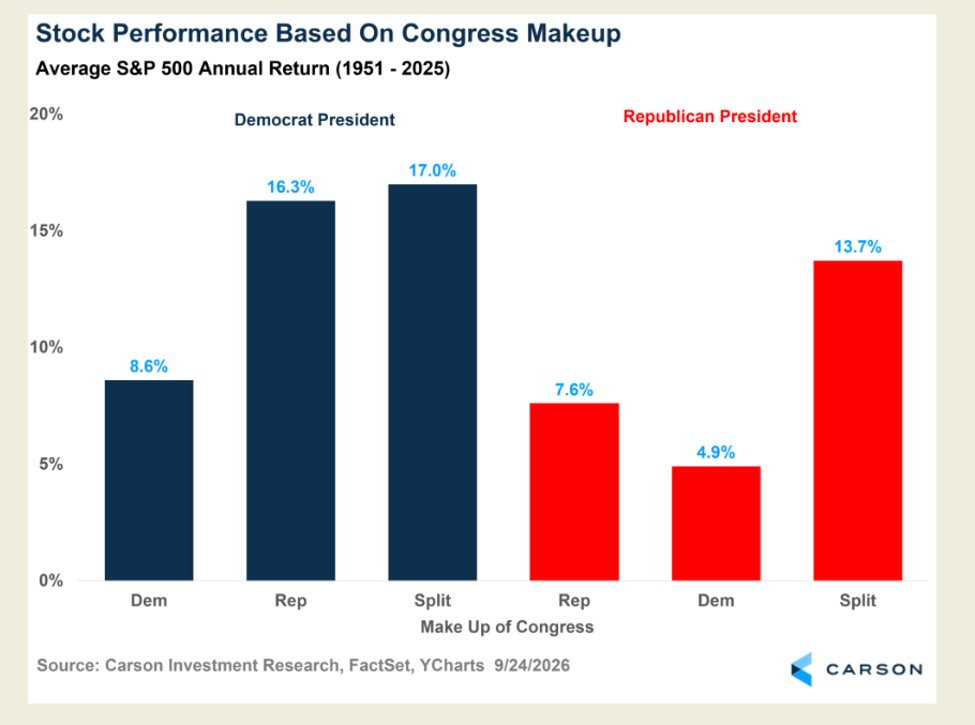
That said, the figures do suggest somewhat better performance when control of Congress is split between the two major parties.
According to the Carson research, going back to the 1950s there’ve been 13 instances of a split Congress — and the S&P 500 rose every time!
Just for reference, the most recent instances were 2023–24… 2019–2020… and 2011–2014.
One more chart of note this morning, and it’s one we’ve visited from time to time the last couple of years.
This is the one from Bespoke Investment Group comparing the Nasdaq’s performance during the dot-com boom and the current AI boom. Bespoke’s starting point for the dot-com boom was the release of the Netscape web browser in late 1994. And the starting point for the AI boom is when ChatGPT burst on the scene in late 2022.
After nearly four years, the two rallies don’t line up perfectly — but they line up close enough.
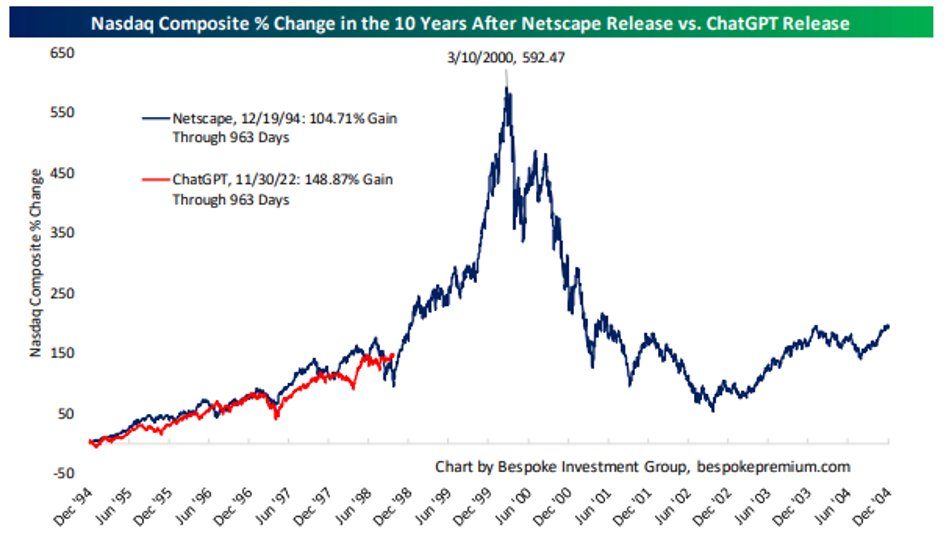
“Melt-up coming next?!?” Enrique muses. Stay tuned…
In the meantime, the major U.S. averages are starting the new week in mixed fashion.
At last check the S&P 500 is nearly pancake-flat — just over 7,800. The Nasdaq is down about a third of a percent, while the Dow is up about a half percent.
Treasury yields are backing down, the 10-year note at 5.24%. After September’s rapid rise, some consolidation is inevitable.
Precious metals are in the red — gold at $4,167 and silver at $60.21. Crypto is little changed from Friday’s levels with Bitcoin at $82,648 and Ethereum at $2,528.
The big scheduled market events this week are the start of earnings season tomorrow morning when four of the biggest banks report their numbers. Wednesday brings the Labor Department’s release of the official inflation figures for September.
➢ For the record: The Financial Times kinda-sorta “walked back” its market-moving story from Thursday afternoon, in which it said OpenAI’s annualized revenue was over 28% less than previously thought. A follow-up article noted that annualized revenue is “a vague metric” often used by AI firms that haven’t gone public yet. Maybe the original article should have mentioned that?
 The End of Saudi Arabia (Not Yet, But…)
There’s nothing in the news this morning to suggest any relief to tight energy supplies.
Before trading opened for a new week last night, Donald Trump said Russia and Ukraine agreed to halt attacks on each other’s energy infrastructure.
He said the same thing a month ago, and it turned out not to be true. So far, it’s shaping up to be a repeat this time.
Meanwhile, there’s no letup in the pace of Iranian attacks on ships trying to transit the Strait of Hormuz without Tehran’s permission — we’re at two–three a day by now.
At the same time we’re seeing scattered reports of new attacks on Saudi Arabia’s east-west oil pipeline — the one it counts on to bypass the Strait of Hormuz. So far, those are unconfirmed but there’s definite confirmation that Yemen’s Houthi faction is attacking the airport in Saudi Arabia’s capital Riyadh. Per Saudi Arabia’s aviation authority, one airstrike killed 13 people and injured another 309.
The spin in The Wall Street Journal is that these attacks thwart the “ambitions” of the Saudi strongman — Crown Prince Mohammed bin Salman — “to turn Saudi Arabia into a global tourism and investment hub.”
Apparently it’s a bridge too far to contemplate whether the House of Saud’s ability to rule is in jeopardy.
“Nothing can be done to save Saudi Arabia as it is,“ Johns Hopkins historian Michael Vlahos said last night during his weekly spot on John Batchelor’s syndicated radio show.
“What [the Houthis] are doing now is essentially just dismantling the Saudi regime. And the Saudis had grown so spoiled and so full of themselves with all [their] money that they didn’t do anything to harden their infrastructure, whether it’s oil infrastructure or the city of Riyadh itself. I simply can’t imagine what the outcome will look like.”
Your editor has seen lots of wild, speculative articles over the last 20 years about “the end of Saudi Arabia.” For the most part, I blew them off.
Now? It might be time to start seriously entertaining the possibility and teasing out the consequences. Stay tuned.
In the meantime, there’s just enough underlying tension to push U.S. oil futures nearly two bucks higher to $93.74.
 The End of Diesel?
Diesel prices have gotten so high that, at least on the margins, they’re starting to make electric trucks look economically feasible.
In August, Bloomberg reported that Swedish freight company Einride (ENRD) plans to deploy 500 Tesla Semis across North America over two years. That would triple Einride’s electric fleet, serving customers including Amazon across five states. At the time, it was the largest announced Tesla Semi deployment.
Barely a month later, Tesla landed a role in an even bigger deal.
The ZET SCALE freight alliance, whose founding shippers include Microsoft and PepsiCo, named Tesla the lead supplier in a 2,500-electric-truck procurement program. Other manufacturers were also selected. IMC Logistics separately ordered another 50 Tesla Semis.
For perspective, only 875 zero-emission heavy trucks were sold in the entire United States in 2025 — about 0.3% of the market.
What's driving the sudden interest? The cost of moving freight.
An Electrek analysis estimates that a Tesla Semi consumes about 20 cents of electricity per mile, compared with 67 cents in fuel for a conventional diesel truck. That's roughly 70% less in energy costs.
The comparison assumes electricity at 12 cents per kilowatt-hour and diesel at $5.35 per gallon.
(For perspective, the average commercial rate for electricity in this country is 14.5 cents per kWh and AAA says the national average diesel price this morning is $6.27 a gallon)
Factor in lower maintenance expenses and the analysis projects savings of $147,000 over five years or $404,000 over 10, depending on operating assumptions.
Tesla also advertises up to 500 miles of range, with charging that can restore 60% of that range in 30 minutes. Its new Nevada factory is designed to eventually produce 50,000 Semis annually.
Yes, there are still obstacles — higher purchase prices, limited charging infrastructure. And projected savings aren't the same as proven results.
But something appears to be changing. For decades, the push to electrify heavy trucking was driven largely by environmental policy. Now the economics are giving freight operators another reason to switch.
Diesel has survived political fights and regulatory deadlines. But can it compete when the companies buying the trucks conclude electricity is simply cheaper?
 Mailbag: Property Tax Relief
On the subject of Florida’s referendum proposing property tax relief, a reader writes…
“OK, first, this would reduce local government income by about 10%.
“Restructures to the level of property exemption have to happen periodically to reflect property values. I believe they started at $5,000, went to $10,000, then $25,000 and are now at $50,000. The percentage of property value that that covers has constantly decreased over the years.
“Florida property values have skyrocketed since 2020 and the exemption needs to increase. Local government income has increased far more than necessary for needed services. Salary jumps have been enormous. Amendment 3 will require about a 10% budget reduction. That affects donations to nonprofits and NGOs and maybe some of the wasted taxpayer dollars, not a reduction in necessary services, which are mandated by state laws. The fraud in Florida local governments has become ridiculous and this is just to slow it down.
“Florida state has run surpluses, paid down debt and fully funded the rainy day funds. Local politicians have funded their own and their friends’ pockets and police and fire pay scales are approximately at the center of the national average.
“Coincidentally, Amendment 3 does not touch school taxes yet the teachers in Florida are some of the lowest paid in the country.
“I think local governments have a lot of explaining to do.”
Dave responds: As for your concluding thought… that’s probably the case everywhere, not just Florida. Don’t get me going about the bad-faith efforts of “civic leaders” in my neck of the woods to sell the populace on a new levy to build a jail/courthouse complex. (For all I know the project is necessary but the lies they’re telling to get their way are breathtaking!)


