
Elon Is No Longer Distracted
 Elon Is No Longer Distracted
 Elon Musk says his businesses would be further along on AI if he hadn’t been distracted by politics.
That’s the big takeaway from a podcast interview Musk did recently with his biographer Walter Isaacson.
“It was kind of cool,” Musk recalls, “because I'm just there in the Oval Office while all these big momentous decisions are being made and sometimes having some impact on what's being done.
“But I think I should have been more in the background and probably only had it last for a month or two because at that point you've seen most of what there is to see within a month or two."
Isaacson asked about the awkward events that led to his departure from the White House in May of last year.
Musk demurred. “Let's let sleeping dogs lie or whatever. Let's not put a spade down in the backyard type of thing. You never know what you're going to find.
“But anyway, the point is I should have gone back and focused on AI a little sooner than I did."
Judging from SpaceX’s latest quarterly numbers, he’s making up for lost time.
As a reminder, SpaceX is not a space company — not after its merger with xAI earlier this year. It’s an AI company. It was obvious from the paperwork it filed ahead of its IPO last June.
And it’s even more obvious now after the company issued its second-quarterly earnings figures.
Of course it’s the headline numbers that get all the attention: Revenue that handily beat Wall Street’s expectations and earnings that nearly tripled what the analysts were counting on. At last check, SPCX shares are up 10% on the day.
But look at the revenue figures broken down by its three major business segments…
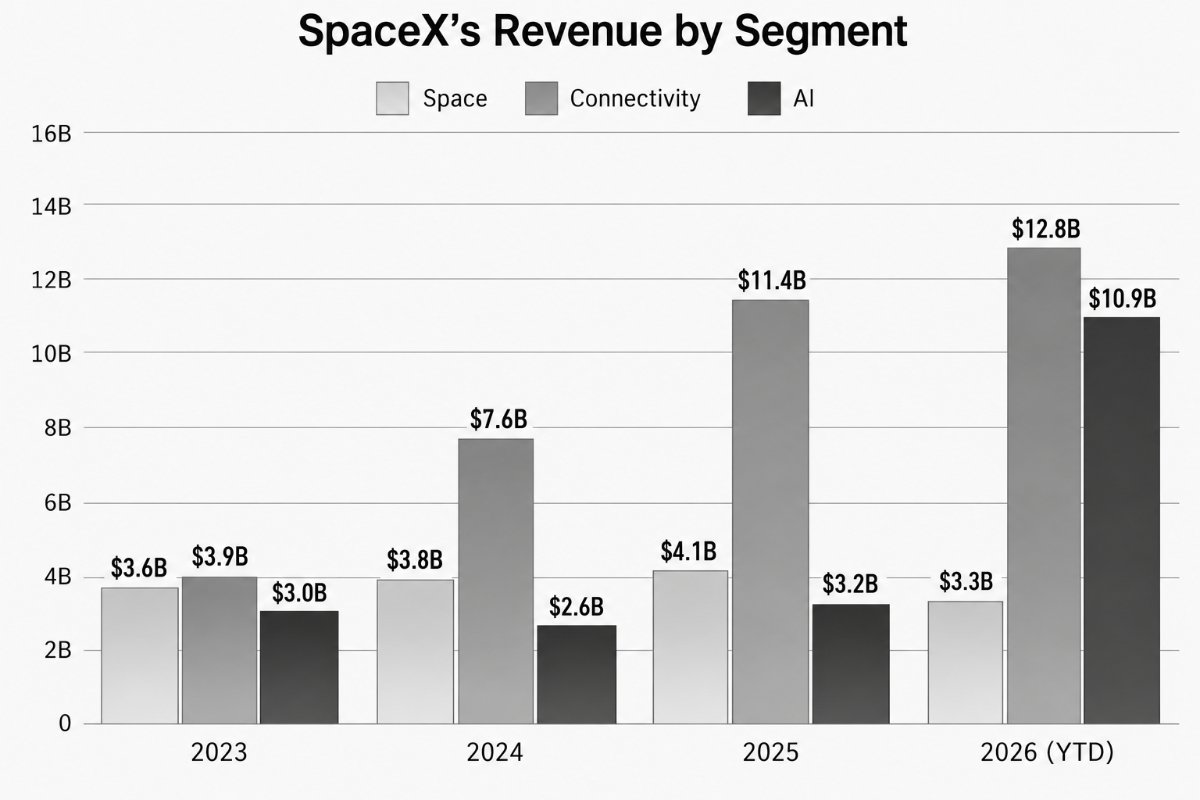
Space? A drop in the bucket now. “Connectivity” — shorthand for its Starlink service — is consistently the No. 1 revenue generator.
“But AI is quickly becoming the growth engine of the business,” colleague Davis Wilson writes. “Revenue from the segment has already tripled from its 2025 total.
“SpaceX owns and operates massive data centers packed with computing power that it rents to companies building and running AI models. Increasingly, SpaceX is competing for the same workloads as hyperscalers like Amazon, Microsoft and Google.”
And to compete effectively, it’s spending big-time: Out of an estimated $40 billion in capital spending this year, only $8 billion is going toward Space and Starlink. Everything else is AI.
SpaceX would still be mostly an AI company after a merger with Tesla.
Since the first of the year, several of our experts — Davis Wilson, Enrique Abeyta, Ray Blanco — have speculated that a tie-up of Musk’s two biggest firms is inevitable.
On the earnings call yesterday, Musk said the two companies have formed special committees to explore a potential merger. Musk himself cannot take part in those reviews but he made no secret of his assessment that “there is a lot of merit in combining the companies.”
You might think TSLA is primarily a car company. But Musk is betting its future on its Optimus robot unit. Those humanoid robots don’t work without huge quantities of AI “compute.”
As if to reinforce that AI is where all his priorities lie, Musk said on the call he’s spending four days a week these days in Memphis, overseeing SpaceX’s Colossus data center.
Again, making up for lost time after his diversion into politics last year. As he told Isaacson, “I got carried away basically.”
 The $100 Red Line
For the moment, the politicos and the media have jawboned U.S. oil futures back under $100 a barrel.
When we left you yesterday they were a hair under $103. Then a couple of things happened.
First, there were fake reports of a deal between the U.S. and Iranian governments. West Texas Intermediate futures tumbled below $95.50. Then everyone realized it was nonsense and the price quickly jumped back above $97.
They might have jumped further were it not for a Wall Street Journal article claiming that “Persian Gulf oil exports have surpassed prewar levels.”
The article cited figures from the ship-tracking firm Kpler — which, as we spelled out earlier this month, might have an axe to grind.
Here’s the price action in Brent crude, the global benchmark…
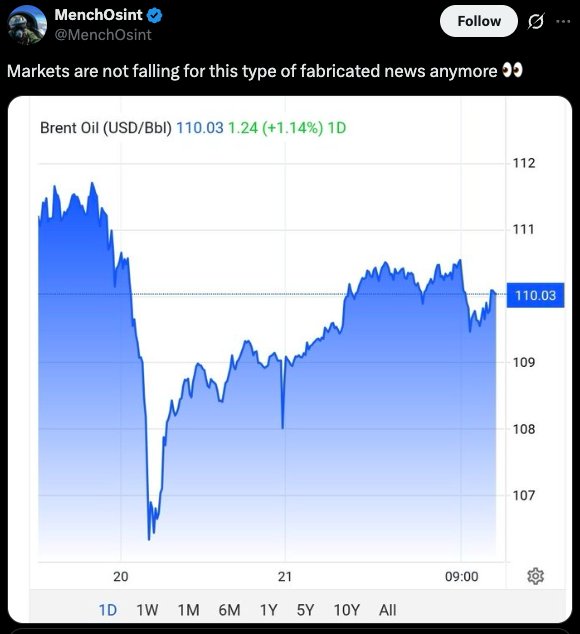
For the moment, U.S. futures sit at $97.25. That’s down huge from the peak over $104 Sunday night — but still way higher than the low below $88 earlier this month.
Meanwhile, congratulations are in order for Rickards’ Insider Intel readers — who just got a sell recommendation today for ConocoPhillips call options, good for 232% gains in about 3½ months.
As for the major stock indexes, SPCX might be giving a lift to the entire tech sector: The Nasdaq is up 1.2% as we write at 26,745.
The S&P 500 is up 0.5% to 7,759 while the Dow is the laggard, up 0.4% at 52,700.
Not much to say about precious metals — gold at $4,130 and silver at $57.46. But crypto is showing signs of life, Bitcoin pushing past $84,500 and Ethereum over $2,500 again.
 Tight Supply, Depressed Prices: Something’s Got to Give
“The U.S. relies 100% on imports of 16 critical minerals,” says Paradigm natural resources pro Matt Badiali — “including manganese, gallium, tantalum, niobium and arsenic, among others.
“These minerals accounted for over $63 billion in U.S. imports in 2025. This lack of domestic supply is a critical piece of the future of metals, and we need to learn more about it in a hurry.”
With that in mind, Matt was in attendance yesterday at the North America Critical Minerals summit in Washington.
“This summit brings together capital markets folks, government entities and critical minerals companies.”
His assessment: A lot of people are still trying to wrap their minds around the opportunity in this sector.
In part that’s because of the rare-earth boom in 2025 and early 2026. “The rare earth sector attracted lots of new investors who don’t understand how mining development works.”
Projects frequently run into delays. “In their minds ‘delay = risk’ and risk is bad, so they sold shares.” If there are more sellers than buyers, share prices go down.
“This is a major disconnect in the market,” says Matt. “We have a bull market in metals yet stock prices are falling.
“So the question we face is: Which is correct? Are metal prices rebalancing or are the stock prices moving ahead of metal prices?
“Metal prices reflect real-world demand. Stock prices reflect the emotional state of the market. I’m far more inclined to trust the metals prices than I am stock prices. So when metals move down and stock prices don’t… I’m bearish. But when metal prices move up and stock prices don’t… I’m bullish. And that’s why I am bullish today.”
 “Generational Opportunity”
The AI boom has Wall Street chasing the next Nvidia. The giant asset manager Blackstone is chasing power plants and transformers.
On Monday, Blackstone announced it raised $8.7 billion for its fifth energy-transition fund. That's roughly 55% more than its predecessor, and demand was strong enough to push the fund to its fundraising ceiling.
Don’t get the wrong idea when you hear “energy transition” — this isn’t about windmills and solar panels. Not anymore.
Rather, we’re talking about the essential but very unsexy business of energy infrastructure.
Oh, and very profitable. Blackstone says its energy-transition investments have earned a 34% net internal rate of return (IRR) since 1997, measured as of June 30, 2026.
David Foley, Blackstone's global head of Energy Transition Partners, calls the opportunity "generational."
His reasoning? Electricity demand is climbing, thanks partly to AI data centers — and somebody has to manufacture and build the infrastructure to deliver it.
As we noted in a recent bullet, you can't prompt a gigawatt into existence. Someone still has to build the power plants, transformers and transmission lines that AI depends on. Blackstone is backing the companies that do.
Among its energy-transition investments is Wolf Summit Energy, a $1.2 billion project to build a 600-megawatt natural gas power plant in West Virginia. Construction began in April. The plant will supply electricity to a cooperative serving Virginia, Maryland and Delaware.
Yes, natural gas. Hydrocarbons. Fossil fuels.
Blackstone also backs MacLean Power Systems, a manufacturer of electrical-grid equipment that has agreed to acquire transformer maker Delta Star.
According to Wood Mackenzie data reported by Reuters, U.S. demand for generator step-up transformers jumped 274% from 2019 to 2025, and lead times for some large transformers now stretch to four years.
Try powering a new data center without one.
As our Byron King recently observed, there are still investors who believe "rocks, rigs and real assets matter." Blackstone seems to agree.
Of course, not every supplier will prosper. Power plants face construction risks, manufacturers can expand capacity and competition will follow. Nor do historical fund returns guarantee future profits.
Still the underlying opportunity is clear. AI may live in the cloud, but building and maintaining the physical infrastructure behind it could create investment opportunities for a generation or more. We’ll stay on top of it as the story unfolds…
 Mailbag: Social Security
“You've had some articles and subscriber emails recently criticizing Social Security's modest 3.6% increase for 2027, but I am a bit puzzled,” writes one of our newer readers.
“If a large percentage of us will receive back more than we ever contributed (even after adjusting for inflation), then I don't understand why people are critical of a modest increase.
“SS was never supposed to cover our entire retirement, just an enforced minimal savings plan that you get back once you retire (and that wealthier people pay more into than the majority of the population as an enforced charity toward the average-income folks). The rest of our retirement needs we are supposed to plan for ourselves. So if SSA is already going to end up paying the average person back a good bit more than they put in even after inflation is factored in, to me that seems like a solid win even if their COLA is modest.
“If you were saving faithfully but had above-average life challenges, then that's definitely frustrating, but SSA was never supposed to be a complete rescue from everything — family/church/friends helping us, taking in a renter to cut down costs, downsizing to a smaller home, etc... are ways to cover the shortfall if our own savings, in spite of every effort otherwise, don't end up being enough. If most people are getting back more than they put in, the government has more than done what it promised. Hasn't it?”
“The reader comment in yesterday’s edition hits close to home,” writes a CPA from an eastern state — “as I am presently 59 and looking to collect Social Security as soon as I turn 62.
“The reason is that I can control my earned income (i.e. wages) and the remainder goes through my S corporation.
“Presently, there are no changes pending on this setup, and I will start to claw back some of my contributions, because I fear and EXPECT that significant means testing to SS will occur.
“Here’s another fact to chew on. The present levels of taxation for SS benefits start at $25,000 for single taxpayers and $32,000 for married taxpayers, and these levels have NEVER been indexed for inflation. This is one mechanism of bracket creep that affects those collecting SS, and Congress has done nothing to fix it.
“As a Gen-Xer, for many many years, I have expected SS benefits to be cut and my generation… do absolutely nothing about it either.”
Dave responds: Yes, the income exclusion for Social Security benefits has sat at a fixed level since 1984.
It’s one of four “gotcha taxes” in the tax code that will get only worse as inflation continues to erode your purchasing power. Invest accordingly.


