
What’s China’s Endgame?
 Gold: What’s China’s Endgame?
 “China’s central bank has bought gold for 23 straight months, and the country is importing more of the precious metal than ever,” says a CNBC article posted yesterday.
The mainstream takes forever to catch up to alternative financial media. Here at Paradigm Press we’ve been hip to China’s gold accumulation — and its implications — for well over a decade.
It seems CNBC perked up at the story now because the People’s Bank of China added 23 metric tons to its stash last month — “its biggest monthly purchase in almost three years.”
Officially, the PBOC’s gold reserve sits at 2,387 metric tons — up 124% since 2009.
Unofficially, however…
“China may also hold gold through other state entities, including the State Administration of Foreign Exchange (SAFE),” says Paradigm macroeconomics maven Jim Rickards.
“China is non-transparent about the full extent of its gold holdings. The exact amount of any unreported gold is unknown. Estimates can be formed based on imports from Switzerland via Hong Kong, but those are inexact.
“One estimate is that the amount of ‘hidden gold’ held by Chinese state entities is approximately the same as the amount reported publicly by the PBOC. If that estimate is correct, total Chinese gold reserves would be about 4,700 metric tons, or roughly 58% of U.S. gold reserves of 8,133 metric tons.
“That would make China the second-largest sovereign gold holder in the world after the U.S. and put China ahead of gold powers such as Germany, Italy and France.”
Yeah, CNBC left out that part…
So what’s Beijing’s agenda here? And what’s it to you and me?
A decade ago, Jim wrote that Beijing’s endgame was to have a “seat at the table” along with the United States, the European Union and Japan whenever the next financial crisis rolled around and the global financial system had to be reset.
But that was when Beijing and Washington were on friendlier terms.
If you look at some of the seamier corners of alternative media, you’re told that Beijing’s goal now is to create a gold-backed version of its currency, the yuan.
For any number of reasons, Jim says that’s totally impractical. “Traditionally, gold holdings must be 20–40% of the money supply to engender trust in a gold-backed currency system. China’s reported gold holdings are in the low single digits as a percentage of money supply.”
Nor is Beijing capable of transforming the yuan into a viable alternative to the dollar as a global reserve currency. That would require a large bond market trusted by most of the rest of the world. “China is simply not in the same league when it comes to reserve-currency status, with or without gold.”
Beijing’s real goal is to facilitate easier trade and transactions — bypassing the dollar — with major trading partners like Russia and India.
“China is looking ahead to the day when a confrontation with the United States could force it to separate from the dollar payments system entirely in order to avoid asset freezes and financial sanctions,” Jim says.
“Chinese policymakers are watching the financial sanctions that the U.S. is imposing on Russia and Iran and drawing the appropriate lessons.”
Seen in that context, Beijing welcomes the decline in the dollar price of gold since last winter — from a peak of $5,500 then to under $4,200 now.
“Any buyer accumulating gold favors a lower price for the time being because it means getting more gold for every dollar spent,” Jim says. “The payoff comes later if the dollar price of gold spikes higher. Whoever has the most gold then is the biggest winner.”
That’s what Chinese leaders are counting on. Jim says you should count on it too.
He’s still anticipating an eventual climb to $10,000. “It will get there faster than all but a few investors expect.”
Yeah, you don’t hear that from CNBC, either…
 What Starts in Asia…
Interesting market action today: A stock panic that began in Asia stayed in Asia.
South Korea’s stock market took a nasty 5.5% spill today after remarks by Hock Tan, the CEO of the U.S. chipmaker Broadcom (AVGO) during a conference in Singapore.
“A lot of investors have no clue what they are investing in,” he said. They “set very extreme expectations only to find out that it’s almost like they are in a casino.”
Understand, over half of South Korea’s benchmark stock index is composed of Samsung and SK Hynix — two of the big three names in advanced memory chips. Thus, the big drop.
Ordinarily, a reaction like that would spread to U.S. markets — but not today.
To be sure, Micron Technology (MU) — the other big memory name along with the two South Korean firms — is down about 5% at last check.
But the Philadelphia Semiconductor Index is down a more modest 2.2% — and the tech-intensive Nasdaq Composite is down a mere 0.4%. The losses in the S&P 500 and the Dow are even narrower.
Perhaps that’s because earnings season is underway today with several of the big banks reporting their numbers. JPMorgan missed the expectations of Wall Street analysts — but it’s still up over a half percent on the day. (It’s not the news, it’s the reaction to the news.) Goldman Sachs’ numbers were a mixed bag but it too is up over a half percent.
Gold is generally steady at $4,159 but silver has shed 1.7% and is back below $60. Crypto continues to stabilize, Bitcoin over $83,000 and Ethereum over $2,500.
U.S. oil futures have sailed past $94, the highest in over two weeks. Iran’s Islamic Revolutionary Guard Corps says it’s struck three ships in the Strait of Hormuz over the last two days.
As you can see from the TankerMap website, precious little oil or refined products are making their way through the strait this month…
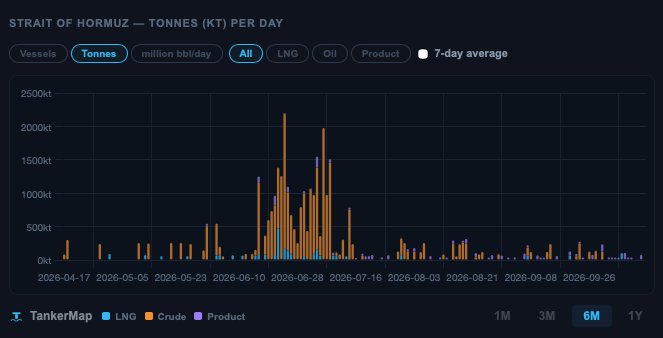
These figures appear to be more reliable than anything coming from Kpler or TankerTrackers. (We unpacked why Kpler is not to be trusted last week.)
The reality for small business in the 2020s is a double-whammy of a labor shortage and rising costs.
Or so you’d conclude from the Small Business Optimism Index issued this morning by the National Federation of Independent Business.
The headline optimism number fell from 98.7 in August to 97.9 in September — just below this survey’s long-term average going back more than 50 years. It’s the second consecutive monthly decline.
More revealing is the part of the survey where respondents are asked to identify their single-most important problem.
Here “quality/availability of labor” tops the chart, cited by 26% of owners. This number has been elevated ever since COVID. The long-term average, again going back more than 50 years, is only 12%.
“We need more experienced and skilled trade workers,” says the owner of a services-oriented business in Michigan.
In second place is inflation, cited by 20% of respondents. This too is well above the historical average of only 7%.
“Fuel prices are killing us on our delivery trucks, as well as fuel surcharges on all freight
coming into the store,” says a retailer in Georgia. “They also reduce the amount of disposable income our customers have to spend at our store.”
After labor quality and inflation, everything else on the single-most important problem part of the survey is well back in the pack — taxes and poor sales each cited by 11%. Everything else was cited by 7% or less.
 ASTS: Buy or Wait?
SpaceX just handed investors a cheaper entry into AST SpaceMobile (ASTS).
Last week, SpaceX's reported $8 billion spectrum deal sent shares of America's major wireless carriers tumbling. AST SpaceMobile (ASTS) fell 10.5% with them.
Paradigm’s Davis Wilson sees an opportunity for readers of his Million Mission e-letter — analysis very much in line with what we’ve shared in 5 Bullets from James Altucher and Ray Blanco.
Davis’ argument is straightforward: AT&T, Verizon and T-Mobile aren't going to hand their customers to Elon Musk. They'll fight back by expanding satellite connectivity.
“AST SpaceMobile is actually one of the biggest beneficiaries of SpaceX's expansion into wireless,” he says.
“ASTS is building a network of satellites that connect directly to ordinary smartphones, allowing people to make calls, send texts and access the internet in places without traditional cell coverage.”
Meanwhile on Oct. 1, the three wireless giants formally established a joint venture to expand satellite coverage. Its purpose isn't simply to purchase satellite services. It's also to encourage competition among satellite providers.
Now that SpaceX is “directly infringing on these existing carriers’ territory,” says Davis, the logical response is to “build out their satellite coverage with ASTS — a company they’re already partners with.”
Davis said yesterday that ASTS is a buy at $53. If so it’s a better buy today at just over $47.
 Thought for the Day
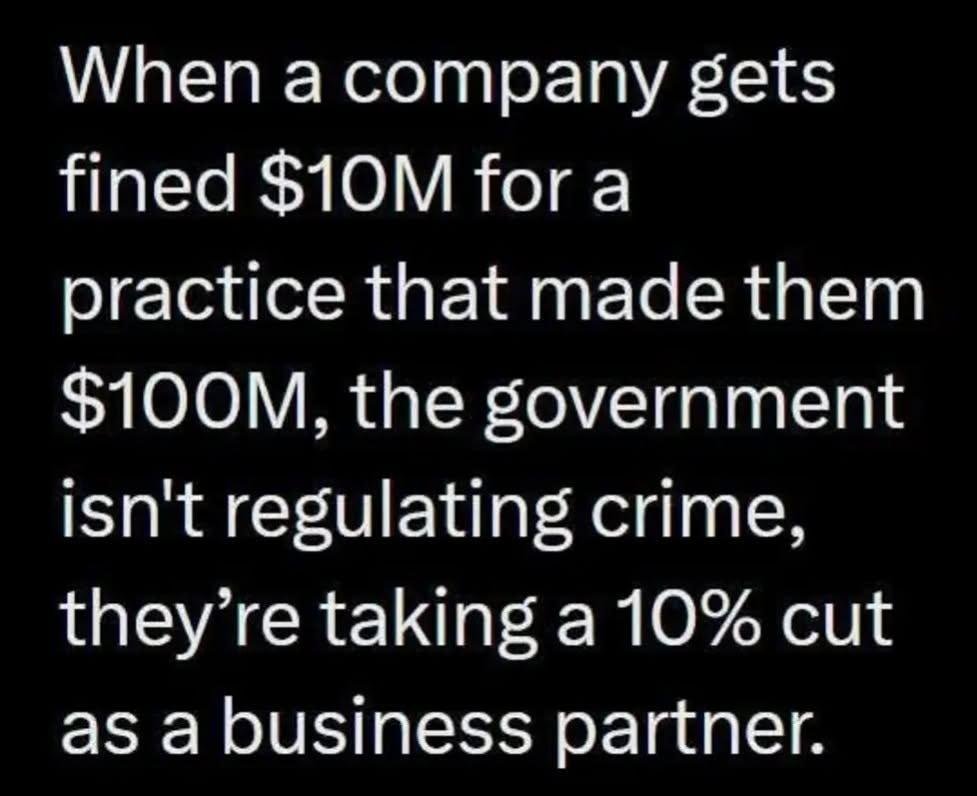
Not sure why this is making the rounds of the meme-o-sphere right now but it is…
 Politics, Prediction Markets and the Stock Market
“If — IF — the prediction markets are right,” a reader writes after yesterday’s edition, “what it's telling me is that when the Democrats win back the House and Senate, the USA is officially dead, as the DSA will soon take control.
“There's not an article that I read that is not calling for this market to correct and to correct at least 20%.
“I've normally found when all are in the same frame of mind that it doesn't happen. But I think the prediction of a market decline in the coming weeks is foretelling that the Democrats will win the House and Senate.
“Guess we'll see in a couple of weeks.”
Dave responds: Hmmm…
If that bar chart yesterday is suggestive of anything, a Dem sweep with a Republican president is the worst possible outcome for the stock market — with an average annual return of 4.9% on the S&P 500. Here it is again…
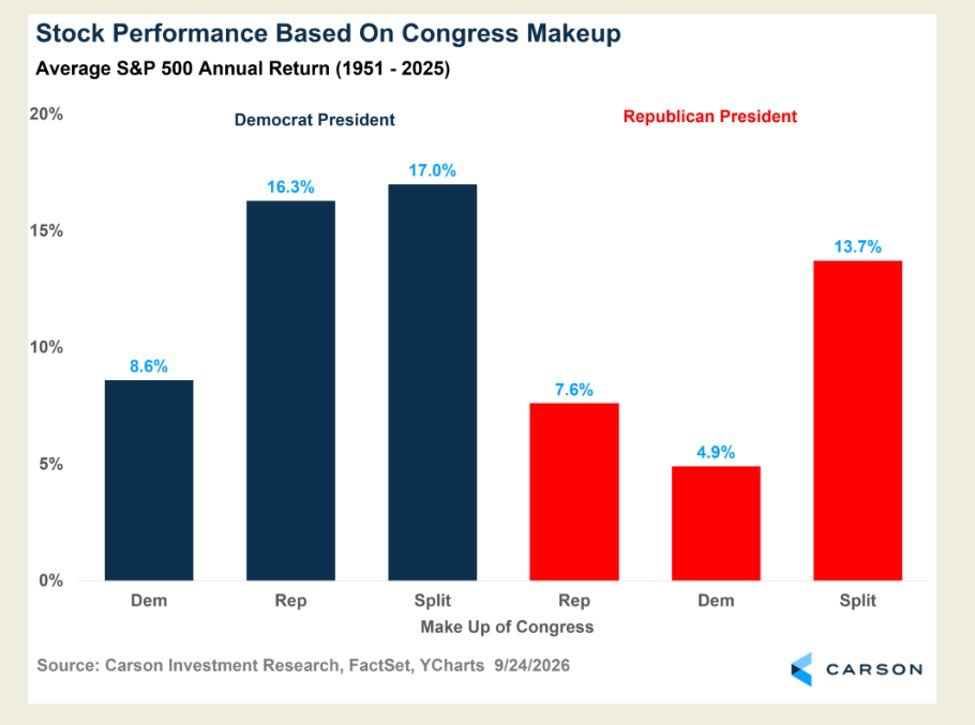
Granted we’re not working with a huge data set here. The most recent instance was 2007–2008, coinciding with the global financial crisis.
Before that there was a six-year stretch encompassing Reagan’s last two years as well as the Bush 41 presidency — a span including the crash of ‘87 and the 1990–91 recession.
Before that there was the entirety of the Nixon-Ford years — smack in the middle of a 16-year bear market.
The only reason the average returns are positive is the market’s performance during the last six years of the Eisenhower administration. (1955 and 1958 were outstanding, not that many of us would remember.)
That’s 22 years out of the last 76. And only two of those years fell during this century. Draw your own conclusions.
You can see how the outcome is much more sanguine if control of Congress is split under a GOP president. But here the data set is even smaller — a mere 10 years.
Here we’re looking at Reagan’s first six years — a stretch including the start of an epic bull market in 1982. Animal spirits were also alive and well during the last two years of Trump’s first term (apart from the brief COVID crash). That average 13.7% gain on the chart would be even higher were it not for Bush 43’s first two years, encompassing much of the dot-com bust. Again, draw your own conclusions.
A lot of these market-moving events were, at best, tangentially related to whoever occupied the White House or Congress at the time.
For instance, much of the blame for the 2008 meltdown can be laid at the feet of a Democratic president (Clinton) and a Republican Congress — who together gave the big banks a blank check when they repealed the Glass-Steagall Act in 1999.
Something to bear in mind if the Dems sweep and the market tanks next year.
Whatever happens, our team will stay on their collective toes for you…


