
Elon Wants to Be Your Wireless Provider
For the last several years, the wireless business in this country has been a snooze.
It’s dominated by three giants — Verizon, AT&T, T-Mobile — in a mature industry, able to grow only by stealing each other’s customers. If only that competition could deliver better service at lower costs!
Enter Elon Musk.
We’re departing from our usual format today to show you how Musk’s SpaceX is making three moves to shake those three giants out of their slumber.
Elon Wants to Be Your Wireless Provider
My wife, Angela, and I need to make a change to our cellphone account.
I've been putting this off for more than two years.
If you've ever tried to change anything with one of the big carriers, you know why. You don't just "switch." You plan a full day. You sit in the store. And you watch customer support struggle with what should be a simple request.
So I keep waiting.
And this month, Elon Musk may have given me a very good reason to keep waiting a little longer.
Where My Phone Goes Dark
Before I get to Elon, here's why this matters to me personally.
I love trail running in the north Georgia mountains. We live near the foothills of the Great Smoky Mountains, not far from the southern end of the Appalachian Trail. It's beautiful country.
It's also where my phone loses signal. That's fine until you roll an ankle three miles from the trailhead.
Around Christmas, we're meeting family at a cabin that's a bit remote. (Family is coming to us for Thanksgiving first, so it's going to be a busy holiday season.) I'm already wondering how much coverage we'll have up there.
And before the end of the year, Angela and I are taking a cruise. I'll be paying a pretty penny for the ship's Wi-Fi so I can keep an eye on our trades on the high seas.
Here's the funny part. Our cruise line, Virgin Voyages, powers its Wi-Fi with a combination of satellite services, and one of them is Starlink.
So in a way, I'm already paying Elon by the day out at sea.
Now he wants to connect the phone in my pocket everywhere else.
What Elon Is Building
Think of this as a puzzle. SpaceX (SPCX) has been quietly putting the pieces together, and the picture is getting clear.
Piece #1: The airwaves. A phone network needs spectrum, the radio frequencies your phone uses to send and receive calls and data. In September 2025, SpaceX agreed to buy wireless spectrum from EchoStar for about $17 billion. That's a huge check for a company that "just launches rockets."
Piece #2: The satellites. Starlink's direct-to-cell service already connects ordinary phones to satellites through a partnership with T-Mobile. Company executives said the service had about 10 million active users worldwide as of March.
A next-generation constellation, built for much faster phone service, is targeted to start launching in 2027.
Piece #3: The towers. Last week, Bloomberg reported that SpaceX is in talks to access about 80,000 cell sites across the U.S. That's roughly half of the purpose-built cell towers in the country.
Put those pieces together and you get something new. Satellites cover the empty places, like my running trails and that cabin. Towers cover the cities, where millions of people need fast data at once.
SpaceX President Gwynne Shotwell has been direct about the goal. On the company's first earnings call as a public company, she said SpaceX wants to make Starlink a "true mobile service" that wins customers from the big three carriers.
The market noticed. Shares of AT&T, Verizon and T-Mobile came under pressure on the news.
To be fair, these are still talks. No tower deal has been signed, and SpaceX hasn't announced pricing, a launch date or a coverage map. But Elon has a habit of turning "talks" into reality faster than people expect.
Remember AOL?
If you were online in the 1990s, you probably remember those AOL discs that showed up in your mailbox every few weeks. You might even remember the screech of the dial-up modem, followed by "You've got mail!"
For a while, AOL was one of the only ways most Americans could get online. It was the gateway to the internet.
Then broadband arrived, and AOL didn't keep up. The company that once owned the front door to the internet became a has-been.
Here's the irony. In 2015, Verizon bought AOL.
Today, Verizon and the other big carriers sit where AOL once did. They control the gateway. And customers like me tolerate them because there hasn't been a real alternative.
In my 25-plus years of investing, first as a fund manager and now with my own money, I've learned that the most vulnerable companies are often the ones whose customers stay out of habit, not loyalty.
Will SpaceX take over the phone business overnight? No. Building a nationwide carrier is hard and expensive, and some analysts doubt the 80,000-site figure. Disruption usually takes longer than the headlines suggest.
But SpaceX can make real inroads if it gets two things right: the technology and the customer service. If I could switch my phone plan in five minutes from my couch, I'd do it tomorrow.
How I'd Play It
A lot of readers will want to buy SpaceX shares right away.
I understand the excitement. But I'm hesitant to buy SpaceX at today's high valuation.At some point, as profits build or the stock forms a base at a lower price, I'll likely be tempted to trade it. For now, I'm watching.
In the meantime, there's another group of companies that could win no matter who wins your phone bill.
Think about it. AT&T, Verizon, T-Mobile, SpaceX and even Amazon (which is building its own satellite network) all need space on cell towers. And most of those towers are owned by a few landlords: American Tower, Crown Castle and SBA Communications.
Crown Castle's CEO said on its Oct. 21 earnings call that the company is talking with all parties, including SpaceX and Amazon.
More competition for tower space means more potential tenants and more leverage for the landlords.
There's an income angle here too. Tower companies are structured as real estate investment trusts (REITs), so they pay dividends. And rate-sensitive stocks like these have been bouncing as bond yields pulled back.I’m watching our AI-powered trading indicator to see if there are signs of a buyout deal materializing for one (or more) of these tower stocks.
In the meantime… until SpaceX's phone service is real, I'll probably still be the guy sitting in that phone store, waiting.
But the next time I lose signal on the trail, I'll be thinking about this trade.
Dave’s last word: Markets are treading water ahead of the Federal Reserve’s latest policy statement due this afternoon.
At worst, the major U.S. stock indexes are flat; the S&P 500 is up about 0.2%. Gold continues to hold the line on $4,000 — but silver has slid hard to $53.45. Crypto remains moribund.
If it’s action you’re looking for, it’s in crude: U.S. oil futures are up 3.5% to $103.47 but we see no dire headlines to trigger the move. Well, other than this…
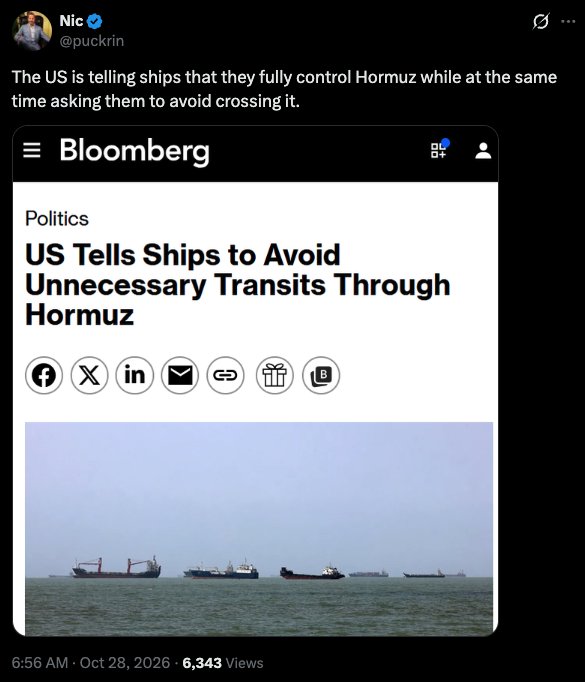
Tomorrow we’ll be back to our usual format including a follow-up on whatever comes out of the Fed announcement. Plus, James Altucher tackles the biggest question about the future of AI right now. Catch you then…


