
Big Banks 2008 = AI 2027?
 Big Banks 2008 = AI 2027?
 The OpenAI freakout didn’t last long. At least not this time.
After we hit “send” on yesterday’s edition, the Financial Times reported that OpenAI’s annualized revenue is about $50 billion — $20 billion less than previously thought. The paper characterized it as “a massive gap likely to damp optimism about the growth of AI demand.”
By day’s end, the Nasdaq-100 closed down 1.4%. After an hour of trading this morning, it had already clawed back about a quarter of that loss.
A flash in the pan? Maybe not.
“AI is starting to resemble something we’ve seen before — something ‘too big to fail,’” says Paradigm trading pro Enrique Abeyta. Like the big banks in 2008.
To be sure, we’ve been following the breadcrumbs of a potential “AI bailout” in these daily missives for nearly a year now.
Back then, research from JPMorgan found that 41 AI-adjacent companies accounted for 47% of the S&P 500’s market cap. Since then, the number has crept closer to 49%.
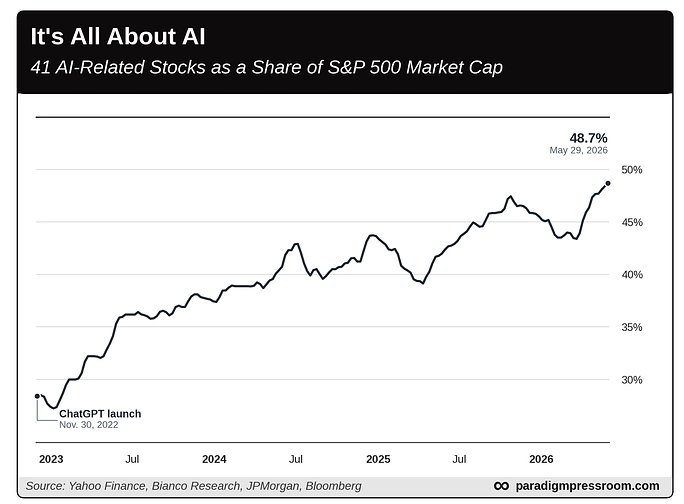
“One theme now touches almost half the value of America's benchmark stock index,” Enrique says. “AI is also driving spending on chips, data centers, power plants and construction. And Washington increasingly views AI leadership as critical to America's economic and military competition with China.”
Too big to fail, indeed.
AI-related investment will total about $650 billion this year. JPMorgan estimates that this per year number will double by 2030.
“And the money is increasingly intertwined,”Enrique continues.
“AI companies need chips. Chip companies invest in AI companies. Cloud companies pour money into AI labs. Those labs commit enormous sums back to cloud providers and data centers. Everybody depends on everybody else.”
Don’t be surprised if the media start tossing around the term “systemic risk” soon — just like 2008.
The risks are now piling up in a way they weren’t, say, in early 2025 — when the Chinese AI model DeepSeek sent a momentary shudder through the American AI sector.
For one thing, Enrique says “the AI boom is increasingly being financed with something the dot-com boom had far less of — debt.”
Case in point: Oracle. “Its 2046 bonds recently traded around 85 cents on the dollar, yielding more than 8%.
“S&P has cut Oracle's credit rating to BBB− (just one notch above junk).”
Meanwhile, Oracle raised $43 billion of debt in its latest fiscal year as it races to build AI infrastructure.
Then there’s the matter of OpenAI models burrowing their way into the systems of the AI company Hugging Face as well as Australia’s government health system. Anthropic’s models have pulled off similar automated hacks.
And don’t forget how the U.S. government is now taking direct ownership stakes in everything from Intel to U.S. Steel to USA Rare Earth — all of them operating in what the feds consider “essential” industries.
At the risk of sounding alarmist, the stage is set for what could be “the dot-com bust and the Global Financial Crisis rolled into one,” Enrique says.
“AI has the spending and speculation of the dot-com bubble. But it also has the debt, interconnected financing and dependence on confidence that made the Global Financial Crisis so dangerous.
“Then add something neither crisis had: credible national security concerns.”
Exactly how might it all play out? Enrique hazards two educated guesses in yesterday’s edition of our sister e-letter Truth & Trends. (In one of those guesses, Elon Musk makes out like a bandit — just as JPMorgan CEO Jamie Dimon did after the financial crisis.)
Check out his full “AI Is Now ‘Too Big to Fail’” thesis at this link.
And don’t get the wrong idea. “This isn't a call to sell AI stocks,” Enrique says. But even more than before you’ll want to stay abreast of your paid subscription(s) for guidance going forward.
 Three Headwinds for the Stock Market
From the standpoint of the stock market, “oil, interest rates and the dollar are all pushing in the wrong direction at the same time,” says Paradigm’s jack-of-all-trades analyst Zach Scheidt.
“Crude jumped again this week as attacks on tankers in the Strait of Hormuz picked back up. The G7 just agreed to release another 100 million barrels of crude and fuel from strategic reserves. That can take the edge off prices for a few weeks. But every barrel that comes out of storage has to be bought back later, which stacks a second wave of demand on top of normal consumption.”
Meanwhile, “the 10-year Treasury yield just touched its highest level in more than two decades. Higher yields give investors a real alternative to stocks, they squeeze housing and they make Washington’s debt more expensive to carry. The government now spends more on interest than it does on the military.
“And the dollar has been rallying right alongside, sitting near its highest level since the tariff scare in the spring of 2025.
“While any of these individual issues is manageable,” Zach writes for Rickards’ Insider Intel, “all three at once can create a strong headwind.”
As with Enrique’s warning about the AI sector, none of this means it’s time to sell everything and hide out in cash.
The next earnings season — starting next week — might provide a valuable tell.
“The last few have been impressive,” says Zach, “which is good news and a challenge at the same time. When companies keep clearing the bar, the bar keeps moving higher.”
In the meantime, the major indexes continue to recover a fair chunk of yesterday’s losses.
Actually as we check our screens, the S&P 500 has made up for all of yesterday’s losses. If current levels hold at day’s end, it’ll be the first weekly close over 7,800.
Otherwise, not a lot of drama — certainly not by recent standards. The 10-year Treasury note is steady at 5.26%. U.S. oil futures hover around $92. Crypto continues licking its wounds with Bitcoin just under $83,000 and Ethereum below $2,500.
But there are signs of life in the precious metals — gold ten bucks shy of $4,200 and silver roaring 3% higher, pushing $61 again.
One economic report of note — the University of Michigan consumer sentiment survey. By and large, this report is worthless. But for years, the Federal Reserve has paid keen attention to the part of the survey where people are asked how bad (or good) they expect inflation to be over the next 12 months.
With the average respondent saying 4.7% — way up from the pre-Iran war reading of 3.4% — there’s still reason to believe the Fed will bump up short-term interest rates again before year-end.
 Moderna's Miracle, Biotech's Misery
One of the biggest breakthroughs in cancer treatment has turned into a headache for biotech investors.
Back in August we told you how Moderna Inc. (MRNA) announced a personalized cancer vaccine built around mutations in each patient's tumor. Its stock skyrocketed 177% that day and has continued higher since.
Other biotech stocks rallied on the news, too. But that enthusiasm didn't last.
Since then, the S&P Biotech ETF (XBI) has fallen about 12%. The clinical-stage biotech ETF (BBC) has plunged 24%.
Paradigm biotech authority Ray Blanco found something even more startling: “By my count, 64% of the 697 U.S.-listed biotech and drug stocks now sit 40% or more below their 52-week highs.” Among companies worth less than $300 million, that figure jumps to 86%.
So what went wrong?
Moderna's rally inflicted an estimated $5.5 billion in paper losses on short sellers. Hedge funds scrambled to cover their positions, selling other holdings to raise cash.
Ironically, the biotech companies favored by specialist investors suffered the most. Ray found that stocks held by three or more leading biotech funds fell a median 29%, versus just 7% for those without specialist ownership.
In other words, the experts' favorites got sold four times as hard.
Nor do the problems end there. “First, money got more expensive,” says Ray — reminding us about rising interest rates.
“Second, the door to new money is narrowing.” Public biotechs raised just $5.9 billion selling shares in the third quarter, down from $14.2 billion in the second.
AI hyperscalers are borrowing billions for data centers, and Washington's enormous borrowing needs are competing for investment capital. There’s not much left for small biotech companies that need outside financing to get their drugs through clinical trials.
For the time being, Ray’s strategy is to keep the focus on companies with enough cash to reach their next important clinical trial or FDA decision without raising more money.
For broad exposure, there's the iShares Biotechnology ETF (IBB). But the best bargains may be found in small companies that have been beaten down by forced selling. Ray has identified several in his Catalyst Trader service.
Bottom line: “This sell-off is about the sellers, not the science.”
His advice for separating the potential winners from the losers? “Companies that need cash are in trouble. Companies that have it are on sale.”
 Oh, Well…
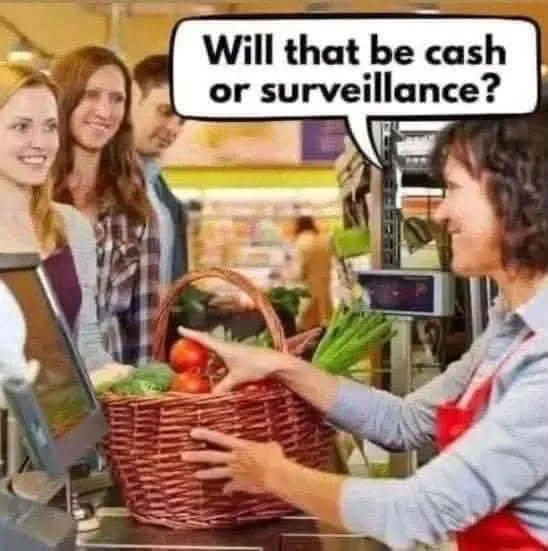
A search on social media for “comic relief” to repurpose in our Bullet No. 4 comes up short today. Best I can do is “grim chuckle”...
 Mailbag: Florida Property Tax
“Stop my Florida property taxes,” a reader writes.
That’s it, that’s the email.
Honestly I’m not sure what brought it on — maybe last Saturday’s edition about mobile phone taxes??
In any event, it’s a good excuse to update the saga of the referendum in Florida that would radically curb property taxes.
When we last visited the story two months ago, a rewrite of the proposal was underway — ordered by a judge in Tallahassee who found the original language was too political, running afoul of state law requiring “fairness and accuracy” in ballot questions.
But the gist of the proposal remains intact — phasing in a homestead exemption starting at $150,000 next year — jumping to $250,000 in 2028. It would also authorize the legislature to abolish property taxes altogether if it so chose.
Skimming Google News we see a poll that finds the proposal commanding 55% support — not that state-level polling is very reliable these days. We also see the longtime sheriff of Polk County (Lakeland-Winter Haven) warning the proposal would threaten public safety — not a surprising stance coming from law enforcement.
The researchers at the Tax Foundation spotlight the potential downsides: “Eliminating such a sizeable share of Florida’s property tax base would not reduce the cost of providing local government services; it would simply require that the lost revenue be generated elsewhere, including from higher millage rates on all property that remains taxable.”
Or maybe a higher sales tax? As we mentioned last summer, the rate in Texas — like Florida, a no-income-tax state — already runs 8.25% in most of the major population centers.
Really, outside the bluest of the blue states where nearly everything is sky-high, it’s all a trade-off. They’re gonna get you one way or another…


