
ChatGPF (The “F” Is for “Fiasco”)
 ChatGPF (The “F” Is for “Fiasco”)
 OpenAI — the firm behind ChatGPT — “will be a public company in 2027.” So promised CFO Sarah Friar yesterday during an all-hands meeting.
Maybe even sooner if “our business continues to inflect.” The quotes, for what it’s worth, come from CNBC, citing “two sources familiar with her comments.”
For the record, Friar is the one who last November floated the idea that OpenAI should get a taxpayer backstop in the form of federal loan guarantees.
A couple of months later, on Jan. 9 of this year, we relayed Paradigm trading pro Enrique Abeyta’s forecast of an “OpenAI-pocalypse.”
“At some point in 2026,” he said, “I think OpenAI will run into difficulties getting the financing for its trillion-dollar buildout” — an event that would have devastating spillover effects on the entire AI industry.
Two glaring signs of those “difficulties” — think of them as brush fires — have emerged in recent days.
“It's like a big forest fire. We know it's gonna happen. There may be little fires to start it. Any little fire might not be the one that starts it, but eventually one of them will.” So said Enrique during the Paradigm team’s weekly editorial meeting — also held yesterday.
The first “little fire” is the fact that the company’s chief revenue officer quit last week after less than a year on the job.
“She had a gajillion dollars in stock but walked away,” Enrique said. “It’s hard for me to spin that one bullishly.”
The second “little fire” was when The Wall Street Journal reported on Tuesday that the company’s revenue grew 18% between the first and second quarter.
Which sounds great — until you compare it with the competition.
That revenue growth “was a third or a fifth of the growth that Anthropic saw,” Enrique said. If OpenAI were a publicly traded company, “shares would have gapped down 30%. Because in the public markets, you have high expectations, and when you miss those expectations, you get hammered on a stock like this.”
Worse still, revenue might be growing, but spending is growing more — and thus, so are the losses.
“There is a very real, non-zero possibility that OpenAI runs out of money before they can go public,” Enrique continued.
This scenario could play out one of two ways.
The more likely one — Enrique assigns it a 60% probability — is that OpenAI goes hat in hand to AI players like Nvidia, Microsoft and Google and begs for another roughly $150 billion.
The somewhat less likely one — which Enrique gives a 40% probability — is that OpenAI is swallowed whole by Microsoft. “Microsoft owns 27% of the company,” he reminds us.
Enrique likens this second scenario to when the investment bank Bear Stearns collapsed in 2008 and fell into the arms of JPMorgan Chase.
Except here, Microsoft would immediately cut off many of OpenAI’s customers — because they’re competition for MSFT. We’re talking about some of the darling names in the AI trade here. “CoreWeave goes to zero,” Enrique said. Ditto for Nebius Group and Cerebras Systems.
A word of caution here: “We know the outcome. We don’t know the timing,” Enrique added.
So it’s not time to bail from any AI names that our editors have recommended in their publications.
But we do want you to know that the “OpenAI-pocalypse” is on our radar. And we want to get it on the record. Today.
Stay with 5 Bullets and stay with your paid subscriptions in the weeks ahead for updates.
 Bessent and Bonds: Too Cute by Half
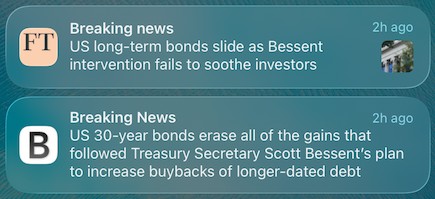
The bond vigilantes are calling BS on Treasury Secretary Scott Bessent.
“Bond vigilantes” — a term coined by economist Ed Yardeni — show up in the market when they want to cast a vote of no-confidence in government fiscal policy.
When we left you yesterday, Bessent had announced he was more than doubling his department’s buybacks of U.S. Treasury debt.
With this added source of demand, Treasury prices rose and yields fell. The yield on a 30-year T-bond — which hit a 19-year high of 5.31% on Monday — sank like a stone to 5.2%.
Yeah, the effect lasted barely 24 hours. The bond vigilantes have shown up in force…
This morning, Bessent told CNBC the buybacks might be even bigger than he announced yesterday. (What was it Einstein supposedly said about the definition of insanity?)
In between Bessent’s two announcements yesterday and today, the national debt crossed the $40 trillion threshold.
Bessent blew it off this morning. “There’s nothing magic about the $40 trillion number, and we can grow our way out of that.”
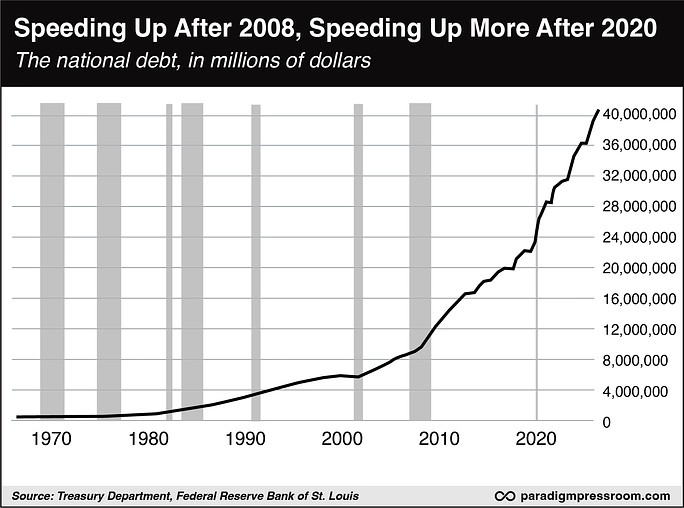
Let’s explore both parts of that sentence. It’s true that there’s no significance to a round number. But there are three charts Bessent is keenly aware of and doesn’t want you to think about.
The first is the growth trajectory of the national debt. You can see how it accelerated after the 2008 financial crisis — and accelerated again after COVID. What will happen with the next crisis? And what will the bond vigilantes do then?
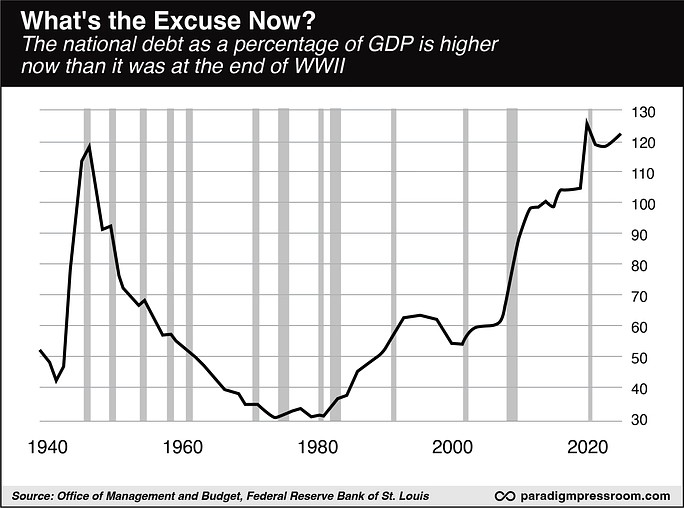
The second chart shows the national debt as a percentage of America’s annual economic output. Lower numbers mean the economy can more easily shoulder Uncle Sam’s debt burden.
But it’s even higher now than it was in 1946 — when Washington had the excuse of fighting World War II to justify unprecedented deficit spending. What’s the excuse now?
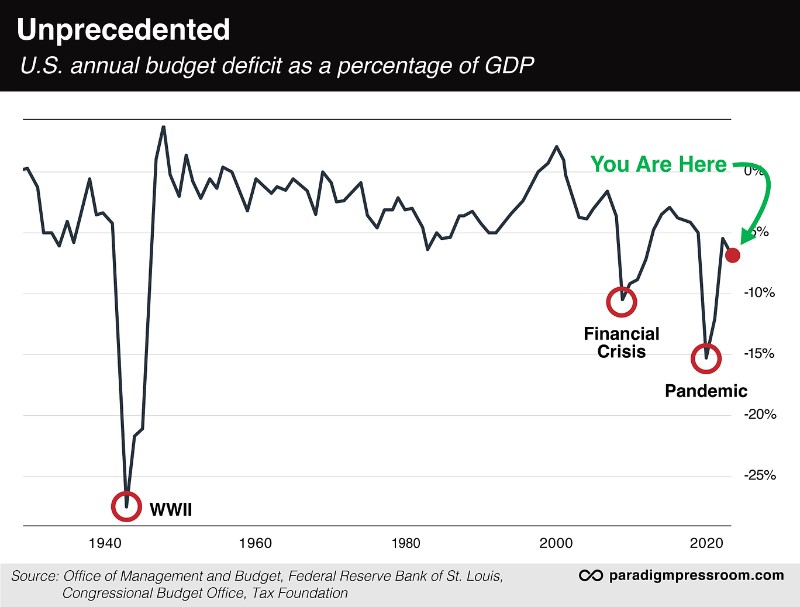
Finally, there’s Uncle Sam’s annual budget deficit relative to the size of the economy. Outside of a world war, financial crisis or pandemic it’s never been this high.
As for the second part of Bessent’s sentence, about how we’ll grow our way out of it…
In the first place, Bessent came into office with his much-touted 3-3-3 plan — the first plank of which was to shrink the annual budget deficit to 3% of GDP by the end of Trump’s term.
As you see from the chart immediately above, we’re looking at 5.8% for the fiscal year that ends next month. How likely are we to get to 3% in the next 2½ years?
Besides, “we’ll grow our way out of it” is what every Republican administration since Reagan has been promising — and it never works out. (Democrats just say they’ll raise taxes, because of course.)
Far more likely is they’ll inflate their way out of it. It’s the only way to shrink the debt burden without cutting spending, raising taxes or defaulting on the debt.
Little wonder gold surpassed $4,500 yesterday. Reclaiming the January highs over $5,500 is just a matter of time…
 Walmart and Tariff Refunds
The reversal in the bond trade has cast a pall over the stock market — and so has the biggest of the big-box retailers.
At last check the S&P 500 is down about a third of a percent and back below 7,700. The Nasdaq — more sensitive to rising interest rates — is down almost three-quarters of a percent.
The Dow is also down about three-quarters of a percent, dragged lower by one of its 30 component stocks — Walmart.
WMT is down 9% on the day after delivering its quarterly numbers — including yearly sales growth of 2.6%.
On the one hand, that number gave management the confidence to raise their net sales and operating income estimates for all of 2026.
On the other hand, the number is also the weakest in six years. The company says it would have been stronger were it not for new pharmacy-pricing regulations.
In addition, Walmart says it took some of its $2.9 billion in tariff refunds to give consumers some relief.
As we noted earlier this month, retailers are feeling the heat on social media and elsewhere for collecting millions or even billions in refunds after the Supreme Court struck down a big swath of the Trump administration’s tariff regime last winter.
Many consumers see it as a double-whammy: First, retailers collected more money by charging higher prices to offset the tariffs. Now they’re collecting still more money as Uncle Sam issues tariff refunds.
On the conference call, management bent over backward to emphasize they’re trying to do a solid by struggling consumers — either lowering prices or raising them less than would be the case otherwise.
Or as CFO John David Rainey put it, “Muting what was otherwise a higher price increase where consumers were feeling pressure.”
Elsewhere, crypto is showing signs of life.
Digital nondollar assets started taking off yesterday after Bessent’s Treasury buyback announcement. Today Bitcoin is approaching $73,000, the highest since early June. Ethereum has sailed past $2,300 to its highest level since mid-May.
Gold is hanging onto most of yesterday’s gains, still over $4,500. Silver has accelerated another 1.9% and surpassed $68 for the first time in two months.
U.S. oil futures are up another 2.2% to $87.72, the highest in nearly four weeks. That’s despite Bessent saying the U.S. government likely won’t restart large-scale combat with Iran.
So what gives? We’ll have to get to that tomorrow. It needs a Bullet of its own…
 Mainstream Overlooks the Real MRNA Story
When it comes to Moderna Inc., “The stock move is getting all the coverage, and it's the least interesting thing that happened yesterday,” says Paradigm biotech specialist Ray Blanco.
Moderna shares more than doubled after the company announced a successful trial of an mRNA-based treatment for skin cancer. Combined with Keytruda, an existing treatment from Merck, it prevents cancer from recurring in high-risk patients.
“Eleven hundred and thirty-seven patients. A real trial, properly run, blinded. The gold-standard for medicine,” Ray says. “It worked, and it worked well enough that an independent committee called it at the first scheduled checkpoint, ahead of schedule.”
Forget about the company’s COVID jab. As Ray sees it, that was a distraction from the work that was Moderna’s whole reason for being throughout the 2010s — and that’s starting to come to fruition.
Unlike every other drug made until now, this one is personalized for the patient.
“There's a single production run,” says Ray — “made for one person, from the specific mutations in that person's cancer — mutations that exist nowhere else in their body and in no other human being alive…
“They sequence your genes. They sequence your tumor's genes. The computer finds every mutation that might yield a novel peptide — a protein fragment that has never existed in your body before your tumor made it. That's hundreds to thousands of candidates.”
And then AI goes to work.
Out of those hundreds or thousands of possibilities, “the AI then analyzes and selects the top 34 most likely to produce an immune response from your own particular immune system, known as HLA (human leukocyte antigen) type,” Ray tells us. “Those top 34 get encoded into a single custom mRNA.
“It goes into your dendritic cells — the generals of the immune system — which manufacture those fragments and display them on their surface. The generals carry them to your lymph nodes and show them to the killer T cells. Newly activated, those T cells go hunting for any cancer cells left behind after surgery.”
Key point: The AI figures out the proper formulation in days. It would take a team of immunologists months to do the same — months that a cancer patient doesn’t have.
“This therapy is not merely improved by AI,” Ray says. “It is impossible without it.”
Ray’s been talking up the potential of “personalized medicine” in these digital pages for over a decade now. And he’s been talking up the potential of AI accelerating drug development since late 2023.
It’s all coming together now.
But that doesn’t make MRNA shares a buy. From Ray’s vantage point, “The stock has already priced in what hasn't happened yet… I am not paying today for outcomes we'll learn about several years from now.”
But other biotech players are competing in this space — and Ray will keep readers of Altucher’s Investment Network in the loop.
 Mailbag: Keeping People Divided
“Very strong and heartfelt Bullet No. 1,” a reader writes after last Friday’s edition. “Thanks for sharing it, Dave.”
Dave responds: Thank you. There was a lengthier, more critical reply and we’ll get to that tomorrow. But there’s a postscript I want to add today.
In mid-May 2020 — when “two weeks to flatten the curve” had stretched into two months — something interesting was happening on social media.
With justifiable alarm, conservatives were starting to share videos depicting heavy-handed enforcement of COVID lockdown orders. One video went viral, showing a cop harassing a man walking on a beach with his young daughter, alone, not another soul around that they could infect or who could infect them.
It was starting to dawn on conservatives, maybe for the first time since the 1990s, that law enforcement isn’t about keeping order — it’s about enforcing the laws.
And then George Floyd happened.
And conservatives immediately forgot all about those videos, going right back into their ideological box — back the blue, thin blue line…
I’m not saying the Floyd incident was orchestrated by the power elite to have this effect. But it sure was convenient for their purposes. The late George Carlin identified the dynamic brilliantly over 30 years ago: “They try to divide the rest of the people; they keep the lower and the middle classes fighting with each other so that they, the rich, can run off with all the ****ing money.”
Why do I bring this up now?
Because here in the latter half of 2026 there are no fewer than three hot-button issues that scramble the partisan divide — data centers, Flock cameras and U.S. aid to Israel.
I have no idea how any of these debates and disputes will play out ahead of the midterm elections — but I’ve got my head on a swivel.


