
Now She Tells Us (AOC)
 Now She Tells Us (AOC)
 Rep. Alexandria Ocasio-Cortez (D-New York) just came clean – fessing up to something your editor’s been saying for years.
Remember all the madness in the summer of 2020?
When strict lockdown orders could be violated as long as you were protesting “systemic racism”? When we were told mere speech constituted “violence” but deliberate property destruction was A-OK? When corporate America embraced the “woke” agenda and employees who didn’t toe the line got fired?
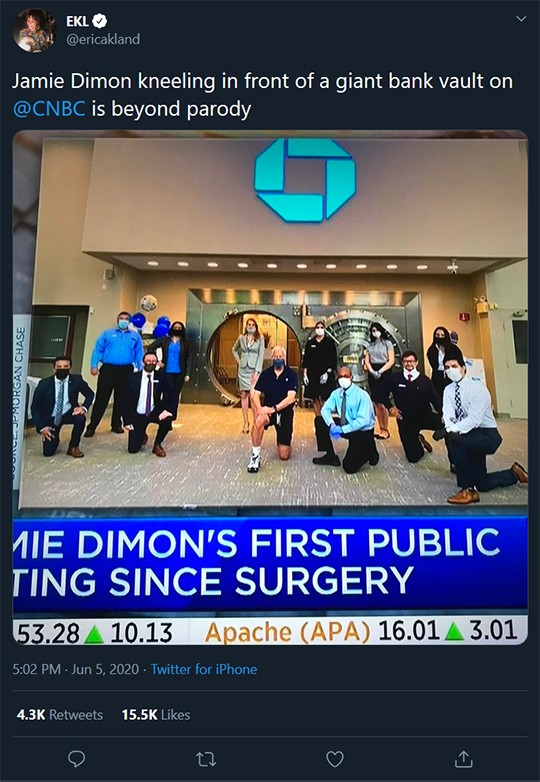
Perhaps the height of the insanity came when JPMorgan Chase CEO Jamie Dimon “took a knee” in the name of social justice…
Yeah, none of that would have happened were it not for the COVID lockdowns that upended the economy by government decree.
I said as much even as the riots were still going full-tilt. “Absent the lockdowns driven by the pandemic… the chaos driven by the death of George Floyd wouldn’t be happening.”
History is clear: Economic hardship leads to societal chaos.
Case in point: The 2014 riots in Ferguson, Missouri took place after poverty rates shot up in neighbhorhood after neighborhood during the preceding decade.
Now, think about the prelude to the Summer of Floyd: “Two weeks to flatten the curve” had stretched into over two months with no end in sight. At the end of May 2020, emergency economic measures including expanded unemployment benefits and an eviction moratorium were about to expire.
Legions of overeducated, underemployed baristas and Uber drivers had spent two months cooped up in their crappy apartments – and now they were about to be rendered penniless and homeless.
Something was bound to send them out into the streets.
The architects of the lockdowns had already lit the match. All they needed was a splash of gasoline. The splash of gasoline just happened to be George Floyd.
Which brings us back to AOC.
When she burst onto the scene during the 2018 midterms, she was all about economic issues and “climate change” – tax the rich, Medicare for all, the Green New Deal.
“Identity politics” wasn’t her thing.
But by early 2021, she fully embraced the woke agenda as she sought to climb her way higher within the Democratic Party’s power structure.
She even threw her fellow Democratic Socialists under the bus – saying they were coming from a “privileged” place if they dared to criticize Biden’s economic policies from the left. “For anyone who brings that up, we really have to ask ourselves, what is the message that you are sending to your Black and brown and undocumented members of your community, to your friends, when you say nothing has changed?… We cannot allow for that in our movement.”
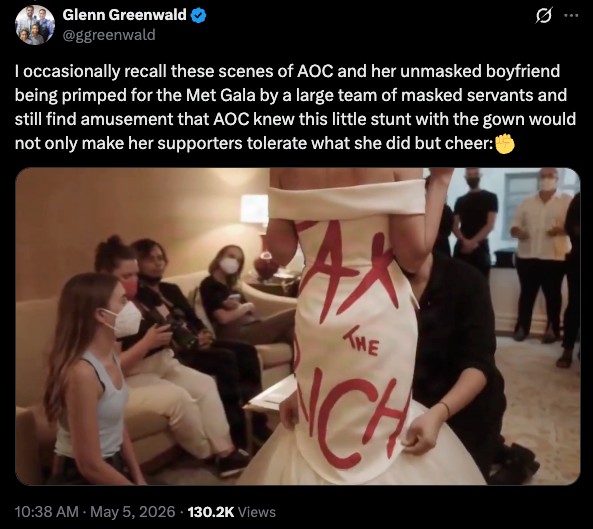
Later that year, she turned up at the Met Gala in New York – where tickets cost $35,000 a pop.
Most of the headlines were about her gown with the words “Tax the Rich” scrawled across her rear end. Less noticed was the fact she and the other attendees were maskless – while the hired help had to mask up.
But now AOC chalks up wokery to a collective burst of temporary “craziness” from which we’re supposed to just move on.
Last weekend she went on the Sunday talk show circuit. She nervously laughed her way through an interview with ABC’s Jonathan Karl – who confronted her with the most extreme positions espoused by the social justice warriors.
Karl: Did the movement go too far with some of those positions? I mean, you, you briefly supported the idea of defunding the police.
Ocasio-Cortez: You know, I think that, I think that during this time, and during, especially during COVID, there was a huge opening of the Overton window. We were shut down. There was some of the highest unemployment rates that we have seen because of those shutdowns. Yeah. And I think that the, the doors were really open in trying to entertain any and every policy that was going to get us to a better place. And I actually think that the discussions that were had in that time were quite fruitful. [Emphasis mine]
There you are, direct from AOC. None of this would have happened if the control freaks and power trippers hadn’t imposed their lockdowns, restrictions and mandates first.
So it’s not just the upended lives, the disrupted schooling, the shuttered small businesses, the excruciating pain of saying final goodbyes to a loved one over Zoom, the federal spending spree that touched off the worst and most prolonged episode of inflation since the 1970s.
It was also the “mostly peaceful” protests, the workplace struggle sessions imposed by HR departments, the ensuing four years in which the culture wars were played out on retailers’ shelves.
All of it can and should be laid at the feet of those ultimately responsible. Anthony Fauci. Deborah Birx. The various state governors (Gretchen “Queen of Hearts” Whitmer in Michigan was the worst).
And Donald Trump – whose culpability I documented in March 2025 during my five-year COVID retrospective. (No Trump supporter wrote in to tell me I was wrong.)
AOC wants you and me to move on. Trump too, when you get right down to it.
Never. Not until there’s justice and accountability.
 Consumers Buckling Under Inflation
Speaking of the worst and most prolonged episode of inflation since the 1970s… it’s now having a measurable impact on consumer spending.
The Commerce Department is out with its monthly read on retail sales. The typical Wall Street economist was expecting a small bump up of 0.1%. Instead, there was a 0.6% decline.
This number is often skewed by auto sales (volatile month-to-month) and gasoline sales (which rise and fall along with gasoline prices).
But even if you factor those out, you get a nasty downside surprise. The “expert consensus” was expecting a 0.4% jump and instead there was a 0.3% drop.
To be sure, one month does not constitute a trend. But for the moment, the mighty American consumer is buckling under the pressure of rising prices. “The elevated inflation rate is having a dampening effect on consumption,” says a summary from Econoday. “Energy costs and tariffs continue to underpin higher prices.”
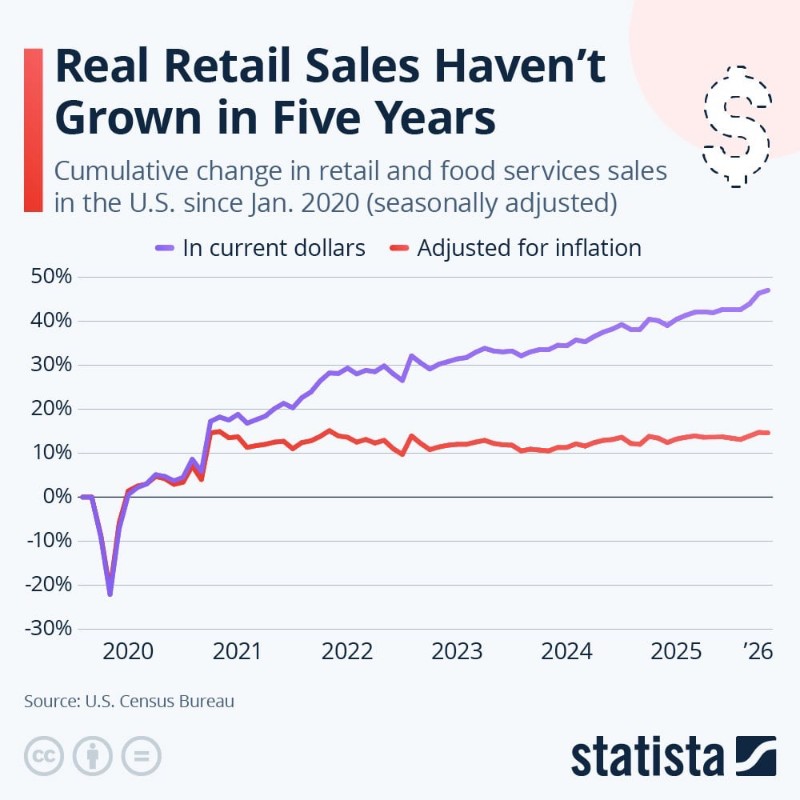
Important reminder: These retail sales figures are not adjusted for inflation. If they were, you would see that retail sales have been flat since early 2021 (when the inflation rate started taking off in earnest).
Here’s a chart that’s now three months old – but we can assure you the trajectory hasn’t changed.
After notching a record close yesterday, the S&P 500 is treading water going into the weekend.
At last check the index is down less than 0.2% to 7,786. (It couldn’t quite break through 7,800 yesterday.) The Dow and the Nasdaq are also in the red, though not by much.
Precious metals are staging a modest rally – gold up to $4,383 and silver a few pennies shy of $65.
Oil, you ask? “Iran blew up two tankers. Naturally oil is down,” says a pithy tweet from commodities analyst Lukas Ekwueme. As we write, U.S. crude futures sit at $81.44.
Crypto is losing ground, Bitcoin well below $63,000 now.
 Follow-Up: California’s Wealth Tax
California’s proposed wealth tax might never reach the ballot in November.
As we’ve chronicled now and then this summer, the referendum proposes a one-time wealth tax of up to 5% on net worth over $1 billion. Doesn’t matter whether those assets have been sold.
Silicon Valley billionaires are fighting back – Google co-founder Sergey Brin committing tens of millions in hopes of defeating the measure.
In a lengthy analysis issued this week by the Tax Foundation, senior fellow Jared Walczak finds the proposal vulnerable to a court challenge.
Among the potential objections: The measure is touted by its supporters as an excise tax rather than a tax on property. “But courts, in California and at the federal level, have long held that the character of a tax is determined by its substance, not its form or label,” Walczak writes. “Merely calling a tax an excise tax does not make it one, and even if it is possible to define a tax as an excise in some fashion, it does not lose its ordinary characteristics.”
Then there’s the part of the referendum that applies the tax to billionaires who resided in California as of January 1, 2026. Walczak says the retroactive residency requirement is fatally flawed in light of Supreme Court precedent.
So far, no lawsuits have been filed challenging the referendum. But if it passes in November, litigation is a sure thing.
Bottom line: “If courts invalidate the tax,” Walczak writes, “California will have the worst of all worlds: a threat that drives away some of the state’s wealthiest taxpayers and spooks the next wave of startup founders, costly litigation that could drag on for years, and not a single dollar in new revenue.”
 Comic Relief
Speaks for itself…
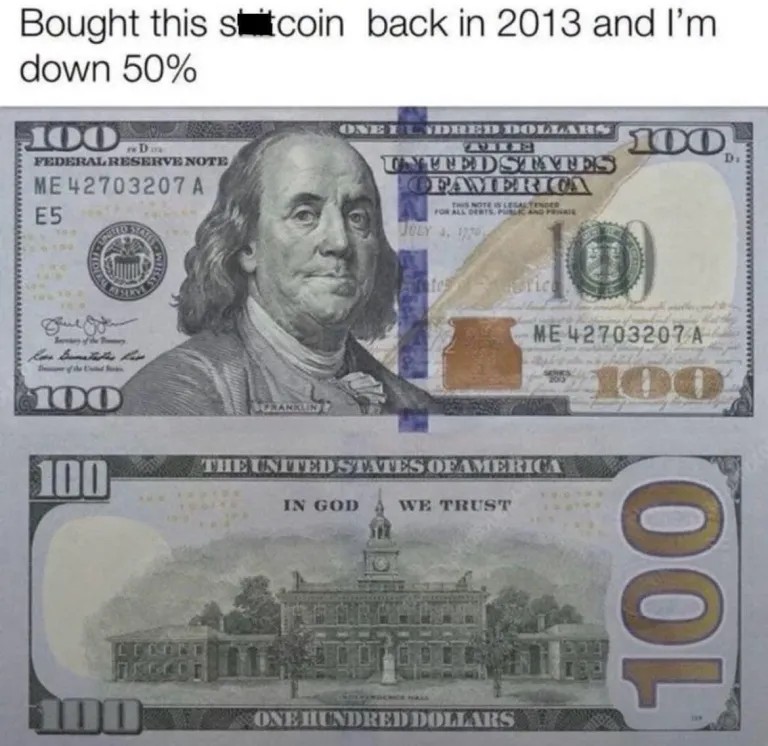
Well, we’ll add this.
If you go by the official inflation numbers, the dollar’s purchasing power has depreciated 30.3% since 2013.
But given the way the inflation figures are gamed, it probably is closer to 50%.
Speaking of gamed economic numbers…
 Mailbag: Funky Stats, Entry-Level Jobs
“Hey Gonigam, watch how government numbers start to get better and better as we get closer to the mid-terms,” a reader writes.
“Trump doesnt care about how he looks in May or June. He knows the American public has no memory, and only cares about the next couple of weeks going forward. With all his political appointees (4,000 +/-) in place and ready for his final orders, those numbers are gonna get rosier and rosier ... no conflict of interest ... rrrrrrriiiiggghhhht.”
Dave responds: Both Jim Rickards and Buck Sexton of our team – neither one Democrat-friendly – have spotlighted the perception thing.
“Trump doesn't need perfection here,” Buck said in this space on June 11. “He needs people to feel like things are getting better. That's it.”
We’ll see. This much is for certain: Since Trump fired Bureau of Labor Statistics commissioner Erika McEntarfer a year ago, only one monthly reading of the consumer price index has come in hotter than the consensus expectation of Wall Street economists. What are the odds?
After our item in Wednesday’s edition about the plunge in the number of entry-level jobs, a reader writes…
“My personal opinion is employers are using the ‘wanting experience’ as an excuse to hire workers with maturity more than work experience. They want someone who is going to show up for work, every day, on time, no excuses, no entitlement.”
Dave: Could be.
On Tuesday we mentioned the monthly survey from the National Federation of Independent Business – in which members are asked to identify their single-most important problem. “Quality/availability of labor” was cited by 27% of respondents.
In the 52-year history of the NFIB’s surveys, the only time this figure was higher was during the worst of the post-COVID labor shortage in 2021-22.
The survey excerpts in the NFIB’s report underscore the reader’s point.
- “Labor is a challenge. We currently rely on older or retired help,” said a retailer in Pennsylvania.
- “Our biggest obstacle is finding technicians with experience. It is also difficult to find office employees. Most [people] we hire off the street do not last. [They] miss a lot of work,” says the owner of a construction firm in Arizona.
- “Employees want more compensation for less work/production. To keep this trend going we must find easier ways to do tough jobs and charge higher prices with stiff compensation,” says the owner of a services-oriented business in North Carolina.
If you lack faith in the younger generations, tomorrow’s 5 Bullets will – well, let’s just say it won’t do much to change your mind. Catch you then for our Saturday wrap-up…


