
The AI Bailout of 2027
 The AI Bailout of 2027
 Slowly, inexorably, the path is becoming clear: The AI industry will be asking for a taxpayer bailout next year. Or, at the latest, 2028.
The signs have been there all along, and we’ve been following them for nine months now…
- Last November, OpenAI’s chief financial officer floated the idea of her company getting taxpayer-backed loan guarantees. Your editor speculated her trial balloon was the prelude to the feds taking an equity stake in the company – an idea which CEO Sam Altman pitched to the White House six weeks ago
- In June of this year, Vice President Vance suggested the formation of a sovereign wealth fund that would invest government money in the AI industry – totally impractical for a government that’s $40 trillion in debt, but he put it out there anyway
- Then last month, word slipped out of Washington about a draft report prepared for the Treasury and the Federal Reserve: It suggested the AI industry poses a systemic risk comparable to that of the 2008 financial crisis.
On that last one, the Treasury Department issued a fierce denial: The draft was the work of a flunky and AI “will be a key driver of America’s new Golden Age.” (As the saying goes, never believe a rumor in Washington until it’s been officially denied.)
All of which tees up two developments this week…
On Monday, Nvidia CEO Jensen Huang unveiled a $500 billion deal with six major Wall Street firms to help finance the ongoing data center buildout.
Executives from all seven firms did a live interview on CNBC, which says the agreement will “treat compute infrastructure much like commercial real estate, toll roads or other assets to borrow against… The effort aims to mobilize more than $500 billion in third-party capital for hyperscalers, frontier AI labs and enterprises to build out data centers and acquire Nvidia hardware, marking a potentially important shift in how AI infrastructure is funded.”
Nvidia’s partners are Apollo, Blackstone, BlackRock, Brookfield Asset Management, Goldman Sachs and KKR.
“By using institutional credit, insurance funds and private capital to underwrite GPUs and data centers, Nvidia is helping its end users secure financing without tapping their own balance sheets,” CNBC continues.
If you’re getting some 2008 heebie-jeebies here, you should be. What began then as trouble in the housing market spilled into the credit markets and ultimately into the banks.
Same drill this time: What might go wrong in AI wouldn’t stay confined to AI.
This is exactly what that draft Treasury-Fed report was warning about – which the Treasury was so eager to deep-six.
“Jensen’s goal is to make the AI bubble so large and so systemic that a taxpayer bailout is forced on everyone,” tweets Don Johnson, chief economist at the MacroEdge research firm.
The same day as Huang and the finance bigwigs made their announcement, federal regulators gave the AI industry a free pass to take new financial risks.
From Bloomberg: “The Securities and Exchange Commission has made it easier for data center owners to sell asset-backed securities, potentially opening the door for more debt sales as tech firms scour Wall Street for ways to pay for artificial intelligence.”
Basically, the SEC took a series of rules that have been in effect since the 2008 financial crisis – and gave data centers a carve-out.
“The SEC said a major subset of data-center securitizations don’t need to have disclosures and investor protections that similar deals require. That includes risk retention, a requirement that companies issuing asset-backed securities retain some of the debt to better align their interests with investors.”
Here the 2008 parallels might not be as obvious – but they’re even more ominous.
In April 2004, the SEC buckled under pressure from the Big Five investment banks – allowing them to amp up the leverage on their trades from 12:1 to as much as 40:1.
It was a staggering level of risk – but one the industry was more than willing to take as long as it had an implicit taxpayer backstop.
The rest was history. Less than five years after that decision, the Big Five investment banks shrank to just two: Bear Stearns collapsed and was absorbed by JPMorgan Chase… Merrill Lynch collapsed and was swallowed up by Bank of America… and Lehman Bros. collapsed with no one to come to its rescue.
Only Goldman Sachs and Morgan Stanley survived – and only because they converted from investment banks to commercial banks, allowing them access to emergency loans from the Federal Reserve’s discount window.
No financial crisis and no bear market play out exactly the same way. And we’re not saying it’s time to batten down the hatches as if it were the summer of 2008.
But we’re on watch.
AI isn’t the only potential catalyst for the next storm. Only yesterday we teased out how trouble in Japan could blow back on Washington and Wall Street.
That said, AI is at least as strong a candidate.
“AI infrastructure has produced one of the largest capital-expenditure draws in modern history, comparable in scale to the nineteenth-century railroad build-out,” Paradigm’s Mason Sexton, editor of The Map, wrote his readers yesterday. “Hyperscaler spending now accounts for a material fraction of GDP growth, yet revenue realization lags the debt and equity capital committed.”
The railroad buildout transformed the nation. But along the way it generated staggering busts that followed stupendous booms – more than once.
Leaving aside the anomaly of the COVID episode in 2020… we’ve been in a nearly nonstop bull market and economic expansion since 2009.
By historical standards, both are getting long in the tooth. We’re much closer to the end than the beginning. Stay tuned…
 Inflation: Still Sticky
The cost of living is still rising at a disturbing rate – just not as fast as it was during the spring.
The Bureau of Labor Statistics is out this morning with the July consumer price index. The official inflation rate is now running 3.4% year-over-year.
On the one hand, that’s the slowest clip in four months. On the other hand, it’s still higher than the entire decade from 2011-2021, and higher than all of 2025.
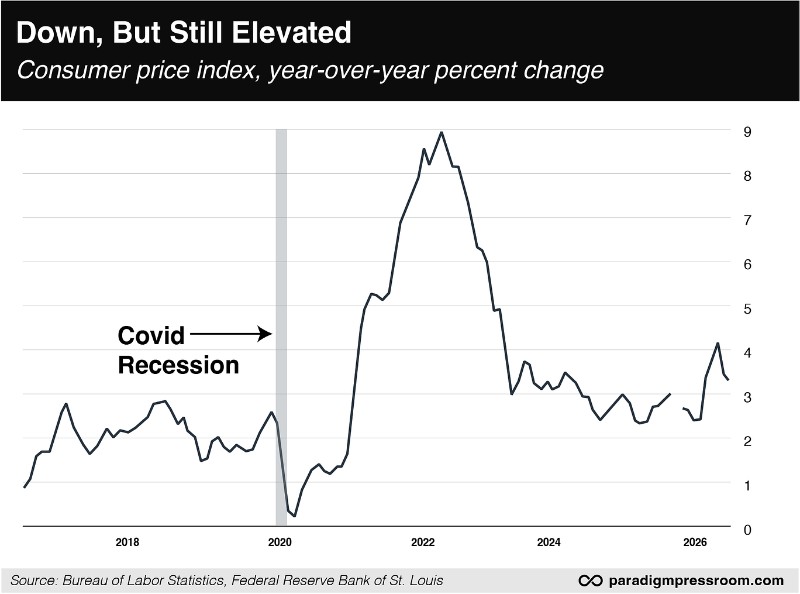
Gasoline prices climbed down 2.9% during July – but they’re still up 24.6% year-over-year.
As always, any resemblance between these numbers and your own cost of living is purely coincidental. But even if you take the numbers at face value, they’ve prompted some pithy social media commentary…
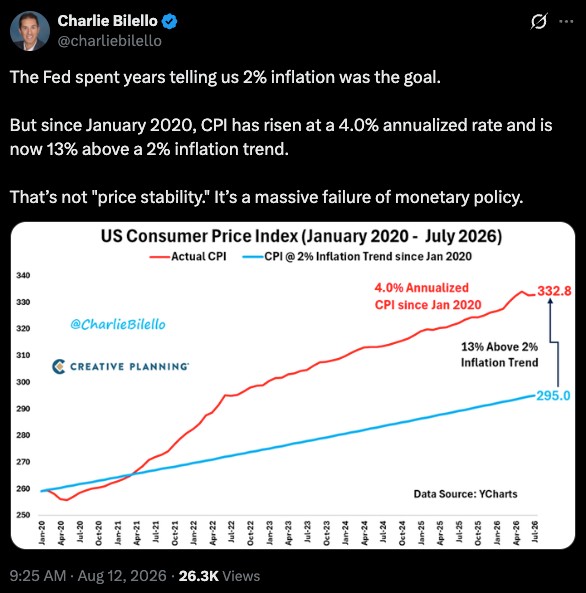
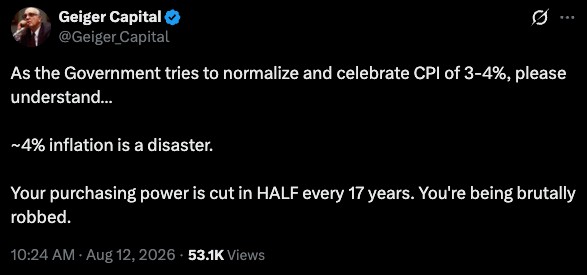
What have we said regularly for over three years? Any time the inflation rate sails past 5% – as it did in 2022 – it typically takes a decade to get back to “normal” 2% inflation.
There’s still one more release of this number before the next Federal Reserve meeting in September. For now, futures traders assign a 62% probability the Fed will leave short-term interest rates alone.
The receding likelihood that the Fed will raise rates in September appears to be giving a lift to both stocks and precious metals today.
It’s the Nasdaq taking the lead among the major U.S. indexes – up nearly a half percent at last check to 26,560. The S&P 500 is up less than a quarter percent to 7,744. The Dow is barely in the green at 53,814.
The bigger gains are to be found in gold, up over 1% and over $4,400 for the first time in more than two months… and silver, up another buck to $65.60.
Crypto just can’t get any traction, Bitcoin at $63,411 and Ethereum at $1,890.
Winners in Paradigm publications so far this week include over 15% in the space of a month on IBM shares in The Map… and on the options side, 132% in less than three weeks on the cybersecurity name SentinelOne in Altucher’s True Alpha.
 Drones and Oil, Russia-Ukraine Edition
For the moment, the big risk to global oil flows has shifted from the Persian Gulf to the Black Sea.
Overnight, the Financial Times reported that Vice President Vance asked the Ukrainian government to lay off its drone attacks on oil tankers loading at a Russian terminal.
“Washington was alarmed that Ukraine was further destabilising oil markets and harming US companies by targeting tankers carrying crude piped from Kazakhstan to a Caspian Pipeline Consortium terminal in the Russian port of Novorossiysk.”
The request supposedly came on July 31. The FT said no strikes on that terminal had taken place since.
And then within hours of the FT posting its story online…
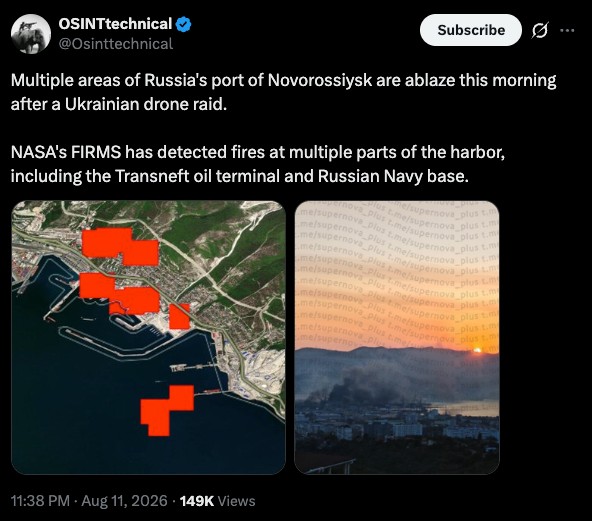
Apparently Kyiv believes it’s still going along with Washington’s request because the targets this time do not belong to the Caspian Pipeline Consortium – in which both Chevron and ExxonMobil own a stake.
Regardless, Ukraine’s steady drone attacks on Russian oil infrastructure are having an impact on global supply. Output from Russian refineries has fallen to two-decade lows. Moscow has banned the export of diesel and jet fuel. And as mentioned here on Monday, Russia is even importing these refined products from South Korea.
In the meantime, U.S. crude futures are holding steady at $83.16.
It being Wednesday the Energy Information Administration has released its U.S. weekly inventory figures. Supposedly private-sector crude stockpiles grew 17.4 million barrels in the week gone by. That’s one of the four biggest weekly builds ever, in records going back to 1982.
Skeptical observers of the oil market say EIA’s figures have become about as reliable as the inflation and jobs data coming out of the BLS…
➢ And just as a reminder: The Strait of Hormuz is still all but closed.
 Grim Statistics (and Comic Relief)
The bottom rung of the career ladder is missing for scads of college graduates.
According to the hiring platform Cadient, only one out of every 50 job openings at the moment is entry-level – compared with one in 15 four years ago.
Furthermore, the number of entry-level job postings collapsed between 2022-2026 by an eye-watering 73%.
Cadient’s researchers analyzed 7,984 salaried openings over that period. "The real issue isn't that entry-level jobs are disappearing,” says Cadient CEO Bill Mastin. “It's that employers increasingly expect candidates to arrive with experience before they're given the opportunity to gain it.”
Which tees up today’s meme nicely…

 Mailbag: The “Xennial” View
We’re not quite done with the recent outbreak of generational warfare in these virtual pages.
We got a long note from a reader that we’ve had to truncate for space.
“Fellow Xer myself. Since you're right on the X-Boomer cusp, you might want to know something. I sit in a unique zone of generational history called 'Xennials' by psychology.
“We began childhood in a non-digital world, and became adults in the first era of a digitized civilization, when Millenials started growing up. The YouTube channel Psychology Simplified has a series on this unique profile, and your assertion that GenX is politically and societally dismissible is both a manifestation of your trademark pragmatic cynicism and a grave miscalculation.
“Xennials might be the last generation to care about and fight for privacy, individual rights, and restraint of state power. I might be overstating the case, because I am told there is cause to bet on Gen Z (I think Jim Rickards made that case in "Tech Bros Run the Marxist Playbook"), but I and my ken are not 'wait-and-see' types.
“You call Boomers a generation of prophets - I rather see them as a generation of doers, who knew their business but didn't necessarily see the future clearly. I remember my father, who was very avant-garde about tech (he brought the first computer into our home in 1986), sitting me down in front of his stepfather, who was a foreman for PG&E for 3 decades, and give me a 'talking to' about getting a stable secure job.
“His concluding line was ‘you find a good company, take care of them, and they'll take care of you.’ I didn't believe him then, and that advice has been shredded by 3 decades of economic upheaval that he didn't live to see. It will suffice to say that I have learned to not take anything, or anyone, at face value, which is why I still read your column regardless of whether I like or agree with you or not.
“I look forward to more of your sarcasm, sardony, and sound analysis in a world-turned-bedlam. Keep the powder dry and the glasses cold. Into the future we go.”
Dave responds: Thank you. To be clear, it’s the demographer Neil Howe who says boomers fit the archetype of a “Prophet” generation – while Xers are “Nomads” and millennials embody the “Hero” archetype. In this construct, the previous Hero cohort was the GI generation that came of age during the Fourth Turning crisis of the Great Depression and World War II.
It’s easier to understand in a table, which I created with the help of the AI engine Perplexity…
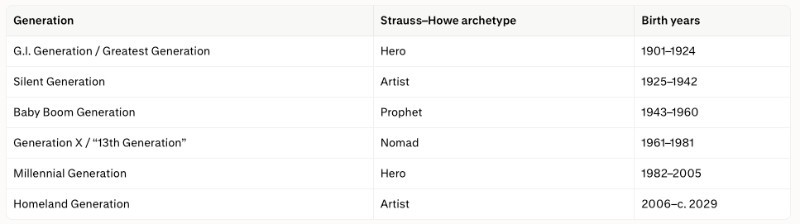
For whatever it’s worth, Howe believes Gen Z is an artificial creation of the marketing industry that has zero reflection of the roles that generational archetypes play through history.
As Howe sees it, the last millennials were born not in 1996 but nearly a decade later. He’s given the follow-on generation the working name of Homelanders – a nod to the post-9/11 zeitgeist.
Well, since he and his late writing partner William Strauss coined the term “millennial,” we have to give Howe his due…


