
680 Miles
 9,800
9,800
 Ukrainian drone strikes inside Russian territory aren’t altogether new. But 680 miles from the Ukrainian border? That’s new.

Local officials in the city of Nizhnekamsk, population 241,000, say the attack overnight killed 13 people – including a child. “It is one of the deadliest single attacks on Russia since the start of Moscow's full-scale war in Ukraine in 2022,” says the BBC.
For its part, the Ukrainian government says it hit an oil refinery – part of its strategy to strike targets that generate revenue for Russia’s government and logistics for Russia’s military.
Nor was that the only drone Ukraine sent into Russian territory: Moscow says it shot down more than 450 Ukrainian drones last night alone.
The Russian defense ministry says Ukraine unleashed a record number of drones on Russia last month – 9,800. That’s over 300 a day.
Not coincidentally, the supply of drones from European Union countries has mushroomed this year.

These drones aren’t especially speedy. And few hit their targets – perhaps 3% at most. They’re unlikely to change the trajectory of the war, which is moving steadily in Moscow’s favor.
The Russian military has its own drone fleet that it unleashes on Ukraine – and those drones appear to be reaching a far higher percentage of their targets.
That’s because Kyiv has exhausted its supply of interceptor missiles – and Washington has no more to give, having already given so many to Ukraine and having used up so many defending U.S. bases in the Middle East from Iranian drone strikes.
These developments have not gone unnoticed in Washington. Which is why a tiny line-item in the Pentagon’s budget blueprint perked up our attention at Paradigm Press.
We alluded to it last Thursday – a staggering 240x increase in the amount of money sought for drone warfare. From $255 million… to $55 billion.
We’ve also been aiming to identify the companies that could be the biggest beneficiaries of this money flood from D.C. And the team at Rickards’ Insider Intel has pinpointed it – with the aid of a proprietary AI tool they call the I-3.
 Energy: Reality Check
“U.S. Oil Price Hits $80 as Doubt Grows Washington and Tehran Will Reach Strait of Hormuz Deal,” says a CNBC headline.
Gee, ya think?
A week ago today, Treasury Secretary Scott Bessent said a deal was in the works “today or tomorrow.” But on Saturday, traffic was at a near-standstill.

Yesterday, Donald Trump did an interview with one of the White House’s fave reporters, Axios’ Barak Ravid. He issued no new military threats against Iran, saying he’ll rely on economic warfare for the time being. Or as he put it, “We are low-keying it.”
Hmmm… That squares with a column last week by The Wall Street Journal’s Holman Jenkins in which he anticipated “the deusltory shooting and talking to continue to Jan. 20, 2029, when the next administration will be able to take a big-bath write-off and blame Mr. Trump.”
Of course, it’s still a long time between now and then – and the status quo can’t hold indefinitely. Some other headlines today…
- The Department of Energy says the U.S. government’s Strategic Petroleum Reserve is now under 300 million barrels – the lowest level since 1983. By law, it can’t fall below 252 million so that the military has a bare minimum to draw on in an emergency. At the current pace of depletion, we’ll be there by late October.
- Ukraine’s attacks on Russia’s oil industry are such that according to Reuters, Russia is importing refined products like diesel and jet fuel from South Korea – which isn’t exactly an energy powerhouse
- Yemen’s Houthi faction continues to inflict pain on Saudi Arabia’s oil industry – launching another drone attack on Saudi Aramco’s Jazan refinery, which the company says is now disabled until at least the end of this month. (More about the Houthis and drones in tomorrow’s edition…)
And with that, U.S. oil futures are now over $81 for only the second time this month – up more than three bucks from Friday’s close.
As for stocks, the major U.S. indexes are little moved from their Friday closes.
At last check the S&P 500 is up fractionally in record territory at 7,764. The Dow and the Nasdaq are slightly in the red.
The Paradigm editors racked up another slug of winners for readers at the end of last week. Enrique Abeyta’s The Maverick logged a 15% gain in less than four weeks on shares of Construction Partners Inc. – and 239% playing options on Atlassian Corp.
Atlassian was also a big winner for Zach Scheidt’s Income Alliance – a staggering 157% in a single day. And in Altucher’s True Alpha, readers bagged 196% in less than four months playing options on Unity Software.
Elsewhere, gold is consolidating last week’s gains – up $21 as we write to $45,362. But silver’s still on a tear, up 2.5% and now over $65 for the first time since June.
No joy in crypto, though – Bitcoin just over $64,000 and Ethereum under $1,900 again. “Bitcoin’s trading range has tightened to a point where we should expect a major move soon,” says Greg Guenthner at The Trading Desk. “Whether that move is up or down remains to be seen.”
 Et Tu, Texas? (Data Centers)
For the record: The most data center-friendly state government in the country has paused new approvals.
Last week, Republican Gov. Greg Abbott of Texas ordered a pause on new approvals for every data center that wants to connect to the power grid. That’s because ”less than 10% of data centers responded to the state’s requests for them to report their power and water usage,” according to the Texas Tribune.
And so all approvals are on pause until the state can perform an audit – some 1,800 projects representing 474 gigawatts, five times the Texas grid’s record peak demand.
Donald Trump criticized Abbott’s decision – gently, and without calling him out by name. “I just think it’s a mistake, because there are other communities that want it. When a community wants it, it means a lot of money is going to come into that community.”
Abbott spokesman Andrew Mahaleris counters that “many are unaware that [the Electric Reliability Council of Texas] is tracking a more than 500% increase in peak electricity demand. This unprecedented growth could endanger the reliability and stability of the Texas electric grid.”
The situation is almost certain to encourage more data centers to spin up their own power on-site, “behind the meter.” The simplest and fastest way to do so is with natural gas.
But that’s not problem-free. In July we mentioned the objections neighbors have to SpaceX’s colossus project in the Memphis area.
Last week, The New York Times had a front-page story that began with the tale of a woman near El Paso who will soon have a new Meta data center for a neghbor – powered by natgas turbines.
“I thought I’d bought my dream home, that I’d be looking out on the dark sky, hearing the coyotes call,” says Cynthia Crouse. “Then I woke up to the biggest nightmare I’ve ever had.”
The Times story zeroes in on “planet-warming carbon dioxide” – because of course it would.
But you don’t have to buy into the climate change hoopla to recognize that the turbines “also produce harmful pollutants including particulate matter, formaldehyde and smog-forming nitrogen oxides that can contribute to heart disease, asthma, lung cancer, strokes and other ailments in people living nearby.”
This much is certain: The backlash over data centers isn’t going away. And it transcends partisan lines.
 Great Moments In AI
You know the saying “close enough for government work”? Yeah, this ain’t it…

Recently the State Department held its annual AIDS conference in Brazil. During one presentation, an official map spotlighted six African countries with which Washington has agreements for AIDS funding.
And the map botched both the shape and placement of every one.
From an NBC News account: “The map showed Nigeria, where the U.S. has several hundred troops deployed, as landlocked in the Sahara. Mozambique, which is in southeastern Africa, was relocated to the Horn of Africa, while Ivory Coast in West Africa was placed on the other side of the continent.”
It’s… the… State Department. They’re supposed to… know… this stuff.
A watermark on the map said the map was made with the help of OpenAI tools. OpenAI says it’s investigating.
Yeah, I tried using OpenAI’s ChatGPT to draw a map for a 5 Bullets issue one day recently. The approximate position of everything was accurate but the shapes were so distorted I refused to use it.

This is what ChatGPT thinks the Caspian Sea basin looks like…
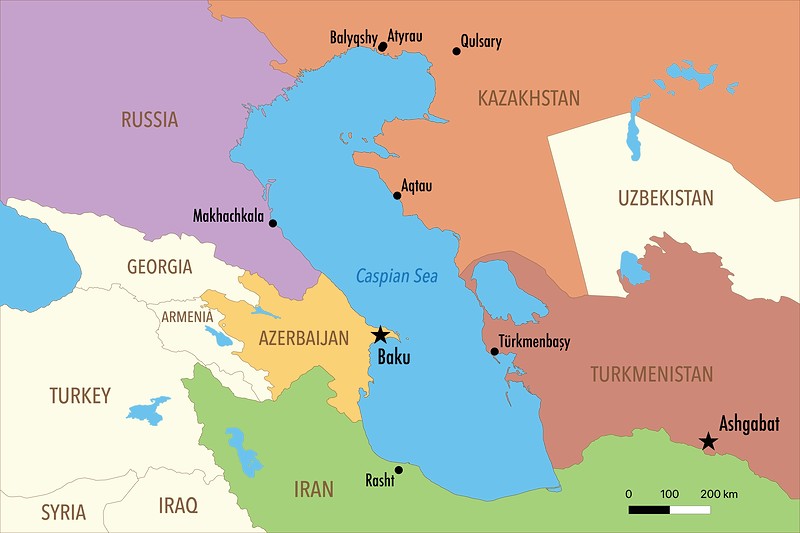
…and this is what it actually looks like.
The State Department says it takes “full responsibility for the confusion and misrepresentation it caused for attendees, including our African partners.”
Betcha no one got fired or even reprimanded, though…
 Mailbag: Show-Me State Taxes
“As a Missouri resident, I wanted to follow up with you about the vote in the state that rejected abolishing the income tax,” a reader writes after Saturday’s edition.
“As it stands now, under the Hancock Amendment and Constitutional Amendment 4 (2016), the Missouri General Assembly cannot raise state taxes or expand state revenue beyond a constitutional growth cap without sending the proposed increase to a statewide vote for public approval.
“Plus, cities, counties, school districts, and special taxing districts cannot create new local taxes, increase existing tax rates, or expand sales tax levies without direct voter approval. And, if overall property assessments in a taxing district grow faster than inflation, local taxing authorities are constitutionally required to roll back their tax rates to prevent automatic revenue spikes—unless voters specifically approve keeping the higher rate. (There are some exceptions and caveats, but I hope this gives you the big picture of the tax scene in Missouri.)
“Amendment 5 would have ended income tax; BUT it would have authorized the Missouri General Assembly to expand sales and use taxes to a wider array of goods and services without requiring a separate, subsequent public vote. (Effectively ending the safeguards outlined above.)
“From my conversations with people from all over the political spectrum, I got the feeling that the vast majority of people did not want to allow politicians to expand sales and use tax at their discretion. Plus, they wanted to keep voter protections in place. (You kind of got the feeling it would have turned into an everything tax that could easily feel like a VAT for the state.)
“In any case, I hope that paints a picture of the tax scene in Missouri and what Amendment 5 would have done.
“Keep up the great work! Love the 5!”
“I never met a tax I didn’t hate, and for 27 years as an expat, I structured it so I paid little or none. I find income taxes almost as distasteful as slavery,” chimes in another reader.
“When I saw the amendment proposal to eliminate income and property tax, I was elated. Then I read the fine print. As you mentioned, they had to get funds from somewhere. In this case, it eliminated the constitutional restraints on sales and services taxes.
“So our choice was to trade on a known form of robbery for another with no theoretical limits. As the winds and political fortunes shift over time, politicians would have a field day favoring this and taxing the hell out of that, with no say from the taxpayer. It would have been a great instrument for social engineering. Fortunately, enough people figured that out.
“Unfortunately, but perhaps not surprisingly, the amendment to end simple majority rule (mob rule) and replace it with the requirement for proposed changes to pass with a majority in all voting blocks did not.
“On the surface, this would appear fair, but Missouri is a bit different. The populations of St. Louis and Kansas City on the east and west borders are urban and primarily blue, while the rest of the state in between is mostly rural and red. The proposed amendment would have finally given some clout and better representation to the rural folk and perhaps provided a pathway to alleviate some of the disadvantages we now face. The campaigns in the media misportrayed it sufficiently that it did not pass.
“So no changes. C'est la vie.”
Dave responds: Thanks to our readers contributing on-the-ground insight.
As long as we have local and state taxes on the brain, here’s a quick update on the proposal in Florida that would radically curb property taxes.
Opponents of the measure challenged it in court – and a week ago today, a judge in Tallahassee ruled the language needs to be tweaked.
In particular, the judge said the title of the measure – “Save Our Homes From Excessive Property Taxes” – was too political, running afoul of state law requiring “fairness and accuracy” in ballot questions.
Gov. Ron DeSantis says while he doesn’t “necessarily agree” with the ruling, a rewrite is underway. The referendum still goes before voters on Nov. 3.


