
“Bloodbath”
 “Bloodbath”
 Yeah, I can’t resist starting the Election Day issue on an irreverent note. Or two, as seen in the patriot/prepper meme-o-sphere…

On a somewhat more serious note… and to the extent mainstream polling data can be taken seriously… this chart must surely be causing agita in the White House.
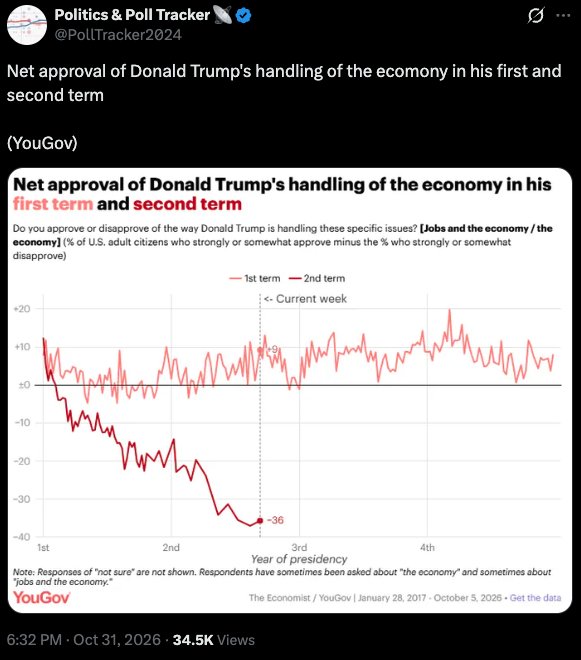
As it is, Democrats took the House from the Republicans in 2018.
"It's now almost certain that voters intend to punish Republicans pretty badly for ignoring their wishes and concerns,” tweets independent pollster Rich Baris.
It pains Baris to say that; he has zero affinity for Democrats.
But Baris says Donald Trump took a sledgehammer to his fragile coalition when he and Benjamin Netanyahu launched their war on Iran. Young people and Latinos who put him over the top in 2024 have checked out.
“Iran consumed all the oxygen,” says pollster Mark Mitchell, a kindred spirit of Baris — “and instead of progress on affordability, what voters got was ‘shut up, this economy is great.’”
Word. It’s exactly the same gaslighting Democrats did during the 2022 midterms. We chronicled it extensively at the time. The Dems lost their majority in the House as a consequence.
Or if you want another historical reference, Trump’s approval rating now is comparable to George W. Bush’s in 2006 — when a war-weary electorate flipped both houses of Congress to the Dems.
“Sure, polls have understated Republican support in several recent cycles,” Baris acknowledges.
“But it was due to Trump and his under-measured popularity. Now he is much more unpopular than in prior elections and that is being driven by unpopularity among right-leaning voters…
“If certain voters are telling us that they aren’t participating or they are defecting, we cannot simply decide we do not believe them.
“Worth noting, a lot of Democratic pollsters did this in 2016 and tried to account for it by weighting Democrats higher. That was putting their thumbs on the scale, and it bit them in the arse.”
The conservative influencer Nick Sortor says the only way to prevent a GOP “bloodbath” is if GOP voters “turn out in droves” today.
“It’s a very tall order for one day,” Baris says, “given the difficulty they have had during early voting. But it is still technically possible until every poll closes.”
With that, we’ll reiterate our own Jim Rickards’ final call that we shared here on Friday: Democrats take the House narrowly, 223-212… while Republicans retain their 53-47 advantage in the Senate.
That stands in contrast with the oh-so-mainstream pundit Nate Silver — who projects a Democratic wipeout of 236-199 in the House and a Democrat majority in the Senate of at least 52.
 The Election and the Markets
“The stock market doesn't care nearly as much about who wins elections as some headlines would make you think,” says Enrique Abetya, our resident hedge fund veteran.
In yesterday’s edition of our sister e-letter Truth & Trends, Enrique shared a chart much like the one we had here last month. This one is from RBC Capital Markets, studying average annual S&P 500 returns under six different configurations of presidential and congressional power, going back to the days of President Dwight Eisenhower…
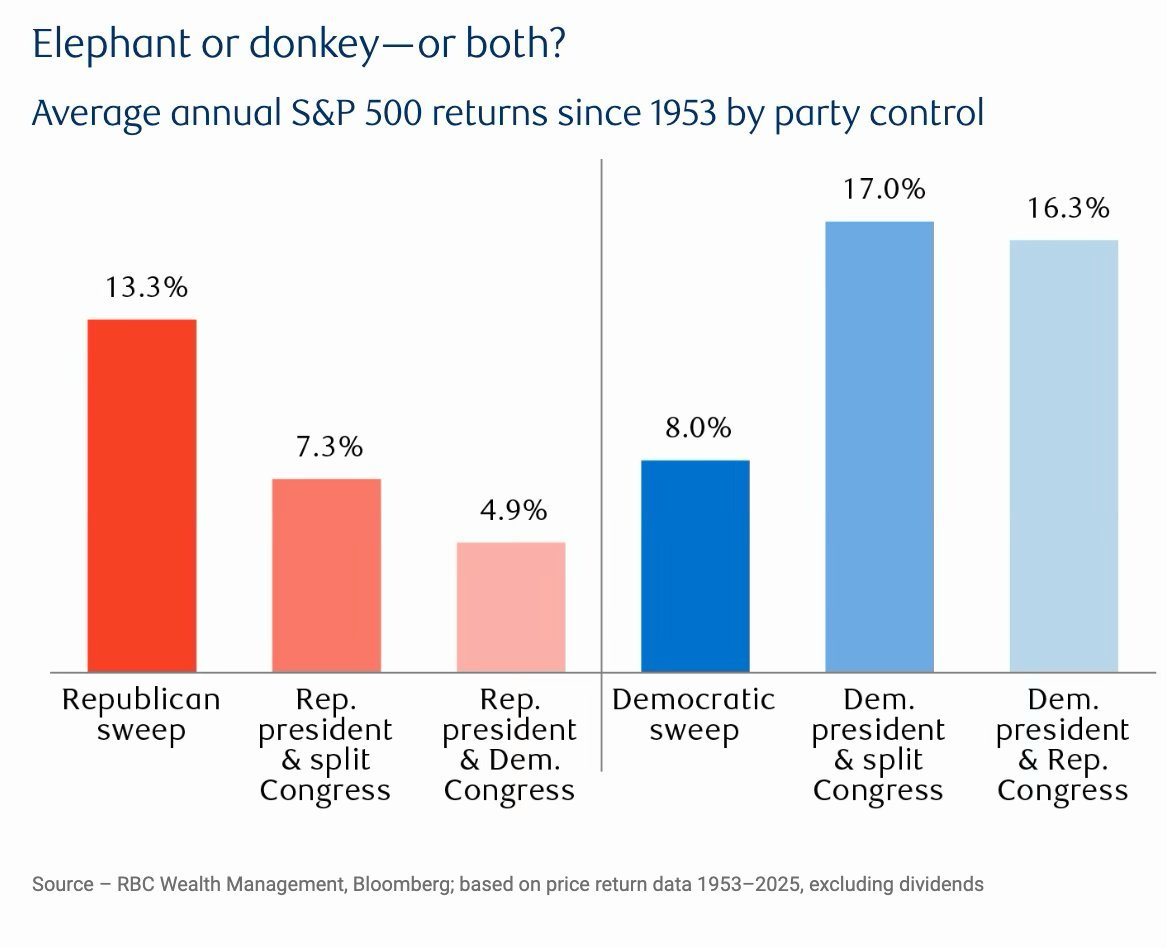
Even under the “worst” potential scenario — a Republican in the White House and Democrats running both houses of Congress — average annual returns were positive.
In addition, we’ll remind you of what JC Parets said in this space last month: We’re in the early stages of the best seven-month stretch for stocks during the four-year presidential cycle. It starts the month before the midterm elections… and continues through the following April.
Following up on yesterday’s chronicle of the data center backlash… there’s a potential upside for certain AI stocks even if the midterms result in new limits on data centers.
In a pre-election dispatch yesterday, Paradigm AI authority James Altucher acknowledged the potential for “higher costs, longer delays and tighter profit margins.
“But it also makes the race to build cheaper, faster and more efficient AI infrastructure that much more important.”
James identified five companies in the Altucher’s Investment Network portfolio that stand to benefit no matter what. That’s because they supply what Nvidia needs to make its pricey and sophisticated GPU chips. They also supply what Google needs for its up-and-coming competitor chips called TPUs.
OK maybe the tech sell-off will take a breather today.
Of course, that’s what it looked like at this time yesterday… but the Nasdaq Composite ended the day with another 1.1% loss.
Checking our screens today, the Nasdaq is up more than three-quarters of a percent to 25,365 — not great when you consider the index first crested that level six months ago. The S&P 500 is up a more modest 0.4% while the Dow is in the red.
The green in two of the three major indexes comes despite another disappointing earnings report from a Magnificent 7 company: Apple delivered respectable numbers for the quarter gone by… but it warned for the current quarter that its profit margin is likely to keep shrinking. That’s because rising memory costs are running ahead of the price increases Apple can slap on its signature products.
As such, AAPL is down 2% as we write.
Gold continues to hold the line on $3,900 but silver has sunk back below $50. U.S. oil futures remain below $96 despite U.S. bombing of an Iranian island.
Bitcoin remains mired below $78,000, Ethereum below $2,300. Crypto continues reeling after the Binance hack. On the other hand, when the FTX exchange collapsed at this time four years ago, it marked a major bottom for crypto. Just saying…
 Supply Chain Alert
Incoming supply-chain snags?Don’t look now, but a West Coast dockworker strike could be underway by Thursday.
Workers represented by two unions at the ports of Los Angeles and Long Beach have been working without a contract since the summer of last year. They were set to go on strike Sunday — but the unions agreed to hold off on a walkout for a few more days while talks continue.
Only about 2% of the unionized workforce is affected… but the unions say those workers handle 85% of cargo moving through the Port of Long Beach and 33% at the Port of Los Angeles.
“The union members earn an average of $170,000 a year. The sides hasn’t disclosed exact issues in the negotiations,” says a report from the trade site FreightWaves. “The watchmen’s negotiations are separate from the broader West Coast longshore labor agreement, which runs through 2028 and covers approximately 22,000 workers at 29 ports.”
As you might recall from previous coverage here, the threat of an East Coast/Gulf Coast dockworker strike loomed over the 2024 presidential campaign. Labor and management ultimately came to terms shortly before Donald Trump took office — after Trump weighed in on labor’s side in a dispute over automation.
 Flying Cars Taking off (The Stocks, Not So Much)
Last week, an experimental airplane landed at a Lower Manhattan heliport designed for helicopters. It needed just 100 feet to land and take off.
That accomplishment has implications reaching well past the landing zone.
Privately held Electra's fixed-wing aircraft uses eight propellers to force air across its wings, generating enough lift for extremely short takeoffs and landings. The company says its Ultra Short technology will eventually let passenger-carrying planes take off and land in just 150 feet — about half the length of a football field.
Electra calls the idea “Direct Aviation”: flying from locations near where people live and work to bypass long airport drives and crowded terminals.
Paradigm contributor Davis Wilson sees a similar opportunity in publicly traded companies. Joby Aviation (JOBY), Archer Aviation (ACHR) and Eve Holding (EVEX) are developing electric vertical takeoff and landing (eVTOL) aircraft that rise like helicopters before transitioning to forward flight.
They’re making real progress: On Friday, Joby began a week of demonstration flights in Florida under a federal pilot program.
 A new presence in the skies [Joby Aviation photo posted on X]
A day earlier, Archer announced a partnership with Italy’s ITA Airways to explore air taxi service. Archer estimates its aircraft could fly from Rome's main airport to downtown in less than 10 minutes, compared with an hour by car.
Yet all three stocks have lost more than 60% over the past year. JOBY is down about 70%, ACHR 62%, and EVEX 64%.
To be sure, these companies still have a long way to go. Electra isn’t targeting commercial service with its nine-passenger aircraft until 2030. Joby and Archer together burned roughly $330 million in operating cash in the second quarter.
But the potential for a revival in share prices is ever-present. As Davis puts it, “We just need people to start paying attention again.”
FAA certification, the first commercial routes and the first paying passengers could do it. Because right now, expectations are so low that any significant milestone could revive enthusiasm.
 Mailbag: Prepping
Adam Sharp’s guest edition on Saturday — originally published last week at The Daily Reckoning — brought a torrent of additional reader suggestions to brace for emergencies.
“An outdoor grill or stove is an important addition,” says one. “You can use propane as a fuel source.”
“We have a household generator,” says a second. “Obvious use for the refrigerator but also important if you are on a private well. We also have another generator in our motorhome that can be used as well if needed.”
“Don’t forget medications, both prescriptions and over-the-counter,” advises an MD.
“The under-the-sink water filter is a good idea till the power goes out and then you don’t have any running water,” cautions still another reader. “Best to have one of those water filter straws. You can drink out of a creek. It purifies the water as you need it. Anyway, the rest of that stuff all look pretty good.”
One of our newer readers submits our most comprehensive entry…
“A generator that is powerful enough to be able to power two to four major appliances (depending on the size of your home/household) along with at least two or three propane tanks (16-plus hours coverage) are good to have in any climate that gets severe weather in winter so you are prepared for basic power outages as well as any electrical grid concerns.
“Heavy-duty power extension cords for the generator long enough to reach from outside your house where the generator will be to whatever is needing the power plus a power strip for plugging them all into a single generator.
“For people with any health limitations: Any personal hygiene or medical care items that you need specific brands of or can't afford to go without if a panic would cause a sellout in stores of the item (e.g., I have very sensitive eyes, so I need a certain brand of contact lens solution; and I am allergic to regular sodium fluoride toothpaste, so I have to buy a particular brand of stannous fluoride toothpaste).”
Dave responds: Thanks to everyone for their input. I won’t dwell on things here, just hit a handful of highlights…
- Water will always be problematic just because it’s so doggone bulky and heavy. I keep a LifeStraw in my everyday carry backpack. And at home a Berkey-type unit is a workaround for no electricity
- Starting in 2022, I’ve recommended now and then that you keep a wad of cash on hand, keep your vehicles topped up (never below a half tank) and keep your battery-powered devices charged. Even in a short-term power outage, no electricity means no credit/debit cards and no electricity to the gas pumps
- Also starting in 2022, I’ve passed along warnings from the North American Electric Reliability Corporation about the potential for rolling blackouts in the event of severe summer heat or severe winter cold. It was that year I got a generator for essential loads; I had an electrician install a transfer switch and breaker interlock. If you go this route — it’s cheaper than the Generac “whole house” thing — test your backup system at least three times a year so you’ll know what to do step-by-step once the lights go out for real. (I did my most recent drill last weekend because I had to change the clocks on the microwave, coffeemaker, etc. anyway.)
Point of all this being, the power grid was already under stress before AI data centers began to proliferate…


