
You Think Inflation’s Bad Now?
 You Think Inflation’s Bad Now?
 Inflation “is about to get much worse,” Paradigm’s Jim Rickards warned his Situation Report readers on Monday.
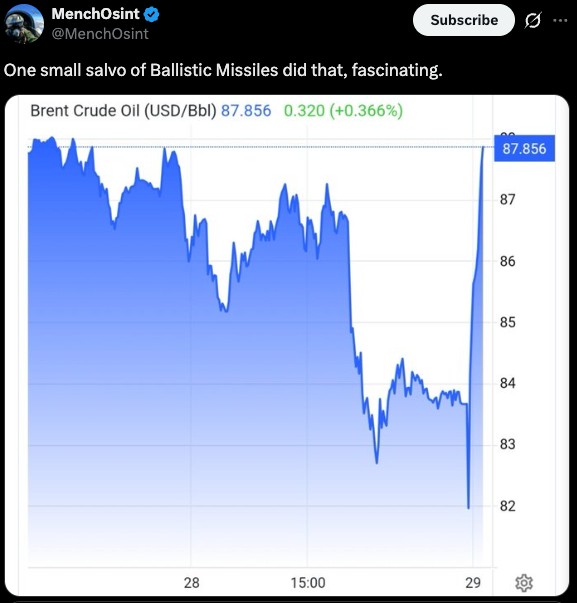
And that was before the Iran war got cranked up again last night — sending oil futures shooting higher again.
Yesterday Israeli prime minister Benjamin Netanyahu was in Washington — his eighth visit to the United States in the last 18 months, just in case you’re keeping score. After meeting with Donald Trump, Netanyahu pronounced it “one of the best conversations” they’ve ever had.
Evidently Iranian leadership figured another U.S. attack was coming, so they should act preemptively for once. They lobbed a few missiles at a U.S. base in Jordan, to limited effect.
Or maybe Iranian leadership knew the Federal Reserve was making a decision on interest rates today and wanted to jack up the oil price to make the Fed lean in the direction of raising rates.
You know, just to mess with Trump. At this rate, why wouldn’t they?
This morning on Fox News, Trump went on a foul-mouthed harangue — promising to deliver a “beating” to Iran. Which the Iranian side is surely prepared for and might even welcome.
Amid that backdrop, U.S. oil futures are up nearly 7% at $84.63.
Lost in the war-is-off, war-is-on-again headlines is the fact the Strait of Hormuz remains closed to anyone who lacks Tehran’s permission.
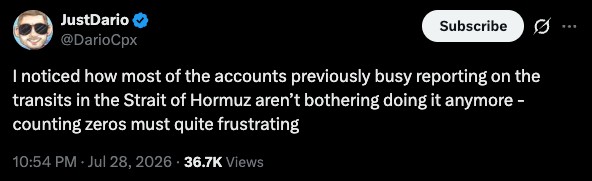
“This closure affects not only oil and liquefied natural gas (LNG),” says Jim Rickards — “but also urea, nitrates and sulfur, all of which are critical inputs for fertilizer. Helium exports are also affected, and helium is essential to semiconductor manufacturing.
“The only reason the global economy has not already partially shut down is because prewar stockpiles helped cushion the disruption. Those inventories are now being depleted, and the world is moving dangerously close to a global recession.”
Which brings us to the Energy Department’s weekly inventory figures — which come out every Wednesday.
Private-sector reserves fell by 3.7 million barrels last week — the biggest drawdown in six weeks. The big terminal at Cushing, Oklahoma remains at “tank bottoms” — which means that with any further drawdowns, there won’t be enough pressure to move the oil into pipelines.
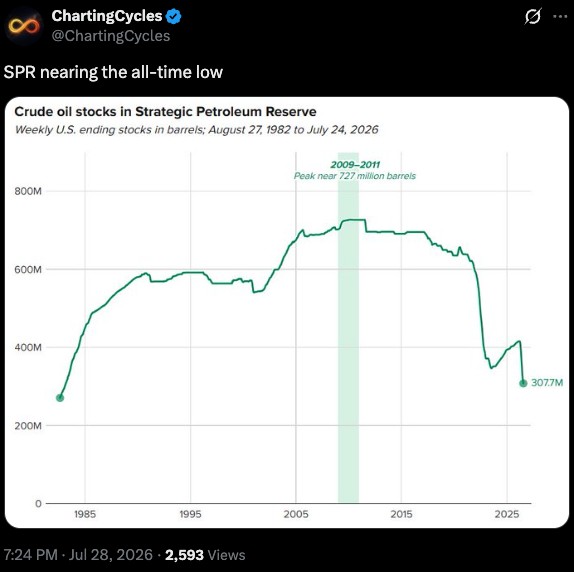
Meanwhile, another 3.7 million barrels was drained from the government’s Strategic Petroleum Reserve. We’re at still another lowest-since-1983 level.
“The ripple effects from the closure of the strait are only beginning,” Jim Rickards continues.
“Global shipping is itself a supply chain, involving shipowners, charterers, captains and crews, insurers, logistics hubs and sovereign navies. When a vessel is stranded in the Persian Gulf, it cannot be somewhere else loading new cargo.
“Goods will begin piling up in Shanghai because container ships cannot complete their normal rotations. The costs of those delays, known as demurrage, are eventually added to the price of whatever goods consumers ultimately buy.”
According to AAA, the national average gas price today is $4.09 — up meaningfully from $3.86 a month ago.
“The price of gasoline is literally in your face every time you fill your tank,” Jim says. “But diesel may be even more important because nearly everything you buy, whether in a store or online, arrives by truck. Trucks run on diesel. Those higher transportation costs eventually work their way into the price of almost everything you purchase.
“Price increases move from crude oil to refined fuels to paper towels and soap in the blink of an eye. That process is still in its early stages because this war is nowhere near an end.”
And don’t forget about fertilizer.
“One-third of globally traded urea, a key fertilizer input, and one-half of seaborne sulfur, another critical ingredient in phosphate fertilizers, passes through the Strait of Hormuz,” Jim tells us.
“Those supplies are now effectively cut off from world trade. Fertilizer prices at the New Orleans hub, a major import location, have risen from $516 per metric ton before the war to $683 today.
“Russia and Southeast Asia have some nitrate supplies, but moving them is not as easy as placing a phone call. The logistics chains involve railroads, ports, vessels and unloading capacity at their destinations. All of that must be reconfigured on short notice from existing supply routes.
“These disruptions take months to sort out, and suppliers may hesitate because they’ll insist on long-term contracts rather than one-time sales. Given those logistical hurdles, higher prices are inevitable.”
And that’s for those of us lucky enough to live in the developed world. In the Global South, “we could be looking at mass starvation on a scale not seen since Bangladesh in the 1970s or China during the Great Leap Forward.”
If you’re a Rickards reader, hold on to the energy recommendations from Jim and his team. If you’re not a Rickards reader, you can offset your rising cost of living with an ETF like the State Street Energy Select Sector SPDR ETF (XLE).
[Dave’s disclosure: XLE is a long-term hold in my portfolio.]
 Markets Today: Odd Behavior
The stock market is not behaving the way it usually does on a day like this.
Usually the major indexes tread water ahead of a Federal Reserve policy announcement — and ahead of major earnings announcements. Both are coming our way this afternoon.
By the time you read this, the Fed will have announced that it’s leaving the benchmark fed funds rate steady at 3.75%. The potential drama lies in whatever Fed chair Kevin Warsh says during his post-announcement press conference, only the second of his term.
Then after the close, two of the big AI “hyperscalers” report their quarterly numbers — Microsoft and Meta. Wall Street gave a hostile reception last week to Google’s plans to continue stepping up its capital spending on data centers and other AI infrastructure — even if that spending does benefit other AI players like the chip and memory suppliers.
For whatever reason, Mr. Market is mashing the sell button ahead of these events.
The S&P 500 is holding up best among the major U.S. indexes — but it’s still down over 1% and below 7,400 for the first time in a month.
The Nasdaq is down nearly 1.5% and well below the 25,000 mark now. And the Dow is down 1.75%, back below 52,000.
Amid the sell-off, Paradigm readers are still booking winners: Alan Knuckman urged his Weekly Wealth Alert readers to take 100% gains this morning on Ford call options. Meanwhile yesterday Ray Blanco recommended that Catalyst Trader readers take 143% gains on the biotech name Axsome Therapeutics.
Precious metals are likewise selling off with gold about to lose its grip on $4,000. But silver is fairly steady, a hair under $57.
Not much to say about crypto — Bitcoin just over $64,000 and Ethereum just under $1,900.
We now have a clearer picture of the downdraft that might be headed the stock market’s way for the next couple months.
Bespoke Investment Group has updated its fascinating chart comparing the Nasdaq Composite’s performance during the 1990s dot-com boom and the 2020s AI boom.
It sets the starting point of the dot-com boom with the launch of the Netscape web browser in December 1994. And it sets the start of the current boom with the launch of ChatGPT 3.5 in November 2022.
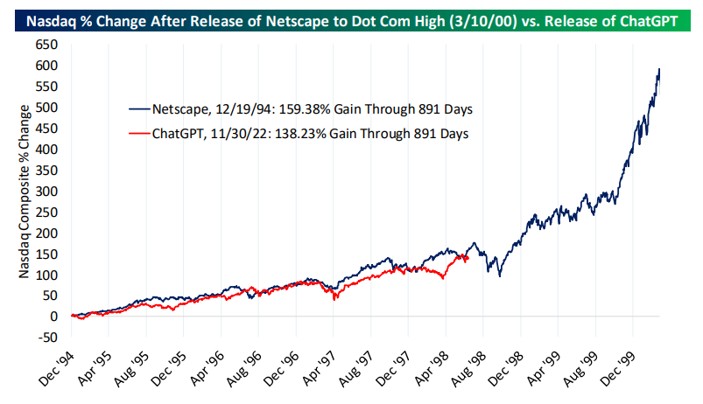
Note the substantial drop that might be just ahead of us if this analogue continues to hold.
In 1998 the drop was triggered by the Russian government defaulting on its debt. A U.S. hedge fund called Long Term Capital Management was sitting on complicated bets tied to Russian debt. And all of the big banks had a daisy-chain relationship with LTCM.
Jim Rickards — who was lead counsel for LTCM — says the crisis had the potential to bring down the global financial system. But Jim negotiated a rescue with the banks and the Federal Reserve — no taxpayers were harmed in this operation — and the market roared back later in the year.
That late-1998 recovery set the stage for the blowoff top in 1999 and early 2000.
Here in 2026, we still have late summer and early fall to get through. “We are going into the worst seasonal period of the year — August to October,” says Paradigm trading pro Enrique Abeyta.
And that’s not just 1998 — that’s the average performance going back nearly a century.
 Data Center Power Play
The nation’s biggest power-grid operator says when push comes to shove, everyday people and businesses will get priority over data centers.
PJM Interconnection serves 67 million customers in a region stretching from New Jersey to Illinois — including the biggest concentration of data centers in the world in northern Virginia.
On Monday, PJM warned the data center operators on its grid that starting next year they could face mandatory power outages to prevent other customers from experiencing blackouts.
“The present trajectory of rapid load growth, tightening supply and rising capacity costs is not sustainable,” said PJM chair Paula Conboy.
PJM plans to hold an emergency power auction in September — with data centers expected to shoulder the bulk of the rising costs.
The regular annual auction held this month was a bust. “Despite the high prices that are meant to incentivize the construction of new power plants,” says a Reuters dispatch, “PJM fell short by about 6.8 gigawatts of its reliability requirement to meet projected demand — a steeper shortfall than what resulted from the previous auction — which raises the risk of blackouts on the grid.”
“The decision arrives as the breakneck pace of data center construction has grid operators scrambling to generate power,” the Tech Crunch site reminds us. “By 2035, data centers are expected to use four times more electricity than they do today…
“The move will likely spur many new data centers — and potentially existing ones — to set up their own sources of on-site power. Those that don’t will probably rely on backup generators, which tend to be costlier to run…”
It’s been over two years since we first warned that AI was turning into “the monster that ate the power grid.” Last year, many Paradigm readers profited from the trend by playing independent power producers like Talen Energy. New profit opportunities were on the agenda today during the Paradigm team’s weekly conference call, so watch this space as well as your paid publication(s).
 Comic Relief
This seems like an amenable way to wind down our recent socialism discussion…

 Mailbag: When Editors Disagree
I’d planned a mailbag focused on the data center backlash today, but a reader’s query takes precedence.
He writes in light of Mason Sexton’s warnings that the current bull market might come to an end this week.
“This may not be proper to ask James Altucher and Jim Rickards about, but would they please comment on Mason’s predictions? Are they selling a lot of their stocks soon or just riding the market out?
“We have paid James and Jim a lot of money and I believe the members would like to know what they think about Mason’s predictions.”
Dave responds: I sent your inquiry to our executive concierge Dustin Weisbecker for follow-up. But let me address the question in a general way, for you and everyone else.
You should know up front that we don’t enforce a “company line” among our team.
The last thing we want is for our editors to censor or second-guess themselves. You’ve paid good money for your subscription(s) and you deserve the editors’ unvarnished, no-holds-barred opinions.
On those occasions when their opinions diverge, we respect your intelligence enough to weigh those opinions and come to your own conclusions. (Presumably if you subscribe to both Rickards and Altucher publications, you’ve done exactly that when it comes to gold and Bitcoin.)
Good editors are few and far between, but we attract them like moths to a flame — for good reason.
A typical denizen of Wall Street is always answering to someone — clients, advertisers, the board of directors. When he's not looking over his own back, he's kissing someone else's backside. If he thinks the stock or other security his firm is flogging is junk, he has to hold his tongue.
All those problems go away if he comes to work for us: He's beholden to no one. He can speak his mind. He can live where he likes — the beach, the mountains, the small town where he grew up. Subscription revenue (from people just like you) is our industry's bread and butter, so as long as he speaks his truth and his truth resonates with his subscriber base, he's golden.
Whatever paid publications you have, stick with the guidance of the editor or editors as long as their ideas continue to ring true for you. Their research is thorough and well-considered. They wouldn’t be on our team if it weren’t.
And thanks for the opportunity to address the question once again. We have new readers all the time, and even old hands need a gentle reminder now and then…


