Socialism, Then and Now
 Socialism, Then and Now
 “Socialism is a failed economic theory,” Colorado’s Democratic Gov. Jared Polis said last night on Fox News. “I think it’s important to talk about the dangers of socialism.”
We’ll take up the governor on his challenge today.
Actually we took up the challenge years ago — a few weeks before the first votes were cast in the 2020 presidential primaries, in fact.
That’s because in late 2019 a poll showed 70% of millennials willing to vote for a socialist like Bernie Sanders — significant because 2019 was also the year demographers said millennials surpassed boomers as the largest living adult generation.
Your editor was concerned, but not panicked.
At the time, no one used the term “socialism” in its original sense — state ownership of the means of production. “Socialism” simply meant a system of “free” or heavily subsidized health care, higher education and so on.
Which wasn’t the worst thing in the world. In fact, research from JPMorgan Chase found that compared with the United States, the “socialist” Nordic countries had stronger protections of property rights and exerted less control over private enterprise.
But that was in 2019. Bernie Sanders is almost 85 now. The “socialist” torch has been picked up by a new — and evidently more militant — generation.
Perhaps its most famous member is New York’s mayor Zohran Mamdani — who’s 50 years Sanders’ junior.
In recent weeks, Paradigm’s macroeconomics maven Jim Rickards has been sounding the alarm with his readers about the advent of congressional candidates aligned, like Mamdani, with the Democratic Socialists of America.
In a handful of primaries this summer, DSA candidates have knocked off center-left incumbents in safely Democratic districts. One of those victories came in Denver — hence the concern on the part of Colorado’s Gov. Polis.
Once sworn in next January, they’ll combine forces with the so-called “Squad” led by Rep. Alexandria Ocasio-Cortez (D-New York) to comprise a faction of about a dozen members who could make or break major legislation.
To hear Jim tell it, this generation is much more radical and you wouldn’t be out of line to call them communist: “They give it away when they talk about ‘the means of production’ and ‘the abolition of private property.’ Those phrases are straight out of Karl Marx.
“They favor wealth taxes. That means after you pay income tax and invest the remainder, they want to tax the assets themselves, not just the income. Some people might have to sell their homes to raise the cash needed to pay the wealth tax on their portfolios.”
“Investors need to know what’s coming before the DSA knocks on your door and tries to move in,” Jim goes on.
In recent dispatches to Strategic Intelligence readers, Jim counsels residents of deep-blue states to consider moving elsewhere; as mentioned here last Saturday, a wealth tax is on the ballot in California this fall.
If that’s too extreme a step, he advises reducing exposure to stocks — because they’re a target for wealth taxes — and increasing exposure to cash and physical gold. “Gold can preserve value and is difficult to trace. There is no government reporting requirement for privately held physical gold.”
And there’s another step to consider, one that could make the most difference — “strategic empathy” for younger voters answering the siren song of socialism.
“Strategic empathy” is the term coined by an anonymous account on X called “Election Wizard,” which is affiliated with the predictions market Kalshi.
It simply means you’ve got to understand where younger people are coming from if you’re going to have a prayer of persuading them to see things a different way.
“Millennials got hit at two critical moments,” Election Wizard writes. “Many entered the workforce during the 2008 financial crisis, when jobs were scarce, wages were weak and a lot of them were already carrying student debt. Then, just as many were finally building some wealth, COVID-era inflation hammered their purchasing power.”
[Which is why they were piling into meme stocks in early 2021, by the way…]
Gen Z didn’t have an adult experience of 2008… but many of them entered the workforce during the pandemic, and likewise feel as if they can’t get ahead.
Furthermore, Election Wizard reminds us that millennials and Gen Z have little conception of what communism is all about.
“They didn’t live through the Cold War, the Berlin Wall or the Soviet Union. And given the state of American education, you can’t assume they were ever seriously taught about the mass murder, repression, famine, gulags and human misery communist regimes produced.”
Election Wizard says these generations are absolutely persuadable: “In 2024, younger voters moved sharply to the right, while voters 65 and older shifted slightly toward Harris. Millennials and Gen Z do not belong to the left. They are now a large and powerful voting bloc, politically restless, economically frustrated and looking for someone who seems serious about ripping out what they think is broken.”
And if Republicans don’t deliver policies that give them a chance to better their circumstances?
Well, then, “a charismatic radical like NYC Mayor Mamdani will take their anger, give it a target and turn it into power.”
OK, your turn: How concerned are you about the socialist wave? And what, if anything, are you doing about it? (“Vote harder” is not an answer, heh.) Write here — feedback@paradigmpressroom.com — and we’ll share your feedback either tomorrow or Monday.
 Tech Tanks
Gee, what should we tackle first as we turn our attention to the markets today? Soaring oil prices or tanking tech shares?
The tech sector is falling out of bed with Google parent Alphabet having delivered its quarterly numbers after the closing bell yesterday.
The revenue and earnings numbers were great. But Mr. Market is deeply concerned about the accelerating pace at which GOOG is investing in AI infrastructure such as data centers.
“For the full year 2026,” says Paradigm trading pro Enrique Abeyta, “they raised spending by almost 10% and said 2027 will ‘increase significantly.’
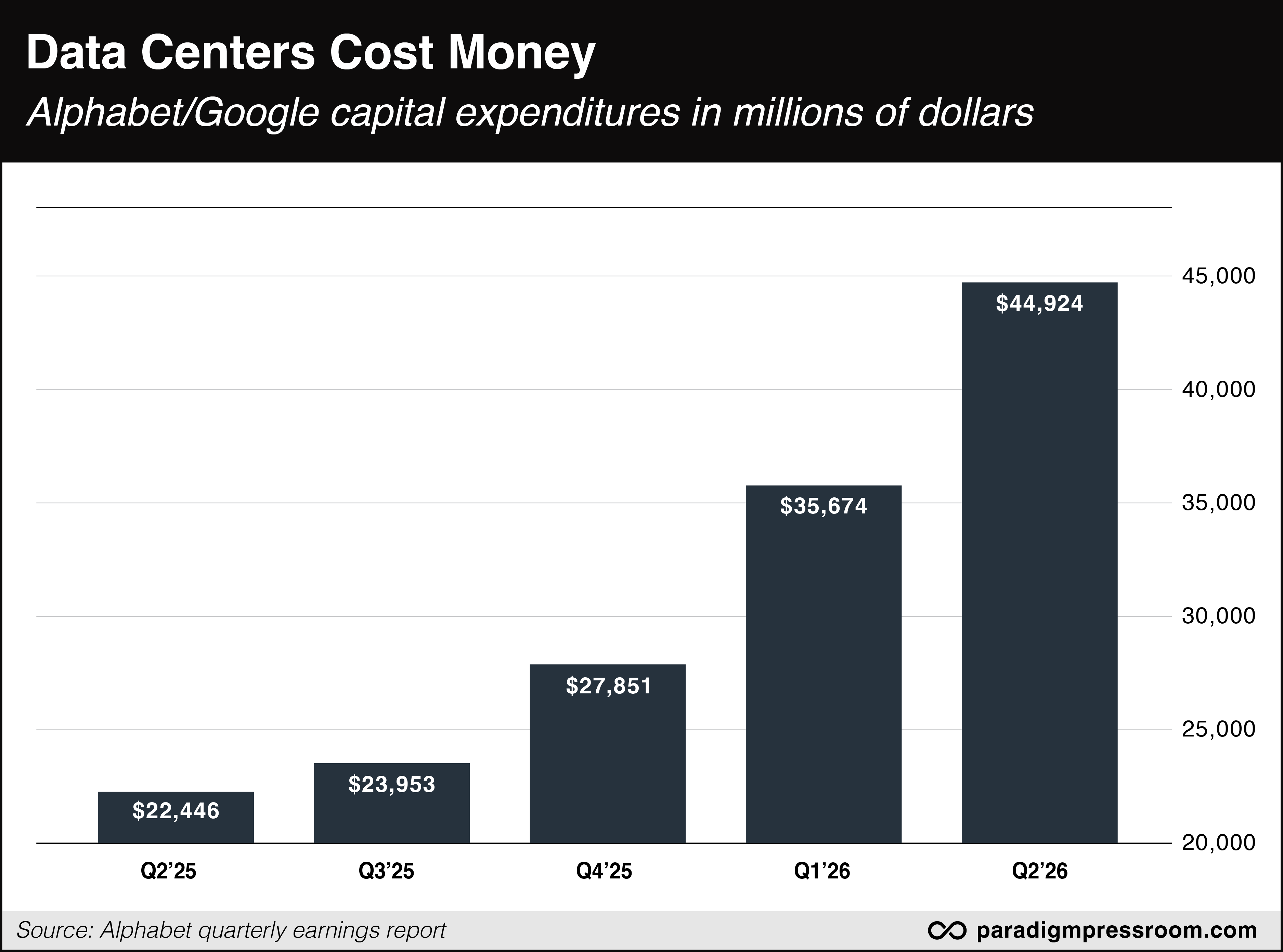
Result: GOOG’s free cash flow — the money left over after meeting both operating and capital expenses — has now gone negative for the first time in over a decade.
Time was that these Big Tech companies had money to burn. No more…
So what does it all mean? “At some point these companies are going to have to rein back the spending,” Enrique says — “but it doesn't look like that is today!”
Indeed, “this AI buildout isn’t stopping,” affirms Davis Wilson of our sister e-letter The Million Mission.
It’s bad news for GOOG today — down 7% as we write. It’s also bad for the other “hyperscalers” staring up the same intimidating capex cliff. Microsoft is down 3%, Oracle 4.5%, Meta 4.75% and Amazon 5%.
But… looking ahead a few weeks and months, Enrique says all that spending will benefit semiconductors and other AI infrastructure plays. Sure enough, the Philadelphia Semiconductor Index is holding up fairly well under the circumstances — down 1.5% on the day.
Overall, however, it’s a miserable day for the major U.S. indexes — especially the tech-heavy Nasdaq.
Checking our screens the Nasdaq is down 2.6% and in danger of cracking below 25,000 for the first time since the end of April.
GOOG wasn’t the only “Magnificent 7” name to report its numbers yesterday. So did Tesla — whose earnings fell short of Wall Street’s expectations. TSLA is down nearly 13% on the day.
The S&P 500 is holding up a little better — down 1.4%. But it’s broken below 7,400 for the first time in nearly a month.
The Dow is holding up best, down 1% but well beneath 52,000 now.
 Another Oil Chokepoint
U.S. oil futures are up nearly 6% to a six-week high now that both of the major “chokepoints” for Middle East oil shipping are snarled up.
By now you’re familiar with the Strait of Hormuz — through which traffic is still barely 10% of prewar levels. And that’s on a good day.
But as we anticipated last week, traffic is now severely curtailed through the Bab al-Mandab — at the south end of the Red Sea.
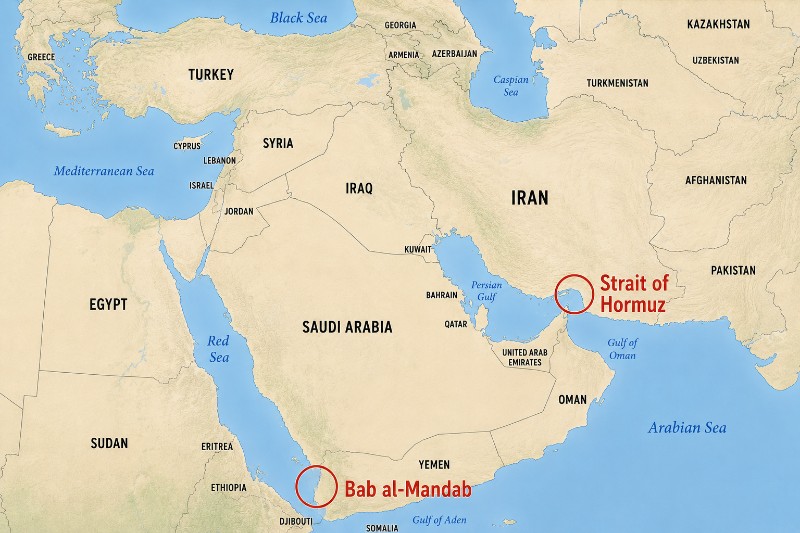
Fighting flared up last week between Saudi Arabia and Yemen’s Houthi faction for the first time since 2022.
Overnight, the conflict turned into another front in the broader Middle East crisis — as the Houthis (loosely aligned with Iran) fired missiles and drones on two Saudi Arabian oil tankers in the Red Sea.
This is problematic in the extreme for Saudi Arabia. While the Strait of Hormuz has been closed, the kingdom has kept oil flowing to the rest of the world via a pipeline stretching westward to the Red Sea, where it’s loaded onto tankers.
But if that oil can’t move south through the Bab, it has to instead move north through the Suez Canal… and then all the way around Africa to its Asian destinations, which adds 40-plus days to the trip. Worse, the largest tankers are too big for Suez — which means the crude has to be transferred to smaller vessels and then back onto larger ones.
Still… not all Saudi Arabian crude is stymied. We’re seeing credible reports that vessels bound for China are still allowed to get through. Funny how that works.
What a mess. Little wonder U.S. oil futures are back over $92. And Brent futures — the global benchmark — are over $100.
Once more, rising oil prices are feeding rising inflation expectations… and thus rising interest rates.
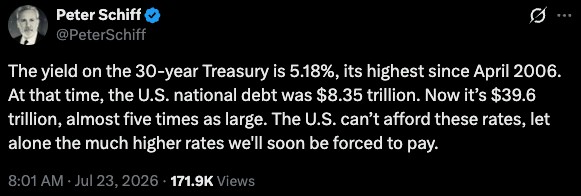
The yield on a 10-year U.S. Treasury note punched through 4.7% today — the first time that’s happened since January 2025. And the 30-year bond? Hoo boy…
But rising rates feed through to lower precious metals prices. All of yesterday’s gold gains have been vaporized, and then some — the bid back to $4,048. And silver’s down two bucks to $57.60.
Crypto is likewise giving up much of its gains the last 24 hours — Bitcoin back under $65,000 and Ethereum below $1,900.
 Follow-Ups: Truth Social Pay-for-Play, DOGE Scam
OK, it appears Wall Street lawyers have caught on to the problem we spotlighted Monday with a new scheme surrounding Donald Trump’s Truth Social platform.
As we mentioned at the time, Trump Media (DJT) wants to charge banks and hedge funds for early access to posts by the president as well as Donald Jr. and other major names on Truth Social.
On CNN, some reporter dweeb said the scheme was legal because other social media firms like X and Meta do the same thing.
Whelp, maybe it’s not so legal after all.
The Financial Times interviewed a couple of law professors who raised red flags similar to the ones yours truly raised here on Monday.
“If I were the general counsel of any of these institutional investors I would say, ‘Don’t even touch this unless Truth Social will guarantee there will be no advance notice of any posts that contain information about the actions of the United States government,’” says Richard Painter, a corporate law prof at Minnesota and an ethics adviser to the Bush 43 administration.
Trump and other administration officials “have no business commercializing information that they generate in their official positions,” adds Duke’s James Cox.
And yet… Wall Street firms might still choose to bite. “His tweets move markets so we all need to pay up,” an anonymous hedge fund exec tells the FT — although he adds “it’s so bad that nothing surprises me in that sense anymore.”
File that one under “Don’t hate the players, hate the game.”
Meanwhile, you can’t make this stuff up: Some of the DOGE boys who were hired to reduce government spending are now pursuing government contracts.
You remember DOGE, right? The effort spearheaded by Elon Musk to slash federal spending by $2 trillion a year? Musk commissioned young ambitious tech bros to sift through the government’s books in search of savings.
The original $2 trillion goal then became $1 trillion. And then $150 billion. And in the end, about $9 billion or 0.1% of the federal budget. DOGE formally ceased to exist by November 2025.
But now the Reuters newswire, citing three anonymous sources, reports that “a team of former DOGE employees have raised a major funding round for a startup that aims to use AI to expand U.S. military cyber capabilities…
“The startup, called Cathedral, was launched in recent months with a plan to secure U.S. government contracts… As part of the plan the company is looking to acquire a data center, or partner with a data center provider that can provide dedicated compute power to the cyber operations.”
Potential valuation of the company — $1.4 billion.
It’s at this moment we invoke the author Charles Goyette’s lament way back in 2009: “America’s national government has moved way beyond a political spoils system. America has become a piñata: Everybody gets a crack at it. Presidents and other elected officials pass the big stick around as a reward to those who help keep them in charge of the piñata party.”
 Comic Relief
We wind up today’s edition in more or less the same place where we started…