
[UPDATE] Buffett’s Sudden About-Face
 [UPDATE] Buffett’s Sudden About-Face
 Some people refused to believe it.
We kicked off our June 23 edition with a bold proposition by Paradigm AI authority James Altucher: Berkshire Hathaway’s $10 billion commitment to Google came at the behest of Warren Buffett.
Was it out of character for Buffett? On the surface, absolutely. Buffett invests in tangible things he can readily understand. Insurance, soft drinks, railroads. “Technology” was never his bag; even his investment in Apple stemmed from the fact AAPL is a consumer-product powerhouse.
And besides, didn’t Buffett step down as CEO at the end of last year? Also true.
But none of that mattered, said James.
James said as Buffett sees it, Google parent Alphabet is no longer a “technology” company. Nowadays it’s all about “data centers, power grids, cooling systems. The kind of capital-intensive, durable infrastructure Buffett has always understood.”
Furthermore, “Buffett remains chairman and the largest shareholder. A man who spent six decades watching technology booms from the sidelines doesn't sign off on something like this because a new CEO asked nicely.”
A skeptical reader wasn’t having it: “Really hard to believe that Warren is buying AI,” he wrote. “In the past Warren has never bought stocks at their highs.”
But here’s the man himself…
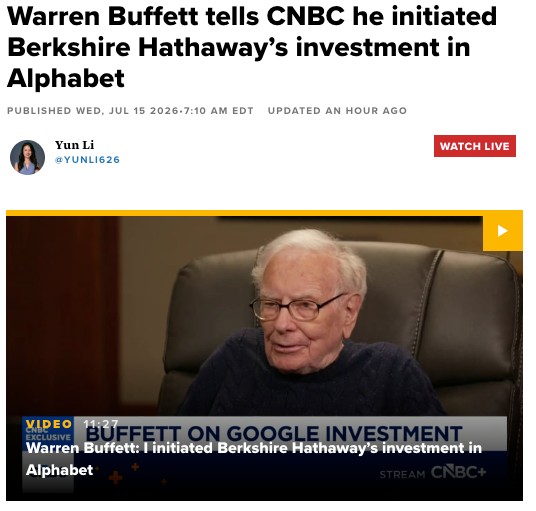
“I initiated it,” Buffett said in a CNBC interview this morning — not his successor Greg Abel.
“I am not doing anything that he doesn’t approve of. He’s not doing anything I don’t approve of. We talk all the time, but he is the decider,” Buffett clarified.
Buffett said Google meets all his traditional tests. “The trick in life is to find — I mean investing — is to find businesses that are going to earn high returns on capital for an extended period of time.”
The commitment now is even more notable in light of the regret he expressed way back in 2018 about not investing in Google sooner.
“When it comes to finding some of the biggest winners in the stock market — think Google, Microsoft and Nvidia — one standout feature they share is their absolute dominance in their given sector,” James Altucher says.
“All of these companies developed a technology so powerful that it set them far apart from their competitors, making them virtual monopolies.”
And as far as Warren Buffett is concerned, Google’s still got it — 28 years after it was formed and 22 years after it went public.
 How Long Is Forever?
The mainstream is worrying about the wrong thing when it comes to the Iran war.
“Analysts Warn Conflict Risks Becoming ‘Forever War,’” says a CNBC headline.
The article quotes a Andreas Böhm, a lecturer in international affairs at Switzerland’s University of St Gallen, who anticipates a years-long conflict — “a long-time low-level conflict and therefore one of the forever wars Trump pledged to end. Each side will try to raise the costs for the respective other until it will become prohibitive.”
One problem with that line of thought, says Paradigm macro maven Jim Rickards: “The U.S. is running low on cruise missiles, Patriot interceptors, 155 mm artillery shells and other weapons and ammunition. The strain on key stockpiles has become increasingly serious.”
Part of the problem is Washington’s ongoing support for Ukraine in its conflict with Russia: “The Patriot systems supplied to Ukraine have been heavily used and several have reportedly been damaged, underscoring both the intensity of the war and the difficulty of replacing these highly sophisticated weapons. Production remains slow, and replenishing inventories will take years.
“Trump recently met with the CEOs of major defense contractors at the White House. According to reports, he berated them for not stepping up weapons production. He seems not to realize that many production lines were shut down years ago, they take years to restart and many of these weapons are so technologically sophisticated they’re built in relatively small numbers rather than mass-produced.”
So as Jim sees it, a “forever” war isn’t even an alternative — the current escalation notwithstanding. “Trump may discover that sustaining a prolonged conflict is more difficult than ending one.”
For the moment, Mr. Market has once more consigned the war to background noise.
Within the last 24 hours Trump is back to threatening airstrikes on Iran’s bridges and power plants. If he follows through on those threats, Tehran will surely lay waste to the oil infrastructure in the Gulf sheikdoms.
Perhaps on the theory that Trump already knows this state of play, U.S. crude futures are little changed from yesterday’s close at $79.26.
It being Wednesday, the Energy Department has issued its weekly inventory figures. They show another 3 million barrels of crude drained from the government’s Strategic Petroleum Reserve — plus 1.7 million barrels drained from private-sector reserves. And those figures cover the week ended last Friday — when there was at least a shred of hope the ceasefire might hold and U.S. crude futures were still around $71.
Nor is there much movement today in the major U.S. stock indexes. They’re all down but by less than a fifth of a percent.
Shares of PayPal Holdings are up 16.2% on the news that the online payments firm Stripe is joining up with the private equity firm Advent International to submit a $53 billion bid to buy the company. 10X Trade Club editor Chris Cimorelli has been anticipating a buyout for a while. A month ago he recommended PYPL call options and this morning he recommended closing that trade for an eye-watering 1,782% gain.
Gold is down a bit but still holding the line on $4,000. Silver, however, is down two bucks to $56.59, retesting its late-June lows.
Bitcoin is knocking on the door of $65,000 and Ethereum has surpassed $1,900.
The big economic number of the day is wholesale inflation — down 0.3% in June thanks in large part to the pause in the Iran war and the resulting drop in energy prices. Still, the year-over-year increase is a blistering 5.5%.
Milestone: Small Nuclear Reactors
 Milestone: Small Nuclear Reactors
With little fanfare, the U.S. government met a nuclear-energy goal in time for a July 4 deadline.
We mentioned the effort briefly back in February — when the U.S. military airlifted a miniature nuclear reactor to an Air Force base in Utah.
The privately held Valar Atomics is one of the companies hoping to make hay with “small modular reactors” that can be built at their own factory and transported anywhere to produce electricity — in contrast with the 94 mega-reactors currently in operation around the United States. No taxpayer funds were involved in the stunt; Valar picked up the cost of the flight.
The Trump administration set a goal of getting three of these SMRs to go “critical” — running all their nuclear systems smoothly — in time for the nation’s 250th anniversary a few days ago.
That goal has been met — and a fourth reactor went critical shortly after Independence Day.
“The fact that they can do this and do this so quickly, it shows that the preconceived notions we’ve had about nuclear are no longer valid anymore,” the Department of Energy’s Michael Goff tells Politico.
But that doesn’t mean SMRs will go into widespread commercial use just yet. Like big conventional nuclear reactors, SMRs fall under the purview of the Nuclear Regulatory Commission. The NRC is notorious for stifling innovation in the industry.
And while there’s talk within the Trump administration about a path to faster NRC approval, even an enthusiast like Goff says putting SMRs into use for, say, a data center, will be “a matter of a few years.”
 Half-Baked Time Change
The good news: The U.S. House has voted 308-117 to do away with twice-a-year time change. But yes, there’s bad news…
… They’ve opted for year-round daylight saving time.
Every now and then in these virtual pages, your aging editor laments the insidious stressors of time change. We’ve regularly documented how it doesn’t save energy… but it does make for more workplace accidents, car crashes and heart attacks.
In 2020, the American Academy of Sleep Medicine, along with several other groups, published a position paper in the Journal of Clinical Sleep Medicine.
Its recommendation — year-round standard time, because that’s what would be “best aligned with human circadian biology and has the potential to produce beneficial effects for public health and safety.”
Besides, the nation previously experimented with year-round DST and everyone hated it.
After the Arab oil embargo of late 1973, Congress passed and President Nixon signed a measure imposing year-round DST. It took effect just as kids returned to school from their Christmas-New Year break in January 1974.
Even in the easternmost stretches of every time zone, where the sun rises earliest, they were going to school in the dark. This clipping from The Washington Post is easily found online…

Year-round DST was repealed just in time for the darkest months of the 1974–75 school year.
As for the present proposal, we’ll see what unfolds. Four years ago it was the Senate that passed year-round DST legislation — only for it to die on the vine in the other chamber.
 Mailbag: Generations, Goldman
After the provocative meme I shared at the conclusion of yesterday’s edition — something you could interpret more than one way — a thoughtful email rolled in.
“I’ll make my partisan position clear right off: Someone spent all their time making money when they should have devoted more time to teaching their kids to be adults. Kids need parents. Is this one of our greatest shortages today, or what?
“I speak from experience, having grown up in the ’50s and ’60s, when white-collar American families traded fathers in the home for good incomes, through the alluring miracle of commuting. The cultural upheavals that concluded the ’60s were one result.
“Things haven't gotten better, and are not on a path for self-correction anytime soon. We need to regain respect for our heavenly Father if we expect to have any idea what an earthly father should be like, and how he should operate.
“Good topic, Dave.”
Dave responds: Good points, dear reader. And everything you lament goes hand-in-hand with the corruption of the currency.
The end of the gold-linked dollar in 1971 — however tenuous the link was by that time — set in motion both the hollowing out of the middle class and the “financialization” of the economy.
You wanted to get ahead? You had to adopt the earning-and-burning lifestyle — which doesn’t allow much room for giving children the guidance they need.
“Oh, no, no,” objects a longtime reader after I casually labeled Goldman Sachs an “investment bank” yesterday, distinct from the likes of Chase and Citi.
“Goldman is a deposit-taking commercial banking institution, don'tcha know?... fully able to hit up the Fed''s discount window.
“Definitely not an investment bank. Absolutely not. No way. Think of them as a close cousin of Bailey Brothers Building and Loan and its officers as real-life Jimmy Stewarts.”
Dave: Heh. Of course I was well aware of the history when I wrote what I wrote yesterday.
Goldman infamously converted from an investment bank to a “commercial bank” during the 2008 financial crisis so it could get access to emergency loans from the Federal Reserve’s discount window. (Morgan Stanley did the same.)
The company did make a foray into online banking for the hoi polloi about a decade ago under the brand “Marcus.” But this segment of the business accounts for only a tiny fraction of GS’ revenue. Depending on how you parse the 10-K forms, it’s as little as 1%.
Still… for purposes of the next financial crisis… Goldman remains every bit as much a “commercial bank” as the First National Bank of East Podunk. And don’t you forget it!


