
Trump’s 10-Day Deadline
 Diminishing Returns
 Ummm… Cause and effect?
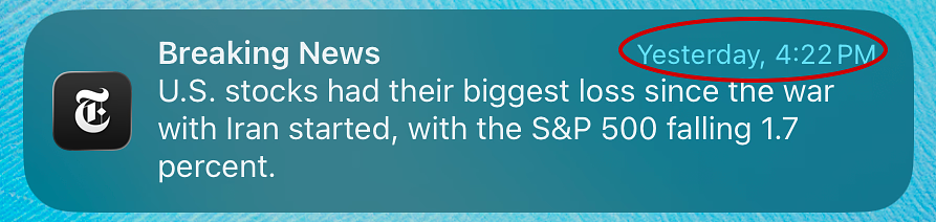
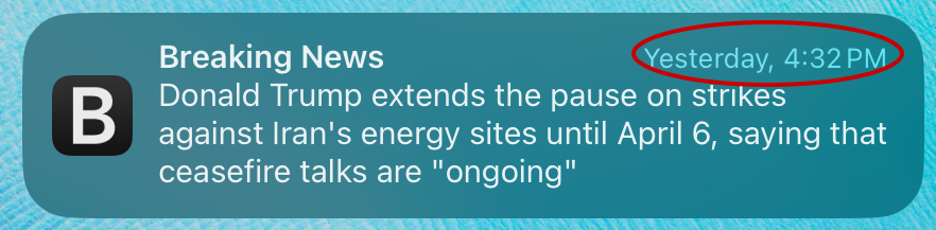
Shortly after the market closed yesterday afternoon, Donald Trump took to his Truth Social platform: “As per Iranian Government request, please let this statement serve to represent that I am pausing the period of Energy Plant Destruction by 10 Days to Monday, April 6, 2026, at 8 P.M., Eastern Time.” He said talks are “ongoing” and “going very well.”
So here’s a pithy summary of how the situation has evolved since Trump’s initial announcement last Saturday…
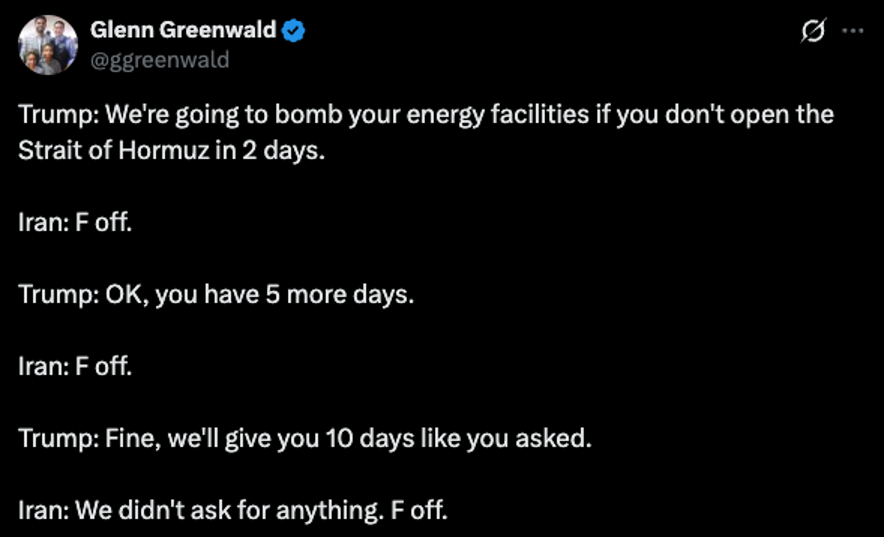
It’s been hard to keep up, no doubt. Recent days have brought a whole new meaning to the term “headline-driven market”…

We’ll get to today’s follow-on action in stocks momentarily. But what about oil?
If the president’s objective is to once more talk down the oil price, yesterday afternoon’s announcement didn’t work.
A wag on X going by the handle “professional hog groomer” put together the following chart of West Texas Intermediate this month, annotated with Trump Truth Social posts. (Click to enlarge…)
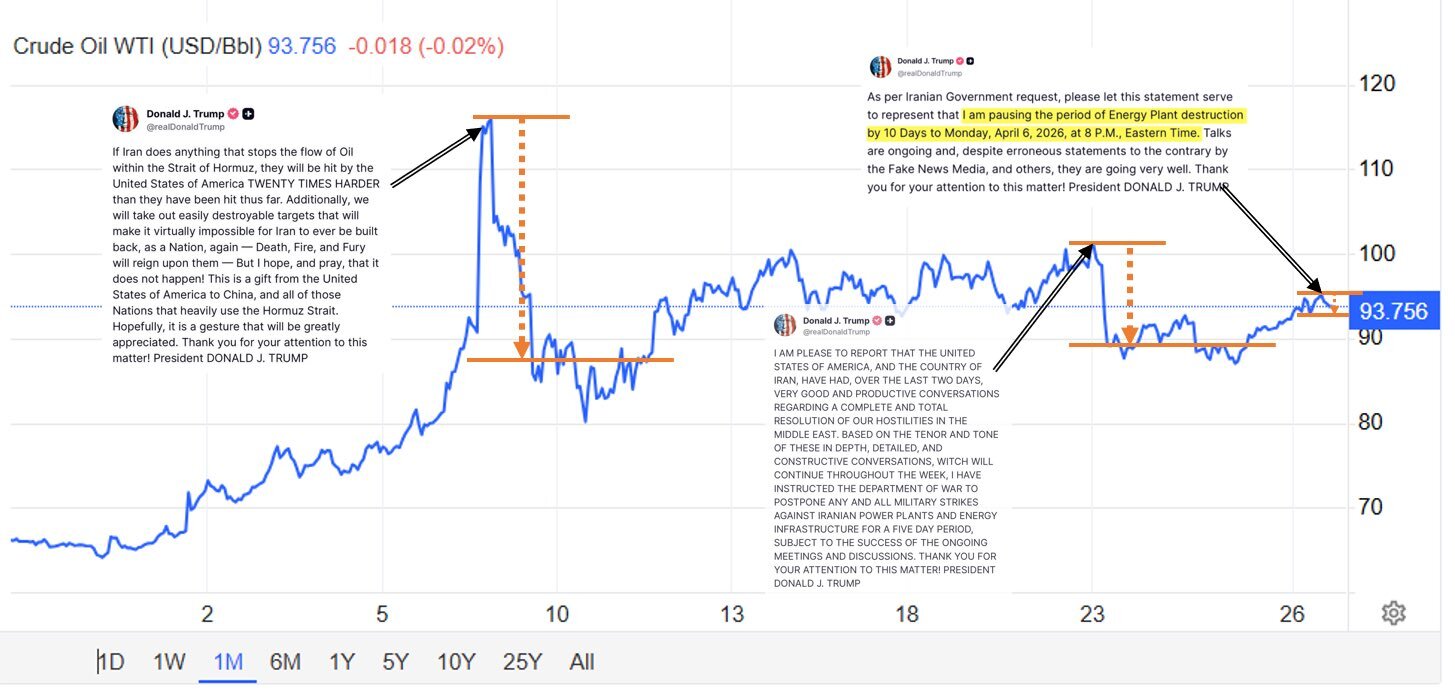
Diminishing returns, for sure.
Checking our screens, a barrel of West Texas Intermediate is up over three bucks on the day at $97.78 — the highest since the president’s post about “productive conversations” with Iran on Monday.
And while oil is rising, stocks are falling — again, presumably not the intended result.
Yesterday the S&P 500 cracked below the 6,500 level that had been a floor going back more than six months — closing at 6,477. At last check, it’s down another three-quarters of a percent to 6,426.
For the moment, the S&P and the Nasdaq Composite have avoided entering “correction” territory — a 10% drop from their most recent peak. Not so, however, for the more concentrated Nasdaq-100 and the Dow. And the small-cap Russell 2000 crossed that barrier a week ago.
Still… opportunity is there to be found. This morning, readers of The Situation Report booked 72% gains playing call options on the chemical firm Olin Corp. And Rickards’ Strategic Intelligence booked 30% gains on the energy name APA Corp.
The big economic number of the day is consumer sentiment from the University of Michigan. It sank big-time from 56.6 in February to 53.3 in March — a bigger drop than Wall Street economists were expecting.
Also not reacting the way the president would like — the bond market.
The financial corners of social media are chockablock with observations that each of Trump’s adjusted Iran deadlines coincided with the yield on a 10-year Treasury note rising to 4.4%.
But while the yield pulled back after Monday’s “productive conversations” announcement, that wasn’t the reaction this time. The yield popped to nearly 4.5% this morning — although it’s since pulled back to 4.4% on the nose.
In a welcome reversal for precious metals bulls, gold and silver are rallying strong to end the week.
Gold is up over $150 or 3.5% — back over $4,500. And silver has rallied over three bucks, nearly 5%, to back over $71.
Still, gold was at $5,200 four weeks ago today, just before the first U.S.-Israeli airstrikes.
“The declining price of gold and some gold sales by some central banks do not tell you much about gold,” says Paradigm’s macroeconomics authority Jim Rickards.
“What it says is that there is a global dollar shortage underway. The world needs dollars to pay for much higher priced energy and to cover losses and margin calls arising from the private credit crisis. In addition, stocks are declining sharply, which gives rise to margin calls for leveraged positions.
“In short, the whole world wants cash.
“When you want cash and you don't have it, you have to sell something to get it. The two most liquid assets are gold and Treasury notes and bills. You see gold being sold (lower gold prices) and Treasuries being sold (higher interest rates) to raise cash to cover the dollar shortage.
“There's hard evidence for this in the fact that bank dealers are increasing reverse repurchase agreements (meaning they're lending cash to needy borrowers in exchange for Treasury note collateral) and the TIC report, which shows foreign sovereign holdings of Treasuries in decline.
“Or, as Tom Cruise would say, ‘Show me the money!’
“This will get much worse, although I expect gold to find a bottom in the coming days.”
➢ Lest we overlook it, crypto is moving in the opposite direction from precious metals. Bitcoin is in danger of breaking below $66,000 for the first time in nearly a month. And Ethereum has cracked beneath $2,000.
 Other Notes From the War
The Washington Post is confirming something we first told you over two weeks ago.
“The U.S. military has fired more than 850 Tomahawk cruise missiles in four weeks of war with Iran, burning through the precision weapons at a rate that has alarmed some Pentagon officials and prompted internal discussions about how to make more available, said people familiar with the matter.”
Back on March 10, Jim Rickards warned in this space: “The U.S. and Israel are running low on offensive and defensive bombs and missiles.
“This is the result of the massive bombing attacks on Iran, the need to fire thousands of anti-missiles to shoot down thousands of incoming drones and missiles, the fact that the U.S. has allowed its military industrial capacity to atrophy and the large number of weapons wasted in Ukraine.
“U.S. industrial output of 800 cruise missiles per year cannot keep up with Israel and the U.S. launching 100 per week. Ships need to reprovision. Repairs cannot be neglected. Diego Garcia is days away from the battlespace. The U.S. will be badly stretched.”
The Post article says Tomahawks cost $3.6 million each.
Hmmm… A generation ago when Bill Clinton was firing his “Monica missiles,” Tomahawks cost $1.2 million. Even if you adjust for inflation, the cost to the taxpayer should have “only” doubled by now — not tripled.
“Iran’s oil exports have not collapsed and are fetching much higher prices than before the war,” says a report from the OilPrice website.
Iran now has sole access to the Strait of Hormuz. Thus, its volume of crude exports is steady — and it’s collecting a higher price.
Per Bloomberg calculations, Iran has earned $139 million a day so far in March — up from $115 million in February.
 The War Enters Week Five Tomorrow
If Mr. Market isn’t buying the president’s latest pronouncement, maybe that’s because of what’s become a familiar pattern — big U.S. military action while the market is closed Friday night and Saturday, so that the market reaction is muted come Sunday night and Monday.
Sure enough… “The Pentagon is developing military options for a ‘final blow’ in Iran that could include the use of ground forces and a massive bombing campaign,” says a new dispatch from Axios reporter (and former Israeli intelligence officer) Barak Ravid.
The possibilities include an invasion or blockade of Kharg Island, Iran’s main oil export hub. (This is the third Friday we’ve had to bring up Kharg Island, just in case something goes down over the weekend.)
Ravid’s report doesn’t put a timeline on things. But as we mentioned earlier this week, Trump is skipping out on a previous engagement scheduled for tonight — a charity fundraiser in Palm Beach. He’s also missing the CPAC gathering in Dallas for the first time in a decade.
At the same time, the usual suspects who’d been braying for this war since the start of Trump’s second term are now pulling the ol’ bait-and-switch.

The Strait of Hormuz was free before Washington and Tel Aviv launched this war — but why quibble over details?
By the way, at age 42 Ben Shapiro is now eligible to serve under the U.S. Army’s recruiting rules that were relaxed this week — up from the previous age limit of 35. Just sayin’...
 No Internet, No Funds
It seems Russians are starting to revert to a world without digital payments — or, for that matter, the internet.
We worry about such things in this space now and then — internet shutdowns by governments, which have the effect of shutting down most non-cash payments.
India has been in the vanguard for the last decade — but we haven’t forgotten what the late Sen. Joe Lieberman (D-Connecticut) once said: “Right now China, the government, can disconnect parts of its internet in case of war and we need to have that here too.”
Which brings us to current events in Russia. From a report by the Singaporean outlet SBS News…
Pagers, walkie-talkies and portable radios have reportedly been flying off the shelves of Moscow after the city's roughly 13 million residents were hit with week-long internet disruptions, which some believe could be part of the Kremlin's trial of a nationwide internet censorship system.
The blackout, which was first reported on 5 March, occurred initially in some out suburbs in the capital, Moscow, before later spreading through the city's downtown areas.
During the disruption, many foreign websites were blocked on mobile phones, while online government services, top banks and taxi apps also stopped working.
Russian media outlet Kommersant estimated that a five-day shutdown cost the city's businesses between $54 million and $89 million.
Shutdowns were also later reported in Saint Petersburg, Russia's second-largest city.
It appears that broadband access has been unaffected so far — just mobile. Thing is, many service businesses rely on the wireless network to process card and digital payments. So they were out of luck.
For the same reason, many parking meters were disabled — and even ATMs. (Want cash to circumvent the outage? Too bad…) Of course, ride-sharing apps were disabled and folks reverted to hailing taxis.
The Russian authorities are justifying the shutdowns on the grounds that they need to disable incoming drone attacks from Ukraine. But everyday Russians suspect more sinister motives.
The article continues: “There have been reports the mobile internet blackout has come as Russia tests a so-called ‘whitelist’ system, which would permit access to government-approved websites, apps and services. Moscow officials have reportedly said previously it would include ‘all resources needed for life.’
“But many observers expect such a system could cost Russians access to the global internet.”
No wonder walkie-talkies and portable radios are in demand now.
Oh, road maps too…
 Mailbag: Toilet Paper Shortages
Geez, this has been a heavy edition of 5 Bullets, especially for a Friday. Let’s try to inject some levity before we go.
Our closing bullet in yesterday’s edition about toilet paper hoarding in Japan — and our recollection of a similar episode in this country during the 1970s — brought forth this comment from a longtime reader…
“OMG! I've just returned from Costco with three cases of TP! The market might not be treating me well, BUT I've got TP!!!
“I remember Covid. I also remember the oil embargo in the ’70s… LOL! Have a good weekend.”
Another reader was more reflective about supply chain snags — but I’m pretty sure he was also invoking the toilet paper thing…
“We Americans are such an insular, uninformed and miseducated bunch. We are conditioned to just consume knowing not the source of our food or products.
“At least your readers will know why they’re rubbing their backsides as the blowback from this boondoggle washes ashore.
“Thanking you and the Paradigm team for all you do to inform, enlighten and educate macro-wise.”
Dave responds: Thanking you likewise — and all of our readers — for your patronage and trust.


.jpg)