
COVID = Iran War?
 Mortgage Rates, the War and Inflation
 If you’re in the market to buy a home, your shot at a sub-6% mortgage has come and gone — thanks to the Iran war.
Freddie Mac issued its weekly read on mortgage rates yesterday: The average 30-year fixed is back up to 6.11%.
For a brief moment late last month, the average rate dipped under 6% for the first time since September 2022. Then Tel Aviv and Washington launched their war on Iran and it’s all over now.
Mortgage rates are highly correlated to the rate on 10-year Treasury notes. For much of February, the rate on a 10-year T-note was moving down, down, down. It looked as if we were headed for a sustained period under 4% — something we hadn’t experienced since the late summer and early fall of 2024.
Then came the war. And rising oil prices. And fears of rising inflation. Rising inflation pushes long-term interest rates higher because bond investors want to be compensated for holding a fixed-income asset while inflation is rising.
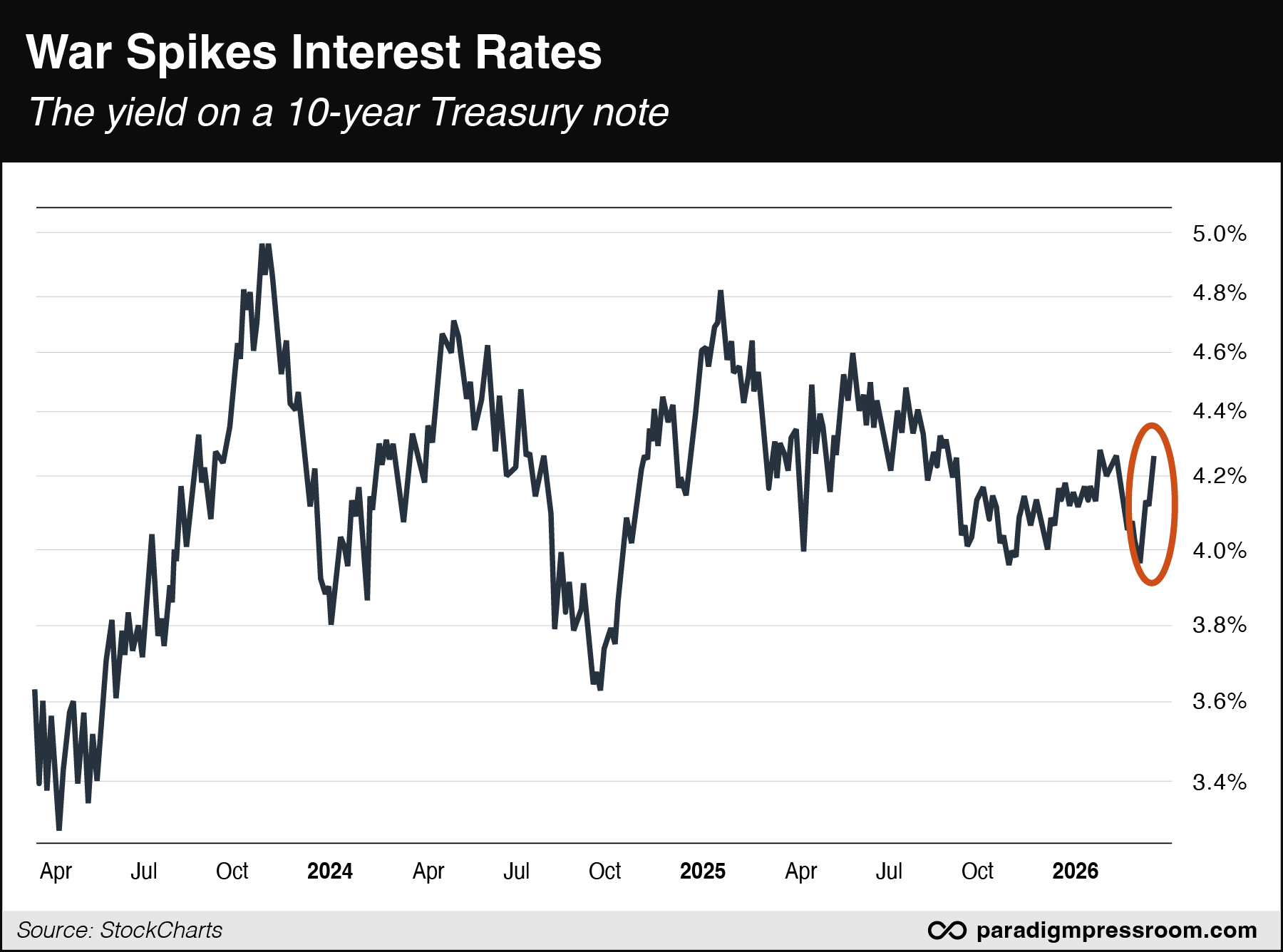
Checking our screens, the 10-year rate is 4.28%. As mentioned here a few days ago, if it breaks over 4.3%... it could be the start of a sustained uptrend.
Even going into the war, inflation was on the rise.
The Commerce Department came out this morning with “core PCE” — the Federal Reserve’s preferred measure of inflation.
It’s the January number, delayed by the partial government shutdown. And it clocks in at 3.1% — the highest since March of 2024. The number’s been moving steadily higher since last spring.
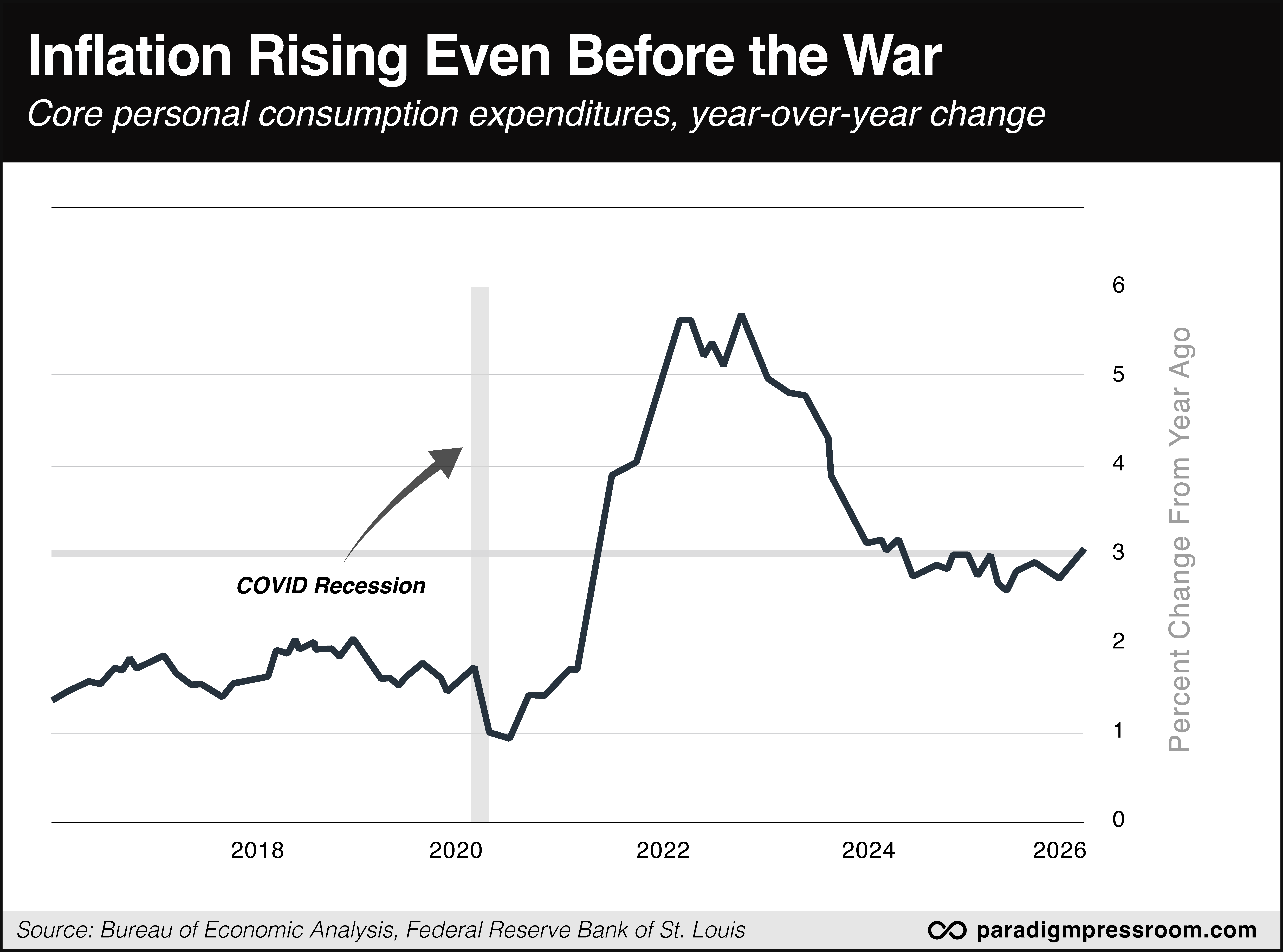
And with that, any hopes that the Federal Reserve will cut short-term interest rates is out the window. Looking at the action in the futures market this morning, traders are betting the first cut won’t come for another six months — and even then you’re looking at only a 50-50 chance.
Take another look at that chart and the sub-2% inflation going into the pandemic. “This is not the 2010–2020 period,” Bianco Research chief Jim Bianco tells the MacroVoices podcast.
“And if we have enough inflation now because of the rise in crude oil we’re seeing, because of the rise in gasoline that we’re seeing now, to keep the inflation rate above 3%, the Fed is just off the table. They just cannot step in and start cutting rates under that environment.”
That’s even if the economy starts to wobble by conventional measures.
➢ And on that score, the Commerce Department is also out this morning with a revised reading of fourth-quarter GDP. The previous guess of an annualized 1.4% growth rate has been slashed in half to 0.7%.
Even without the war, inflation was already baked into the cake for the rest of this decade.
It comes back to the research we’ve been citing for nearly three years now: Once inflation sails past 5% — as it did in 2022 thanks to all the pandemic money-printing — it takes an average of 10 years to get back to “normal” 2% inflation.
That means the winning asset classes for the rest of the 2020s will be very much like the ones of the inflationary 1970s — precious metals, base metals, energy. Commodities. Natural resources. Tangible stuff.
Even with gold up over 60% in the last 12 months, it’s not too late.
Oh — did we just say “pandemic” a few moments ago?
 COVID = Iran War?
It was six years ago today — also a Friday the 13th — that President Trump declared a national emergency.
The journalist and famed COVID dissident Alex Berenson sees ominous parallels between lockdown then and the Iran war now.
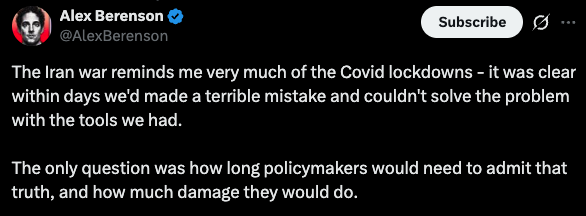
Chilling when you consider the hell that was unleashed the following Monday in 2020.
What might transpire between now and this Monday, while markets are closed?
In the last week, there’s been growing chatter in the Beltway about sending in ground troops to seize Iran’s big oil terminal at Kharg Island.
Located about 15 miles off the Iranian mainland in the northern Persian Gulf, Kharg processes about 90% of Iran’s crude exports. It’s a safe bet the leaders in Tehran view Kharg as existential.
An attack on Kharg all but guarantees Tehran will aim to retaliate by destroying as much oil infrastructure as it can in the Gulf sheikdoms.
For the moment, the problem with global oil flows is that oil is stranded by Iran’s blockade of the Strait of Hormuz.
That’s a somewhat solvable problem should the war wind down soon. It would take time to restart terminals that are currently filled to capacity — you don’t just flip a switch — but the system can normalize over time.
On the other hand, if oil infrastructure in Saudi Arabia, Kuwait and the UAE gets blown to bits by Iranian missiles? Forget it.
Maybe that’s what a spokesman for Iran’s Revolutionary Guard Corps had in mind this week when he said, “If you can tolerate oil at more than $200 per barrel — continue this game.”
In the meantime, crude has pulled back a bit from this time 24 hours ago — a barrel of West Texas Intermediate a shade under $96. We’re still on track for the highest weekly close since the summer of 2022.
The major U.S. stock indexes have found a floor for the moment after yesterday’s sharp sell-off.
At last check the S&P 500 is down about a third of a percent to 6,651 — a level last seen during Thanksgiving week. The Nasdaq is down about two-thirds of a percent but the Dow is slightly in the green.
Gold is slightly in the red but still comfortably over $5,000. Silver, however has been knocked down three bucks to $80.77
Bitcoin staged a huge rally starting last night… and gave back half of it in a matter of moments at midmorning. After nearly bursting past the $74,000 level it’s back under $72K. Ethereum, for the moment, is still over $2,100.
 War Follow-Ups
The warnings we’ve aired in the last week about a U.S. shortage of missiles — from our own Jim Rickards and from outside experts like retired Army combat officer Daniel Davis — is breaking into the mainstream.
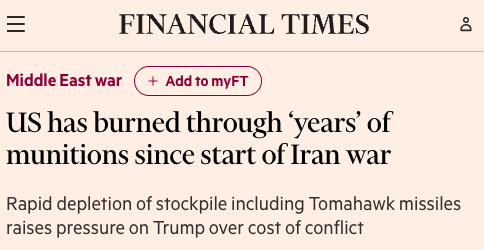
The Financial Times is zeroing in on Tomahawk missiles — a “massive expenditure” of them, according to one anonymous source. “The Navy will be feeling this expenditure for several years.”
The Pentagon will likely go to Congress in the coming days to ask for another $50 billion to wage the war.
Depending on how you do the counting, the Pentagon has already burned through nearly 40% of that total.
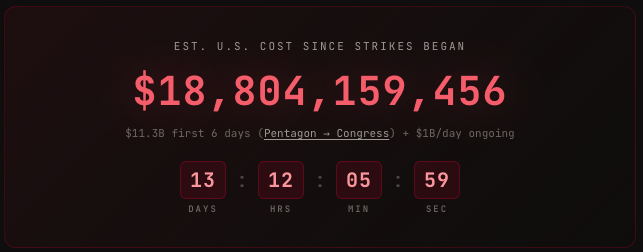
The Iran War Cost Tracker has revised its methodology — and upped its estimate of the war’s cost to date accordingly.
Pentagon officials told Congress this week that the first six days of the war cost $11.3 billion. Add to that the previously reported estimate of $1 billion a day, and we’re pushing $19 billion at midday today.
The mainstream is also catching up to our warnings days ago about the ongoing deindustrialization of Germany.
“Surging Energy Costs Put German Industry ‘Really in Danger,” says The New York Times.
Gee, you don’t say? We were saying the same thing last week. Actually we’ve been tracking the slow-motion decline ever since German leaders engaged in an epic moment of virtue-signaling in 2022, deciding to wean their people off Russian natural gas.
Of course, they wouldn’t have been so dependent on Russian natural gas if German leaders hadn’t decided a decade earlier to shutter all their nuclear power.
Now Germany is resorting to dirty old coal to keep the lights on and the factories humming — and it’s barely enough.
 Comic Relief
Lordy, do we need some comic relief as the week winds down. Although, really, this is too easy…

Heck, let’s do a double dose…
 Mailbag: “Degrading the Country”
Yesterday’s edition prompted the following reader complaint…
“Hey Dave, if you have so much angst for the country that lets you run off at the mouth and degrade it, why don't you go back to Ireland with Rosie O.? The negativity is getting a little old.”
Dave responds:In the first place, I’m primarily of German extraction. As far as I know, nothing traces to Ireland. You’ll have to find another revolting celebrity with whom to tar me by association.
In the second place — and as I showed last year — any “negativity” on my part stems from an idealism rooted in this country’s founding values.
And on the subject of those values… the “country” doesn’t “let” anyone speak up. Nor does the Constitution grant that right, as many people mistakenly believe. The Constitution recognizes we already possess that right simply by virtue of being human.
Judge Andrew Napolitano clarified in a column last fall. When helping draft the Bill of Rights, James Madison “insisted that the word ‘the’ precede the phrase ‘freedom of speech’ in what was to become the First Amendment, so as to reflect the views of the Framers that the freedom of speech preexisted the government. Madison believed that pre-political rights, which he enumerated in the Bill of Rights, are natural to our humanity.”
So as long as Paradigm Press is kind enough to furnish a platform where I can “run off at the mouth,” I will use it from time to time to say a provocative thing or two about war and peace — mindful of the Founders’ wisdom on those topics…
The great rule of conduct for us, in regard to foreign nations, is in extending our commercial relations, to have with them as little political connection as possible…
A passionate attachment of one nation for another produces a variety of evils. Sympathy for the favorite nation, facilitating the illusion of an imaginary common interest in cases where no real common interest exists, and infusing into one the enmities of the other, betrays the former into a participation in the quarrels and wars of the latter without adequate inducement or justification.
— George Washington’s farewell address, 1796
… peace, commerce, and honest friendship with all nations, entangling alliances with none…
— Thomas Jefferson’s first inaugural, 1801
Of all the enemies to public liberty war is, perhaps, the most to be dreaded, because it comprises and develops the germ of every other. War is the parent of armies; from these proceed debts and taxes; and armies, and debts and taxes are the known instruments for bringing the many under the domination of the few… No nation could preserve its freedom in the midst of continual warfare.
— James Madison, Political Observations, 1795
Our politicians lost sight of these values after World War II was won. We’ve lived in a state of permanent mobilization for war since the advent of the Truman Doctrine in 1947.
The military-industrial complex has been “eating out our substance” — to borrow from Jefferson in the Declaration of Independence — ever since.
Armies, debts and taxes indeed.
And with the present war underway, former Rep. Ron Paul (R-Texas) recognizes where it’s all going…
The costs of this war will put added pressure on the Federal Reserve to… increase its purchase of Treasury bonds in order to monetize the federal debt. The pressure on the Fed will also increase as other countries reduce their purchase of U.S. debt. These reductions will be motivated by concerns over the economic instability caused by the U.S. government’s out-of-control spending and by resentment over the U.S. government’s hyperinterventionist foreign policy. These factors could also accelerate the increasing rejection of the dollar’s world reserve currency status. A loss of the reserve currency status will cause a dollar crisis, leading to an economic crash worse than the Great Depression.
This crash will likely result in the end of the welfare-warfare-fiat money system. Whether this system is replaced by an even more authoritarian one or by a system of limited government and much more freedom depends on whether those of us who know the truth do our best to spread the message that the key to peace and prosperity is a system of free markets, limited government, individual liberty and peaceful relations and free trade with all nations.
If espousing these values amounts to “degrading the country,” sir, so be it.


