
One Noble Gas, No Substitute
 No Balloons. No Chips
 You might have been planning on green balloons for your St. Patrick’s Day festivities.
Here’s some bad news: The same geopolitical shock that’s reshaping global energy markets may make all balloons an endangered species in 2026. And that’s genuinely the least important part of this story.
Here to add context to our reporting last week, Paradigm’s Matt Badiali has been tracking natural resources through booms, busts and geopolitical shocks for decades.
This week, he’s sounding the alarm on helium.
It all goes back to events in Qatar on March 2. That’s when Iranian drones struck the Ras Laffan Industrial City complex — one of the world’s largest LNG and helium production hubs.
QatarEnergy declared force majeure on its existing helium supply contracts on March 4, legally freeing it from delivery obligations to customers worldwide.
At the time of writing, no restart is planned, and the facility has been offline for nearly two weeks, removing roughly 30% of global helium supply from the market in a single stroke.
Most people hear “helium shortage” and think party supplies. Matt wants you to think semiconductors.
“Helium is vital for making computer chips because it lets factories run their machines extremely hot, clean and precisely without messing up the tiny circuits,” Matt explains.
“It’s a noble gas, so it doesn’t react with the materials used to build chips. That helps keep the environment inside the machines very pure.”
It also does something less obvious: “It carries heat away really well, so it cools wafers evenly during intense processes, preventing them from cracking or warping.
“It helps stabilize the plasmas used to carve out the microscopic patterns on chips and is used to check for leaks in the vacuum systems, since its small atoms are easy to detect.”
Chipmakers now consume 20% of the world's helium supply — eclipsing MRI cooling as the primary industrial use.
Taiwan Semiconductor Manufacturing Company (TSM), which controls over 50% of the global chipmaking market, is the single largest consumer.
And unlike most industrial inputs, there is no substitute. “Like copper in electric motors,” Matt says, “there isn’t any substitute for helium in that role.”
The consequences of losing it aren’t just expensive; it’s a terminal risk. “Without enough helium, you can't make the chips at all.
“It's like water in bread making. The cost of the water is nothing compared to the price of the bread… but you can’t make bread at all without the water.”
The nation with the most to lose right now is South Korea. According to data from the Korea International Trade Association, Qatar supplied 64.7% of South Korea’s helium imports in 2025.
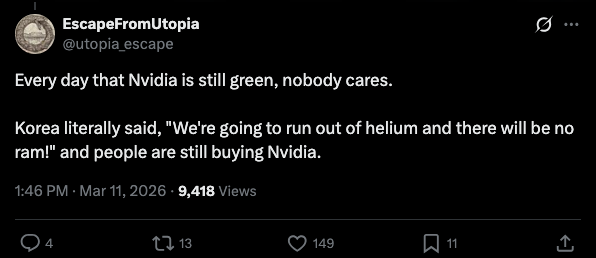 Hmm… Rain in the forecast for the “Woodstock of AI”?
Samsung and SK Hynix together account for about 18% of global semiconductor output. SK Hynix has said it diversified supplies and secured sufficient inventory — but the clock is ticking.
Helium consultant Phil Kornbluth warned at a Gasworld webinar that if the outage extends beyond two weeks, industrial gas distributors could be forced to relocate cryogenic equipment and revalidate supplier relationships — a process that could stretch over months.
If the damage to Ras Laffan is severe, recovery could take far longer. “The current shutdown in Qatar could significantly reduce global chip manufacturing if plants can’t get enough helium,” Matt says. “A shortage of AI chips will dramatically increase prices.”
For traders paying attention, the VanEck Semiconductor ETF (SMH) — which holds most of these companies — is already well off its February highs. Matt sees a potential short opportunity in either SMH or TSM if the situation deteriorates further.
A war in the Middle East. A drone strike on a gas complex. No balloons. And maybe no chips.

“There’s no sugarcoating it — geopolitical tensions are creating some real [macro] headwinds right now,” says Paradigm’s wealth-and-income authority Zach Scheidt.
“Right now, it seems that traditional, heavy-industry names are taking the brunt of the damage,” he notes, “with the Dow suffering consecutive drops as the [Mideast] conflict intensifies and capital derisks.
“But while the Dow takes on water and the headlines scream panic, a much more resilient story is playing out in the tech sector.
“Despite the intense geopolitical pressure, traders have been stepping in (albeit timidly) to buy the dips here and there on tech names that have been heavily pressured.
“Even on down days,the Nasdaq has fought its way back to close well off its lows, showing a clear unwillingness from buyers to completely capitulate.
“The most encouraging sign of relative strength this week has been in software,” Zach says.
“Recently, the sector suffered an aggressive, overblown sell-off driven by a flawed narrative: the idea that AI would somehow allow every company to easily write their own software from scratch.
“The current market environment is proving that thesis wrong. Established, bulletproof software platforms aren’t going anywhere,” he adds.
“Amidst the surging oil prices and Dow weakness, the software sector has held up decently well.
“After intense selling, it feels like these stocks have successfully carved out a hard floor of support, dismissing the AI fears and signaling that the previous wave of selling has largely exhausted itself.”
Zach’s takeaway: “We’re in the middle of a massive stress test; some sectors are feeling the squeeze. But if you look past the surface-level panic, the price action is actually telling a pretty interesting story.”
Turning to the markets today, the iShares Expanded Tech-Software Sector ETF (IGV) — a benchmark for software stocks — is up 1.50%.
That might not seem like much, but in early February, IGV was down more than 20% YTD. The sector seems to be steadily climbing its way out of bear market territory.
The three major U.S. indexes are all seeing green on this St. Patrick’s Day. The Dow, Nasdaq and S&P 500 are all up about 0.50% to 47,180, 22,430 and 6,730 respectively.
As for commodities, crude is up over 1%, priced at $94.50 for a barrel of WTI. It’s a mixed bag, however, for precious metals. Gold’s up 0.25% to $5,015.50 per ounce; at the same time, silver’s down 0.55% to $80.25.
The crypto market? Bitcoin’s up 0.35% to $74,310, and Ethereum’s barely hanging onto green at $2,330.
 Rickards: Pre-FOMC Prediction
The Federal Reserve meets this week, and our macro expert Jim Rickards says the decision itself is almost pre-written. “The expected outcome for the Fed meeting on March 18 will be no change in the Fed’s target rate,” he says.
Accordingly, rates will likely stay parked at 3.75%, where they’ve been since December 2025.
The Fed’s broader dilemma is familiar by now. Inflation has cooled but remains above the central bank’s 2% target — while the labor market is starting to weaken.
The latest employment report shows the U.S. lost 92,000 jobs in February, pushing the unemployment rate up to 4.4%. That was a surprise for economists, who expected modest job gains instead.
Ordinarily, a weakening labor market would push the Fed toward cutting rates. But a geopolitical shock has complicated the picture.
When the U.S.-Israel war with Iran sent oil markets into chaos, prices briefly surged from $65 to $120 per barrel before settling lower — but still far above prewar levels. Gasoline has followed the same path.
“Higher energy prices increase the price of almost everything, not just gas at the pump,” Jim notes. That inflation risk is enough to keep the Fed on hold for now.
The real drama isn’t the interest-rate decision. It’s Jerome Powell’s final stretch as Fed chair, unfolding against a backdrop of war, politics and a brewing economic slowdown.
Powell’s term as Fed chair expires in May, and President Trump has already nominated former Fed governor Kevin Warsh to replace him.
At the same time, the White House is publicly pressuring Powell to cut rates immediately — something he has resisted.
Jim sees the Fed’s decision this week as part economic judgment, part institutional showdown. “Powell will have good reason to hold rates steady… but he will have the added satisfaction of poking a stick in Donald Trump’s eye.”
For now, the Fed chair still holds the gavel, in a matter of speaking. “Powell will have won the feud, but the economy will have lost the war,” Jim concludes.
We’ll know more when Powell takes questions after Wednesday’s announcement — and we’ll break down the fallout for you afterward.
 Tech Turning Point 2026
“Peter Steinberger spent 13 years building PDF tools in Austria. Then, in November 2025, he sat down and built a prototype in roughly one hour.
“He wasn’t trying to change the world. He was just annoyed that something didn’t exist — so he ‘vibe coded’ it into existence.
“That one-hour experiment became OpenClaw — the fastest-growing repository in GitHub history, with over 175,000 stars,” says Paradigm editor, and James Altucher’s close colleague, Chris Campbell.
GitHub is the world’s largest platform where developers share code — think of it as a public library for software. Linux, the operating system powering most of the world’s servers, “took 30 years to reach similar milestones,” Chris says. “OpenClaw did it in three weeks.”
So what actually is OpenClaw? While every AI assistant you’ve ever used — ChatGPT, Siri, Alexa — is reactive, OpenClaw is different. Chris describes it as an “autonomous agent.”
You connect it to messaging apps (for instance, WhatsApp or Telegram). “Give it access to your computer, your files, your email, your calendar. And then it just... runs.”
According to Chris: “It feels less like using software and more like texting a very capable friend who happens to have root access to your computer.”
Nvidia CEO Jensen Huang framed the bigger picture from the GTC stage yesterday: “The last prompt was what is, when is, who is. This new prompt goes create, do, build, write.”
Chris’ verdict: “AI went from answering questions to taking actions. That’s the whole ballgame.”
“Here's the investment angle — and it’s enormous,” Chris continues.
“A normal AI conversation uses a modest amount of computing power,” he says. “[But] continuous OpenClaw agents running in the background may consume up to 1 million times more [units of work].
“This is why Nvidia is celebrating a software project it didn’t build.
“Every OpenClaw agent [is] another reason to buy more chips. More agents = more compute = more Blackwell GPUs = more revenue.”
Chris underscores: “The hardware thesis just got a second wind.”
But there’s a caveat: “For agents to truly work — to help manage your inbox, run your experiments, coordinate your team, operate your business — they need to remember.
“Persistently. Across sessions. Across tasks. Across time.
“Right now, the entire agentic AI industry is built on a foundation that doesn’t (yet) have this solved.
“Whoever cracks it first doesn’t just win a product category,” Chris summarizes. “They become the connective tissue of every agentic deployment on Earth.”
[That’s the conversation James and Chris will be having at exactly 2:00 pm EST TODAY, live at GTC 2026 in San Jose, California.
Beyond that, James and his team have an incredible lineup covering all things related to AI, robotics and so much more.
If you’re serious about understanding where technology is heading — and where the real money gets made — you need to be in the room.
Here’s your access to this FREE event: Tech Turning Point 2026.]
 Farewell, for Now
After nearly nine years, this is my last regular issue of 5 Bullets — and I find myself struggling to find words to mark the occasion.
This chapter began with a leap of faith — Dave Gonigam’s leap of faith, really. He took a chance on someone who had spent almost 13 years away from the workforce raising children. That was not a small thing. It was a risk, and he took it anyway. Everything that followed flows from that one act of generosity.
Dave has been a mentor, a teacher, a sounding board and a friend. I came to work for him as a complete novice. What I leave with — the instincts, the love of the work — I owe in no small part to him.
I also want to shine a light on the people you never see but without whom none of this would exist: copy editor Erik, marketer Colleen and the email team — Tyler, Heather and Oscar — who keep the whole machine humming, issue after issue. This newsletter has always been a group effort. I just happen to have a byline.
I’ve been incredibly fortunate — in my husband, my family, my friends. Yes, I count Dave and the Paradigm team among them, without hesitation.
As for what’s next, I’m not going far. I’ll still serve as contributing editor at our 5 Bullets highlight issue every Saturday. Plus, I’ll be deepening my craft on Jim Rickards’ team, a new role I’m genuinely excited to grow into.
And then there’s you, reader. Some of you I know by first name from the mailbag. A few of you I’ve had the rare pleasure to meet in person. You have made this work feel like a conversation rather than a broadcast.
Thank you. For your time, your trust and your loyalty. It has meant everything.


