
The Problem With the SpaceX IPO
 The Problem With the SpaceX IPO
 “We’re about to watch a transfer of cash from… ordinary people to the very rich,” said the veteran radio host John Batchelor last night.
He was speaking of SpaceX’s IPO, set for this Friday.
He invoked the railroad boom of the 19th century — and the relentless pitches to own, say, shares of the Erie Railroad in 1870.
In both cases the appeal was that you could own a piece of the future.
But in both cases that ownership came at a ridiculously high price for everyday Americans — ridiculously high relative to the price that early investors paid.
Still, it’s all good for those early investors, who in the case of SpaceX will cash out big-time a few months from now once the “lockup” period is over.
Meanwhile, if the history of other recent IPOs is any indication, everyday folks who buy in on Day 1 will be watching red on their screens for months on end. Example: Facebook shares tumbled 40% after the company went public in 2012.
Yes they roared back and Facebook, now Meta, trades for nearly 20X that initial 2012 value. But how many of those Day 1 buyers sold in disgust within a few weeks or months and booked a loss?
Which brings us to a couple of headlines from Friday. It seems both the federal government and Wall Street are bound and determined to rope as many everyday people into this wealth transfer as possible.
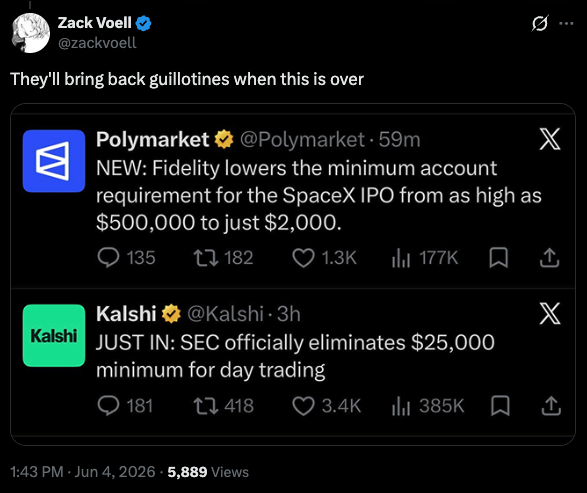
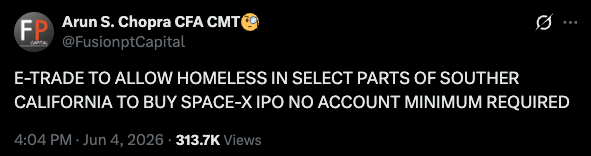
Those were real headlines — although they prompted some amusing parodies as well…
All kidding aside, it’s for reasons like these that in a special email on Friday I explained why our experts are urging you to steer clear of the SpaceX IPO.
Our AI authority James Altucher… our macro maven Jim Rickards… our trading pro Enrique Abeyta… They frequently disagree, but on this point they’re in lockstep. They don’t want to see you take the hit that millions of Americans are setting themselves up for this week.
Besides, they’re also in accord about a much better way to play the SpaceX frenzy — an early-stage investment tied to the growth of SpaceX with profit potential of up to 3,000% in the next two–three years.
All three of our top experts will lay out their cases during an exclusive online briefing titled The SpaceX SuperIPO Summit — tomorrow June 9 at 1:00 p.m. EDT.
They’ll also give you a list of seven space-related stocks they believe could skyrocket along with the IPO, in a report that’s yours FREE just for hearing their thesis. Click here to instantly reserve your seat.
 After Friday’s Rout
It appears the U.S. stock market will defy history today.
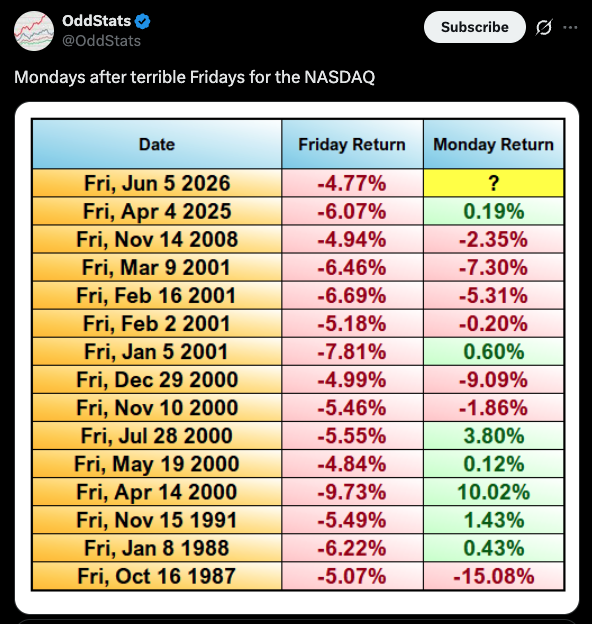
Over the last 40 years there’ve been 15 Fridays in which the Nasdaq took a steep tumble — including three days ago. On average, the following Monday has resulted in further 1.4% drop.
A day like this last Friday was inevitable.
The semiconductor stocks were weeks into a hyperbolic rally that couldn’t go on forever. Apprehensions about AI were building after the chipmaker Broadcom delivered a blockbuster earnings report — but its forecast going forward didn’t match up with Wall Street analysts’ giddy expectations.
The possibility of a continued tech meltdown today was significant: South Korea’s KOSPI index — dominated by chipmakers Samsung and SK Hynix — collapsed 8.3% on the day. Taiwan’s TAIEX — dominated by Taiwan Semiconductor — tumbled 3.5%.
But at last check this morning, the Nasdaq is up 1.8% on the day and the S&P 500 up 1.1%.
Why the divergence?
For once the corporate media are silent about the “reasons” behind today’s rally. But from our perch, it seems pretty obvious.
Donald Trump was aboard Air Force One on Friday afternoon, headed to an appearance in Wisconsin’s Chippewa Valley region. He mused to reporters about the possibility of the U.S. government taking ownership stakes in AI companies.
“There’s a concept out there where pieces could be given to the American public, where the American public essentially becomes a partner with the companies… where the American people can benefit from the success of AI and by doing that they are going to like it better.”
Asked whether it felt strange to be “on the same page” in this regard with Sen. Bernie Sanders (I-Vermont) — Sanders has proposed the government take a 50% ownership stake in major AI firms — Trump said, “As far as economics are concerned, we have certain things that are not that far apart.”
Near as we can tell, these remarks did not become public record until after the market closed on Friday.
As we have seen frequently over the last year — indeed, it’s a trend that’s been very profitable for some of Paradigm’s readership — the feds taking an ownership stake in a company can drive up that company’s share price big-time.
Of course the chatter here is entirely hypothetical. But it’s probably enough to give the U.S. tech market a bit of a lift today.
➢ Checking in on precious metals, they’re licking their wounds after a severe drubbing on Friday. Gold is more or less flat at $4,336 while silver is up nearly a buck to $68.67. But as a practical matter, both metals are mired near their late-March lows.
 Who Calls the Shots?
U.S. oil futures instantly zoomed from $90 up past $95 when trading opened last night for a new week.
Let’s reconstruct what happened while the markets were closed over the weekend.
It appeared U.S. and Iranian negotiators were making progress toward some sort of agreement. An agreement is the last thing Israeli Prime Minister Benjamin Netanyahu wants — but “he won’t have any choice,” Trump told the Financial Times. “I call the shots. I call all the shots. He doesn’t call the shots.”
And then, knowing it would sabotage the talks, Netanyahu ordered a series of airstrikes on Lebanon’s capital Beirut. For weeks, Iranian leaders have said airstrikes on Beirut were a red line. Sure enough, Tehran started lobbing missiles toward Israel for the first time since the U.S.-Iranian ceasefire two months ago.
At that point, Donald Trump told the Axios website that “I am going to call Bibi right now and tell him not to retaliate.”
Yeah, “Bibi” retaliated anyway. But remember, Trump calls all the shots.
➢ Recovered history: When Netanyahu first became prime minister in 1996, he paid a call on President Bill Clinton in Washington. According to veteran diplomat Aaron David Miller’s 2008 book The Much Too Promised Land, Netanyahu was so overbearing that after the meeting, Clinton groused to his aides, “Who’s the f***ing superpower here?” 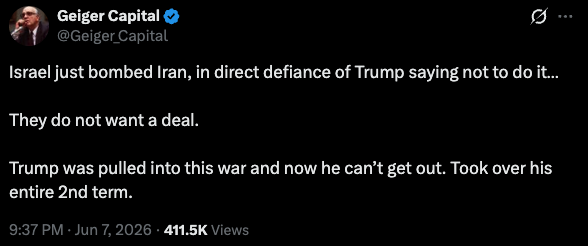
For the moment, however, both Tel Aviv and Tehran say they’re holding off on further attacks — and U.S. crude futures have retreated to $91.41.
As usual, rising oil prices translate to rising inflation expectations, which translates to rising Treasury yields. The 10-year T-note is back over 4.55% — up meaningfully from 4.45% at the end of May.
Today is Day 101 of the war. The Strait of Hormuz remains effectively closed.
[Program note: The war and its market impact were a major topic — but hardly the only one — discussed last Thursday at Paradigm’s “America 76/26” event featuring Jim Rickards and his team.
During a wide-ranging three-hour discussion, Jim and the analysts put out 53 (!) stocks and ETFs for your consideration. If you missed the livestream from Philadelphia, the replay is still available for viewing at this link.]
 Comic Relief
This one’s been making the rounds throughout corporate America…

That one guy on the left seriously needs to work on his form. Just sayin’...
 Mailbag: Florida’s Property Tax Proposal
“Note there are two parts to this amendment,” says the first of several thoughtful emails we got from Floridians about a referendum that would slash property taxes for millions.
“One is the potential increase on the homestead exemption from $50K now to $150K in 2027, $250K in 2028 and then as adjusted by the legislature in following years with proviso in the meantime for CPI increases. The latter would have been welcomed years back but never instituted. The exemption for schools is not affected.
“The other part is to limit property tax to the ‘rollback’ rate and limit what can be used for the property taxes collected to ‘essentials’ such as police, fire, water and sewage, infrastructure maintenance and ???. What are essential? (Rollback rate is the rate which based on the certified property appraiser rolls current assessed property values equals the same $$ collected previous fiscal year).
“Are programs for families and elderly such as recreational courses, pools, adult daycare to be not essential and thus property tax money may not be used for them?
“Can other ‘fees’ be used — and this is where the discussion from the legislators is NO.
“How about those rural or smaller municipalities that 80–90%-plus of their income to support a balanced budget is going to be impacted severely — will there be grants for the state? If so, those grants will have conditions, and how will this go over on their constituents?
“Great idea but short on solid study showing impact and options.
“Short-term fix that may lead to long-term repercussions.”
“The proposal was watered down by the legislature — ‘Don’t touch education money!’ (gotta protect those teacher unions),” another reader points out.
“So the proposal means that in 2027 a five-year-plus homeowner in Florida will get a $150,000 reduction in their property value for the 40–50% of their property taxes that have nothing to do with education.
“In 2028, that reduction would go to $250,000.
“It’s a step in the right direction, but it’s not what Gov. DeSantis was requesting. The legislature is beholden to the schools and counties and not the citizens (despite declining student enrollment). Tax revenue has grown by many multiples of inflation and the government keeps growing to gobble it up.
“Fiscal responsibility and taxpayer empathy don’t exist even in ‘the Free State of Florida,’ at least not at the county level.
“It will likely go down in defeat because there will be nonstop bleating, ‘What about the children?!’ (Who are completely unaffected by the property tax proposal, but it helps to raise the hysteria). And veiled threats to increase county fees to make up the difference, despite state assurances that they will not allow the counties to do that.
“Counties won’t tighten their belts, they’ll just raise fees to make up for any revenue loss. The public sector never has layoffs at the state or local levels. State and local governments always grow, but never shrink.
“Sorry, I’ve seen this cheerleading for tax cuts and seen time and again how our ‘representatives’ and government administrators cannot ever be fiscally responsible; there just isn’t sufficient accountability because of a complicit or braindead press, term limits on reformers, a purposely uninformed populace (see former statement about the press) and greed/kingdom-building mentality of the government managers who just wait out the term-limited reformers like DeSantis.
“Hope springs eternal, but we are dealing with a society that is prone to mass hysteria. Remember Covid and Trump Derangement Syndrome.”
“The tax reduction will only apply to homesteaded Florida residences, which only account for 7% of all taxes across the state, not 75%,” says a second-generation Floridian.
“Commercial, rental and business properties will not be included. I look forward to voting FOR this amendment on Nov. 3 and finally getting closer to actually owning my home.”
Dave responds: Cursory research aided by AI shows primary residences account for about 27% of local property tax revenue in Florida, not 7% — but you raise an important point of clarification, and I thank you. I should have given that number from the Tax Foundation more scrutiny.
“This is a great idea for seniors and those on fixed incomes, especially if they paid off their houses,” says our final correspondent.
“Development frenzy has doubled and tripled tax bases in some areas (like Tampa), but you have to understand those taxes don't pay for the community developments — bonds attached to property deeds do. So where does the tax money go?
“It's a tough issue. I would personally benefit from this, but I can see where smaller, rural areas would be hurt and the tax shift would be real. Florida has no income tax, and most cities do not levy city tax, so all of a sudden we might see 15% sales tax in some areas. Where does my no-state-income tax benefit go if my other taxes go up so high?
“You don't get somethin’ for nothin’.”
Dave: And on that note, you get the last word! Thanks to everyone who wrote in. More feedback tomorrow…


