
SpaceX: The Iran Connection
 SpaceX: The Iran Connection
 So… is SpaceX’s IPO today the reason Donald Trump called off a renewed attack on Iran yesterday?
Yesterday morning on his Truth Social platform, the president threatened to attack Iran “VERY HARD TONIGHT.”
But about six hours later, he declared he had “cancelled the scheduled strikes and bombings against Iran this evening.”
What changed?
One theory is that the Iranian side delivered damaging strikes against U.S. targets — more damaging than anyone in Washington cares to admit — and the Pentagon urged the president to hold off, allowing time to regroup.
Another theory is that a U.S. Treasury auction yesterday went poorly, with very weak demand. An escalation of the war would drive down foreign demand for Uncle Sam’s debt even further… which would drive interest rates even higher.
But among some cynical cats on X, the consensus is that someone put a bug in the president’s ear: You don’t wanna mess up the SpaceX IPO tomorrow, do you?
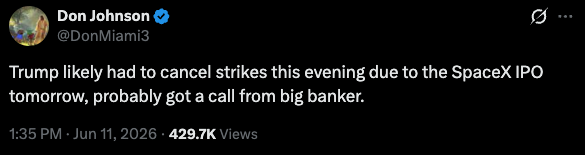
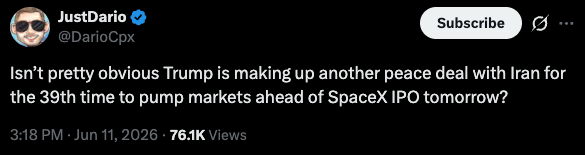
To no small extent, Donald Trump sees his legacy tied up with the performance of the U.S. stock market. Now is no time to throw a wrench in the works. Remember how the market swooned at the outset of the war in March?
But it wasn’t just the threat of a renewed hot war tanking the stock market at a delicate moment.
There was also the threat the Iranian side issued against Elon Musk’s interests in the Middle East.
Yesterday morning, Iran’s semi-official Fars News Agency reported that Tehran planned to target “all interests related to economic holdings managed by Elon Musk in West Asia” — including a Starlink ground station.
“The Islamic Republic of Iran reserves the right to attack all facilities related to [Musk]-managed holdings in the region and occupied territories,” Fars quoted an “informed source” as saying.
There’s precedent behind the threat: During the war’s early days, Tehran attacked Amazon data centers in the United Arab Emirates and Bahrain.
Now, this threat did not carry the weight of coming from the news agency IRNA — the official Iranian government mouthpiece. And if you give it a moment’s thought, the threat was almost surely a bluff: Iranian leaders know how unpopular this war is in the United States. Why would they do anything to anger millions of everyday American investors at a moment those investors are jazzed about the SpaceX IPO?
But if you’re sitting in the White House… and you think your legacy is inextricably linked to the performance of the stock market… you’re not going to take any chances. You’re going to call off the attacks.
That’s our informed speculation, anyway. Whatever the case, the shaky ceasefire looked a bit more steady as the trading day opened… and everything was on track for a smooth introduction of SpaceX as a publicly traded company.
 Here We Go Again (Again)
And so the “war’s almost over” trade is back on. At less than $85 a barrel, U.S. oil futures trade today at a two-month low.
Not only did Donald Trump call off a planned attack on Iran yesterday, he said “discussions and final points have been, in both concept and great detail, approved by all parties involved.”
Never mind that Trump has previously said a deal is nearly done 38 times before. (That count is from CNN, but it appears to check out.) Never mind that as usual the Iranian side is being much more circumspect about prospects for a deal. And never mind that Israel has an effective veto on anything Washington and Tehran might agree to.
Amid that backdrop, and the SPCX debut, the major U.S. stock indexes are just barely in the green after yesterday’s solid gains. The S&P 500 is back over 7,400 for the first time since Monday.
SPCX shares began trading shortly before lunchtime on the East Coast — opening at $150 each, an 11% improvement on last night’s listing price of $135.
With that, Elon Musk has become the world’s first trillionaire. (Granted, the value of a dollar ain’t what it used to be, but still…)
In addition to SPCX’s premiere, leveraged ETFs based on SPCX have also begun trading — a 2X ETF with the ticker SPCH and a 3X ETF with the ticker ELON.
(Guess Musk is out of luck if he wants to merge Tesla and SpaceX into one giant company with the ELON ticker?)
➢ Hats off to readers of Enrique Abeyta’s The Maverick: Yesterday they collected 105% gains after six months with shares of the space name Voyager Technologies. Enrique thought it prudent to take profits on half the position ahead of the SpaceX debut.
Despite the stock market’s sideways chop in recent days — including last Friday’s big drop — there’s an underlying sign of strength: Money is flowing out of the Magnificent 7 names into the broader market.
“Take a look at RSP, the equal-weight S&P 500 ETF,” says Paradigm analyst Zach Scheidt. “It's outperforming the traditional, mega-cap-heavy S&P 500, and it's sitting within 2% of all-time highs. We're seeing the same in small caps. IWM is right up near its own highs and has led the last few sessions.
“This tells us that the average stock is holding up well. We're getting participation from more ‘healthy’ names instead of the whole market leaning on a few giants.”
Precious metals rallied big-time yesterday after Trump called off the Iran attacks… but checking our screens gold is back under $4,200 and silver is off nearly a buck at $66.28. Bitcoin has pushed past $63,000 but Ethereum is still mired in the $1,600s.
 Data Centers In Space(X)
“Just days leading up to the largest IPO in history, Elon Musk unveiled something the market hasn't fully processed yet,” says Paradigm space and tech specialist Ray Blanco.
“Not a rocket. Not a Starlink update. Not a Grok benchmark.”
Rather it was a satellite designed from the jump to be a data center in space. Perhaps not surprisingly, it’s called AI1.
“The timing is not accidental,” Ray wrote yesterday for Altucher’s Investment Network. “You don't unveil your first orbital data center satellite right before the largest IPO in history by coincidence. Musk just showed the world what he's actually building with the money.”
One AI1 satellite generates an amount of solar power equal to that needed for powering 125 homes. “Its solar panels span 70 meters tip to tip,” says Ray. “That's wider than a Boeing 747.
“To keep those chips from melting in the vacuum of space, it deploys a liquid radiator system covering 110 square meters — roughly the floor area of a decent apartment — that bleeds heat silently into the void.
“And the detail that separates this from everything that came before: The compute payload is interchangeable.
“The satellite could run Nvidia GPUs or Google TPUs, or SpaceX’s own custom Terafab silicon.”
Terafab is planned for a site near Austin, Texas — sitting cheek-to-jowl with Tesla’s Gigafactory Texas complex, but 10 times the size.
It will aim for one terawatt of annual chip output — some 80% of that destined for space.
Put simply, “The largest chip manufacturing initiative in human history is being built primarily to supply orbital infrastructure,” Ray says.
“This is the capital allocation decision made by what might be the most aggressive builder in the history of technology, backed by the proceeds of a $75 billion IPO.”
As we’ve emphasized since we first brought them to your attention last fall, orbiting data centers don’t compete for scarce resources on Earth: Electricity comes from solar power that’s available 24/7. No need to suck up water for cooling; space is plenty cold. And no neighbors to object.
“The costs that remain — launch, hardware — are falling faster than anyone predicted,” Ray goes on. “Starship changes the launch economics the way container shipping changed global trade.
“When the cost of getting a pound to orbit drops by 90%, the math on orbital compute doesn't just improve. It inverts.
“The interchangeable compute payload architecture means AI1 isn't a satellite. It's a platform — the orbital equivalent of a server rack that any hyperscaler can populate with their own silicon.”
Just wait till everyone else figures out what we’ve been telling you for weeks: SpaceX isn’t a rocket company. It’s an AI company that sees the future of AI in space.
 Something to Feel Good About
Not sure if you’ve noticed… but there are plenty of visitors to the United States for the World Cup who can make you feel good about being an American.
LIke a fellow from Germany who’s become a social-media sensation with posts like this…

Or a young woman from Sweden checking out the Hoosier State on her way to one of the venues…

Or a visitor from Japan discovering for the first time the astounding variety of ways you can order eggs for breakfast.
In recent weeks both Byron King and yours truly have mused in our respective publications about why the vibe for America’s 250th is much more downcast compared with the Bicentennial in 1976.
In that regard, these visitors have brought us a great gift — the chance to see our country with fresh eyes.
 Mailbag: First They Came for the Illegals…
My brief rant a week ago today about a plan to seize illegal migrants’ bank accounts prompted a small flurry of reader reactions.
Some missed the point: “The rights we have in the U.S. are not universal. Those people entering the U.S. illegally and taking advantage of our resources weaken all of us. If you ever choose to run for a public office I have $5,000 that I can contribute to your opponent.”
Others raised a valid concern: “On balance, your stance against government seizing bank accounts is a wise one, as government always overreaches.
“However, my right to not have illegals (or anyone) stealing my tax dollars to enrich God knows who is important too.
“Care to offer something beyond just saying NO to government, so that my tax dollars are protected from being stolen? An alternative solution perhaps?”
Dave responds: It shouldn’t be controversial — certainly not on “the right” — to strip illegal migrants of welfare benefits.
And yet… a budget bill passed in Washington last winter includes $5 billion in “refugee and entrant assistance” — cash benefits, health care, daycare, job programs.
Rep. Thomas Massie (R-Kentucky) offered an amendment to strip this funding from the bill — only to be shot down by House Speaker Mike Johnson and other GOP leadership. Donald Trump signed the measure into law, and then backed Massie’s primary opponent — who won with the help of an unprecedented $15 million from the GOP donor class. Your beef (and mine) is with them.
I for one would be interested in seeing how it would work out if our leaders actually followed the Constitution’s clear division of responsibilities: The federal government takes care of naturalization/citizenship, while immigration is left to the states.
That might sound outlandish to contemporary ears, but it’s how things worked for our first century of existence as a country…


