
Iran: “A Deal to Make a Deal”
 Iran: “A Deal to Make a Deal”
 “We have to pass the bill so that you can find out what’s in it.”
Remember that? Those were the infamous words of House Speaker Nancy Pelosi during the debate over Obamacare in 2010.
“Truer words were never spoken,” said Cato Institute researcher Michael Cannon. “Heck, Obamacare gives [the health and human services secretary] so much arbitrary power to reshape the health care sector that Congress had to pass the law so that Pelosi could find out what is in it.”
At least then the text of the bill was public knowledge. We don’t even have that much today with the oh-so-ballyhooed Iran deal.
“I have yet to see one authoritative list of terms both sides concur is authentic and that they will abide by,” says retired Army combat officer Daniel Davis, host of the Daniel Davis Deep Dive podcast. “The only thing that has been discussed thus far is a memorandum of understanding to get Phase 1 enacted so we can even begin negotiations for Phase 2.”
“It seems to be little more than a deal to make a deal since the nuclear issue and sanctions relief were left unresolved,” Paradigm’s own Jim Rickards wrote his Strategic Intelligence readers this morning.
Old acquaintance Erik Townsend, host of the Macro Voices podcast, had a pithy summary of how the Iranian side sees it…
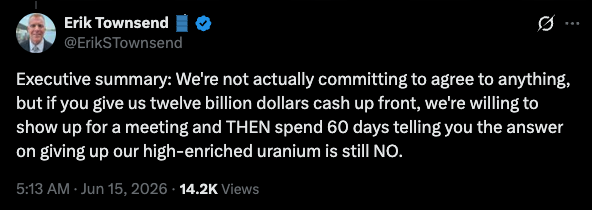
Supposedly the “deal to make a deal” will be signed in Switzerland on Friday. Then maybe we can see a text? Pretty please?
That’s assuming U.S. and Iranian representatives even make it to the signing ceremony. There are two enormous stumbling blocks between now and Friday.
The first is the status of Tehran’s frozen assets, rumored to be valued at $24 billion.
Iranian media say that under the deal, those assets will be restored to Tehran right away. Asked about that on CBS this morning, Vice President Vance said, “We’re open to a lot of things that are on the table but that doesn’t appear anywhere in the text.”
(At least he’s seen the text?)
Given everything we’ve heard from Iranian leadership in recent weeks, the immediate release of these assets appears to be non-negotiable.
And then there’s Israel — not a party to the agreement, as Prime Minister Benjamin Netanyahu has said pointedly.
Netanyahu tried to deep-six the agreement yesterday by escalating in Lebanon — bombing metropolitan Beirut, which is a red line for Tehran.
Fox News Middle East correspondent Trey Yingst — a straight shooter despite who signs his paycheck — quoted a diplomat involved in the talks as saying, “This is a clear attempt by Israel to sabotage the President’s deal and drag the United States back into war.”
It didn’t work — this time. But Beirut is non-negotiable for Tehran. And a lot can happen between now and Friday.
 Deal Arrives as “Tank Bottoms” Loom
And at least until Friday, the Strait of Hormuz remains effectively closed. Here’s a one-year chart of Hormuz traffic, placed in context.
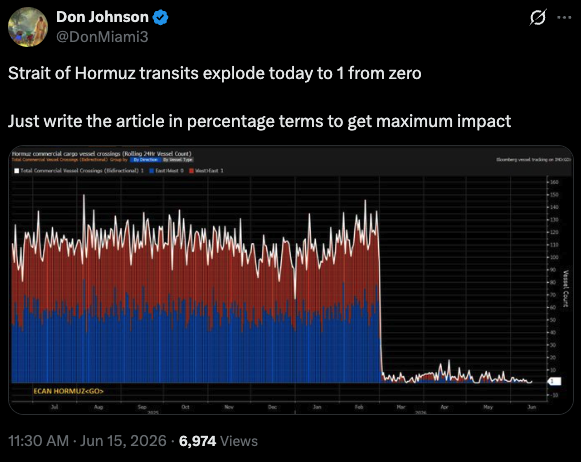
“At this stage, there are no changes to our operations in the region,” says a statement from the shipping giant Maersk. “The announced agreement is a welcome and positive development, but publicly available details are still limited.”
(Gee, you don’t say…)
Even if a deal is signed Friday and everything goes swimmingly from there, it’s going to take time to unscramble the scrambled supply chains.
Clearing the strait of mines? A six-month project. Moving vessels where they need to be? Two or three months. Restarting oil production where it’s been shut down and then restoring to prewar levels? Another three months.
“The war started in a second, but the consequences will linger on much longer,” says Amena Bakr of the trade-data firm Kpler.
Assuming this deal is for real, it comes just in time for U.S. oil inventories.
As we chronicled last month, Carlyle Group commodities guru Jeff Currie said that America will be approaching “tank bottoms” around July 4. And an Exxon executive said the only thing keeping a lid on fuel prices during the war is the fact we’re running down inventories.
Even CNN managed to figure that out by this weekend…
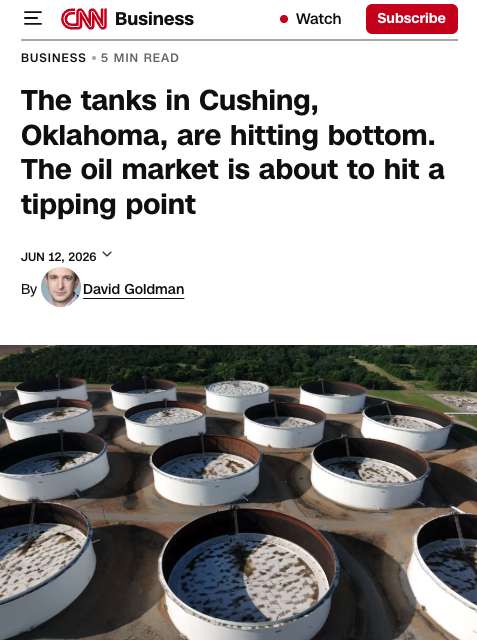
As of the week ending June 5, inventories at the giant terminal in Cushing, Oklahoma totaled 21.64 million barrels. That compares with 40 million or so in normal times… and “operational minimums” of 20 million — beyond which there’s too much sludge mixed in with the oil and pipelines lose pressure.
Meanwhile, the government’s Strategic Petroleum Reserve now sits at its lowest level since August 1983.
The oil price today, you ask? Down over 5% to the lowest levels in over three months, but still over $80.
That might be as good as it gets for a while. Mr. Market hasn’t yet absorbed the realities of how long it’s going to take to restore energy flows to where they were before the war began. (See above.)
Elsewhere, it’s “risk on, baby.” At last check, the S&P 500 is up nearly 2% to 7,573 — not too far off its record close of June 2. The Nasdaq is up 3% while the Dow is settling for a 1.4% gain.
Precious metals are also rallying — gold up $110 to $4,328 and silver up two bucks, only a penny away from $70 again. Crypto is getting traction, too — Bitcoin up to $66,689 and Ethereum above $1,800 again.
One economic number of note: U.S. industrial production ticked up 0.1% in May, less than expected. Manufacturing output was flat, utilities activity shrank, mining/energy output grew. All told, 76.2% of U.S. industrial capacity was in use last month — well below the 60-year average.
 SpaceX: What’s Next?
On Day 2 of SpaceX’s existence as a publicly traded company, SPCX shares are trading north of $170 — up 8% from Friday’s close and 29% from the IPO price.
But where does it go from here?
“The chart below is my best guess for how the next year unfolds after SpaceX goes public,” says Davis Wilson of our sister e-letter The Million Mission.
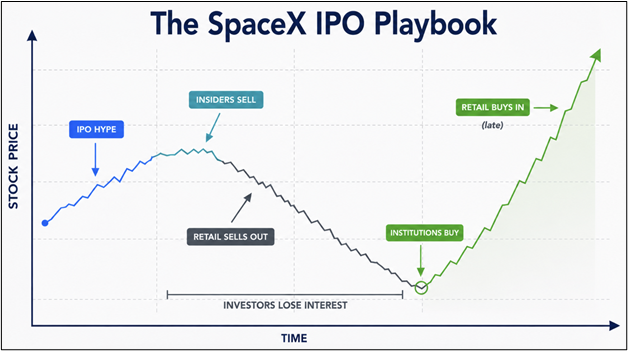
“We’ve seen this movie before,” he says. It breaks down into five phases…
Phase 1: IPO hype. In the brief window before IPO day, demand from retail investors for a limited number of pre-IPO shares was overwhelming. “When disappointed investors rush into the open market to buy shares after trading begins,” says Davis, “It creates a natural source of upward pressure on the stock.”
Phase 2: Insiders sell. The venture capital types, to say nothing of SpaceX employees, who’ve owned shares for years, will want to cash out. And unlike the single “unlock date” that typically happens with IPOs, “shares are expected to be released in stages from roughly July through December,” Davis says. “Rather than one giant wave of selling pressure, SpaceX could face a series of smaller waves as more insider shares become eligible for sale.”
Phase 3: Investors lose interest. “The financial media will move on to the next hot story. The next IPO will arrive… I wouldn’t be surprised if SpaceX enters a prolonged ‘dead money’ period where investors simply lose interest.”
Phase 4: Institutions buy. “Many large funds can't buy meaningful positions immediately after an IPO. And they don’t want to buy at such inflated prices. Instead, they wait for the hype to fade and for insider selling to run its course.” Neither the media nor retail investors will notice. And then…
Phase 5: Retail buys back in. “Suddenly everyone who ignored the stock during the ‘investors lose interest’ phase will decide they need exposure. That's usually how it works. People don't chase what has fallen. They chase what has already gone up.”
No guarantees this is how it plays out. But Davis has seen it play out just like this many times before. “The tickers are always different, but the underlying behavior rarely changes.”
 Trump Admin’s Heavy Hand Slams Down an AI Giant
It’s now apparent what the Trump administration’s approach to AI regulation will be going forward — lurching back and forth between a light touch and a heavy hand.
The heavy hand slammed down hard last Friday on Anthropic, the Claude maker that intends to go public later this year.
As we mentioned at the time, Anthropic rolled out its powerful new Mythos model in April — so powerful, the company claimed, that it unearthed major vulnerabilities in nearly every operating system and web browser.
As such, Mythos’ initial release was limited to only a few dozen big corporate clients so they could patch their systems. A watered-down version of Mythos dubbed Fable was released to the public last week.
The whole time, Anthropic leaned hard into the Mythos-as-cyberweapon narrative, pleading for federal regulation. (When big companies plead for regulation, it’s always to thwart up-and-coming competition.)
Regulation arrived on Friday when the feds issued an export-control order forbidding access to both Mythos and Fable by any foreign national. That’s even if the foreign national is in the United States, and even if the foreign national works for Anthropic.
The company was given 90 minutes to comply.
Under strictures that tight, Anthropic simply revoked access to Mythos and Fable for everyone.
Social media had a field day…

If the Semafor news site is to be believed, the order resulted “partly over suspicions that a China-linked group” somehow accessed Fable, the consumer version of Mythos.
For his part, venture capitalist and White House AI adviser David Sacks says the feds got a warning from “a highly credible trusted partner” of both Anthropic and the U.S. government: Fable was subject to jailbreak. (The Financial Times reports that partner is Amazon.)
In Sacks’ telling, Anthropic CEO Dario Amodei refused to fix it — saying it was no big deal. The feds disagreed and issued their order.
This development comes after a series of mixed signals from the White House in recent weeks: Mythos spurred the White House to rethink its previous light-touch approach during April. A heavy-handed executive order was in the works during May… but then it was watered down come June. Now it’s heavy-hand time again.
You wonder if the Silicon Valley tech bros who gravitated toward Trump during the 2024 campaign are having second thoughts…
 Mailbag: DXYZ, Aging in Place
A couple of complaints filtered into the mailbag this weekend — and I’m hard pressed to say what brought them on.
Both readers called us out — and one called out James Altucher in particular — for talking up Destiny Tech100 Inc. (DXYZ) — a closed-end fund that was an indirect way to own SpaceX pre-IPO. (Last year, SpaceX made up more than half of DXYZ’s holdings.)
As far as I can tell, DXYZ has never been a recommendation in Altucher’s Investment Network.
Over the last year, Davis Wilson of the free e-letter The Million Mission did mention DXYZ now and then — mostly to discourage people from investing. He cautioned that it traded at nearly 4x its net asset value (September 2025) and that its price was falling even as SpaceX’s valuation was soaring (March 2026).
If our editors give readers a bum steer, we expect them to own their oversight. But again, as far as I can tell, there’s no oversight to own here.
After your editor made a parenthetical reference in Thursday’s edition to the fact that many boomers are choosing to “age in place” instead of downsizing — which helps to limit the available housing stock for younger folk — we heard from one of our semi-regulars…
“7,000 boomers a day are making the ultimate downsize,” he writes — “they are dying!
“That is 2.6 million per year. That is a lot of houses becoming empty for the younger generation. What other generation is adding that kind of real estate to the market?”
Dave responds: Valid point. It’s a self-correcting problem in that regard — even if it’s not happening fast enough for young and growing families.
The eventual aging out of the boomers is also why I don’t share in the hand-wringing you hear from many experts about the future of Social Security.
Boomers like to think they’re immortal — heh — but they will be falling off the rolls sooner or later.
It’s still going to take some combination of higher taxes and higher retirement age to keep the system afloat longer term. When the politicians choose to act is up in the air; under the circumstances, they’ll likely hold off until the last minute…


