The CIA and the Oil Price
 Paper Oil
 Uhhh… You didn’t really think there was a breakthrough in the U.S.-Iran conflict on Friday, right?
Your editor exercised caution and skepticism even as the news was still breaking — a stance that’s vindicated here on Monday morning.
After we went to virtual press Friday afternoon, our macro maven Jim Rickards affirmed my suspicions on the Paradigm Press mobile app: “President Trump and the Iranian mullahs agree on essentially nothing. Iran wants its frozen funds back and the U.S. naval blockade to end. Trump wants Iran’s enriched uranium and the Strait of Hormuz fully open. Neither side will concede easily…
“A return to war remains probable. Needless to say, markets have not priced this in.”
We won’t take up space with everything that happened over the weekend. Although the meme-o-sphere has summed it up reasonably well…
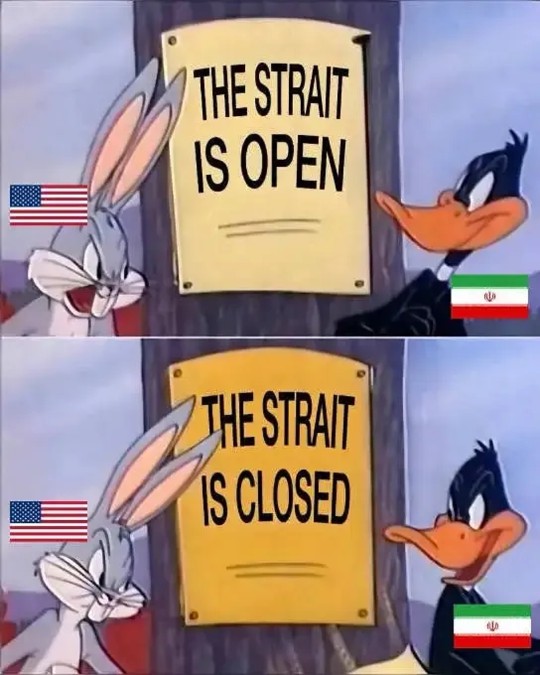
Suffice it to say that today oil is up, stocks are down — and there’s no Monday-morning “stick-save” that Trump has posted on his Truth Social site.
Still, at under $90 a barrel, the price of oil you see quoted in the media bears no relation to what’s happening in the real world.
The disconnect has become maddening — at least for some folks who think about money for a living…
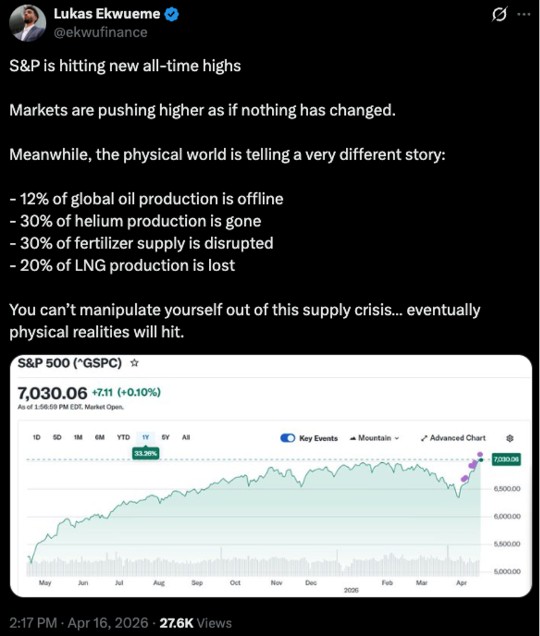
In large part, it comes back to the “paper price” of oil — that is, the price of oil futures quoted on CNBC — versus the price of physical barrels for delivery.
As we’ve mentioned regularly in recent days, there’s a yawning gap between the two; the real stuff trades for 50% more than the paper price.
As long as Brent and West Texas Intermediate crude trade under the round number of $100, the stock market thinks it’s all good.
But real barrels trading for $150 or more tell a different story…
“The world is facing a historic energy crisis worse than prior energy supply crunches, including in 1973, 1979, 1987 and the 2020 pandemic,” Jim Rickards wrote Thursday to his PRO-level members of Strategic Intelligence.
Wall Street bankers and brokers are locked into the narrative that the Strait of Hormuz will reopen in two–three weeks.
“Of course,” says Jim, “they’ve been saying two–three weeks for nine weeks. That’s getting old.
“On the other hand, we have experts who are in physical energy markets. They’re not traders. They own tankers, buy and sell cargoes, operate loading and unloading facilities and run refineries. Some are government officials responsible for keeping the lights on and the factories running in places like South Korea and Japan.
“These participants focus on one thing only — when the energy runs out, the lights go off. Data is no substitute for actual oil, natural gas or refined product.
“What we’re hearing from the market analysts is relentlessly optimistic, with some allowance for short-term inflation. What we’re hearing from those in physical markets is dire and on the verge of panic.
“Those in physical markets have it right. They can’t pretend the way traders can.”
But don’t take it from Jim. Take it from someone much closer to the situation — Saudi Arabian finance minister Mohammed Al-Jadaan.
In a remark completely overlooked by corporate media, Al-Jadaan spoke up during a conference late last week: “You see the screen, $90 a barrel — good luck if you get an oil barrel for $90. It’s $120, $130, $140, $150, $160 even through the last few weeks.”
And those are just “normal” purchases of physical barrels in Europe and Asia. There are extremes like $286 a barrel in Sri Lanka — the island nation off the coast of India.
How long can this disconnect go on?
Answers shortly — after we remind you that these manipulations are nothing new…
 The CIA and the Oil Price
The market for oil futures has been used to mask a host of manipulations for over four decades.
The veteran oil industry journalist James Norman documented these manipulations extensively in his 2008 book The Oil Card.
Modern oil futures as we know them began trading in New York in 1983 — only months after President Reagan signed National Security Decision Directive 66. Under NSDD-66, Washington began colluding with Saudi Arabia to drive down oil prices. Objective: Make Soviet oil exports dirt-cheap and bankrupt the Evil Empire.
One of the leading global oil traders in the 1970s quickly became one of the biggest players in the nascent oil futures market. Transworld Oil, controlled by John Deuss, accounted for up to 30% of NYMEX oil trade — most of it on the short side, betting prices would fall. Deuss had long-rumored ties to the CIA… and it was CIA chief William Casey who did much to implement NSDD-66.
Crude traded around $30 a barrel at the time NYMEX oil futures began trading in 1983. By the late '80s, oil was in a range between $12–22. The Berlin Wall came down in 1989.
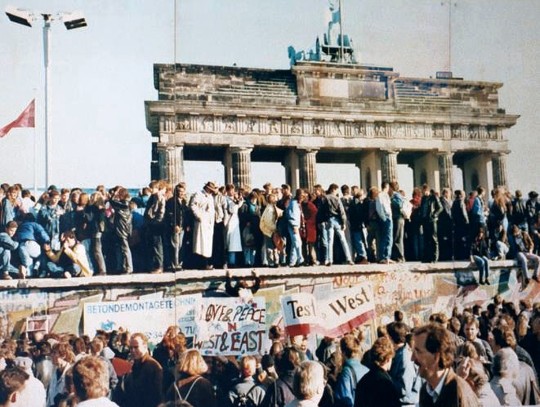 Made possible in part by cheap oil...
[Photo reproduced by Wikimedia Commons user Lear 21]
More manipulations took place as oil climbed relentlessly during the early 2000s.
The geopolitical objectives had shifted: High oil prices would act as a brake on Chinese economic growth. And the Commodity Futures Modernization Act of 2000 would help make it happen. The law "would eventually turn the oil futures market from mainly a zero-sum risk-hedging and price-discovery vehicle into a quasi-securities market," wrote Mr. Norman.
"The price of oil is now less dependent on the actual supply and demand for 'wet' barrels than on the huge sums of money pouring into NYMEX futures from the pension and other investment funds, tacitly enabled and encouraged by U.S. regulators. Daily oil volumes on the NYMEX now dwarf global physical oil consumption."
A decade ago, there were as many as 100 "paper barrels" of oil trading for each barrel of the real thing. Today that figure might well be much higher.
"The volumes are far, far out of whack with any reasonable need to hedge physical supply/demand risk," Norman told me during a 2013 interview. "The amount of funds needed to dramatically influence crude prices would be 'chump change' compared with the sums needed in the debt and equity markets."
So what’s next? Clearly the objective now is not to achieve leverage against a geopolitical rival. It’s simply to craft a perception that it’s no big deal to lose over 10% of global oil production in one fell swoop.
Back to Jim Rickards: “Financial markets will adjust to the physical reality soon, but not right away.”
That’s owing to how the physical oil market works. It takes a long time for oil tankers to move around the world. The final tankers that departed the Strait of Hormuz before the war started on Feb. 28? They’re arriving at their destinations in Australia and Malaysia today, April 20.
So… as long as the June oil futures price is, say $100, why would you pay $140 for a real barrel today when you won’t get delivery of that barrel until June anyway?
Unless and until the “two–three week” narrative breaks apart, the disconnect will go on.
We’ll do our best here to keep track of real-world prices — and real world impact.
➢ Random notes about that real-world impact: The European Commission is recommending that Europeans revert to their 2020–21 work-from-home habits when possible. Meanwhile, Bloomberg reports that the loss of aluminum exports from the Gulf region is forcing companies like Toyota to cut back on production.
 Somebody Knew Something…
And then there was the sketchy-looking trading that took place before all the news broke on Friday.
“Investors placed a bet worth about $760 million on a falling oil price around 20 minutes before Iran's foreign minister announced on Friday that the Strait of Hormuz was open,” reports the Reuters newswire — “another sizeable wager on the world's most traded commodity ahead of major announcements in the course of the Middle East war.”
Supposedly the Commodity Futures Trading Commission is looking into suspicious oil futures trades that took place earlier on March 23 and April 7. We’re not holding our breath.
Checking the paper price for a barrel of West Texas Intermediate, it’s up 5.2% as we write, back over $88.
The stock market sell-off today? Nothing major: At 7,094 the S&P 500 is down less than a half percent from Friday’s record close. The Nasdaq’s losses are steeper, the Dow’s narrower.
“Even as the S&P has been grinding to new all-time highs, the sentiment picture has been deeply bearish,” says Zach Scheidt, editor of The Income Alliance and analyst for several other Paradigm publications.
Zach is looking at the Bull/Bear Spread published by the American Association of Individual Investors — a measure of how retail investors feel about where the market is heading.
This figure “actually turned more negative last week even as stocks made new records,” says Zach. “Nearly half of individual investors still believe the market will be lower six months from now.
“This is the kind of wall-of-worry setup that fuels sustained rallies. When the crowd is bearish and prices are rising, it means someone else is doing the buying.”
This lines up neatly with Jim Rickards’ observation above: Don’t expect markets to adjust to the realities of physical oil shortages just yet.
Which is what will make earnings season so interesting in the next couple of weeks.
Companies are likely to report rising earnings — but what will their guidance be for the rest of the year? If it’s cautious, the reaction could be swift and severe.
Note well: The rise in the S&P 500 lately has been driven by outsized gains in the “Magnificent 7” companies. Five of them report their numbers next week — Microsoft, Google, Meta, Amazon and Apple.
The market for non-dollar assets is a mixed bag as the new week begins.
At last check, gold has inched back below $4,800 and silver is under $80 again. Bitcoin hovers just under $75,000 and Ethereum a little below $2,300.
 Editors out and About
“Beautiful morning at Kennedy Space Center,” said a note on Paradigm’s internal e-chat yesterday from our tech-investing specialist Ray Blanco.
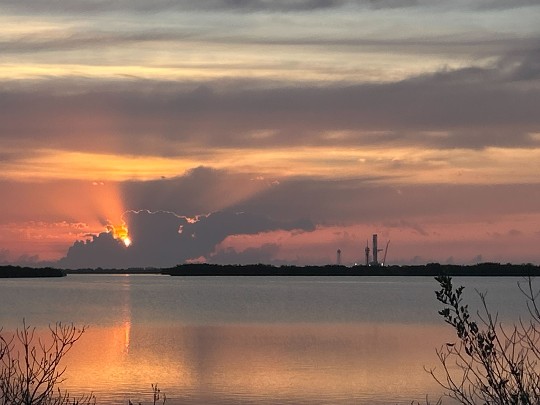 The view at T-minus 4 minutes [Ray Blanco photo]
Ray was on hand as Jeff Bezos’ Blue Origin firm launched a satellite owned by AST SpaceMobile (ASTS) — a satellite that’s key to the company’s ambitions to deliver wireless service via the mobile phone you already have in your pocket.
Unfortunately, while liftoff was flawless, the mission was not. It was the first time Blue Origin successfully reused one of its New Glenn rockets. But the rocket’s upper stage dropped off the satellite at the wrong destination — or as an ASTS statement put it, an orbit “lower than planned.”
Indeed, the orbit is too low for the satellite to be functional — and there’s no way to push the satellite where it needs to go.
The company says it has insurance to cover eventualities like this, but ASTS shares are down 9% today.
Ray’s conviction in the company, however, remains strong: The company has launch contracts with space firms other than Blue Origin. It still expects to launch 45 of these satellites by year-end — although with this mishap that’s down now from the initial goal of 60.
The defense sector is showing its stuff this week at the Sea-Air-Space conference near Washington, D.C. — and our Byron King is on hand.
In addition to his energy-and-mining cred, Byron has a 30-year background as a Navy flight officer and former staffer with the Chief of Naval Operations.
“From the outside looking in, it's hard to know what's happening. Which is why I'm here on the inside, looking around,” he tells us.
Among the things he’s seen: “Huntington Ingalls (HII) has a beautiful model of a Ford-class aircraft carrier at its exhibit space. And look at what's sitting on the No. 3 catapult... an MQ-25 ‘Stingray’ drone, built by Boeing (BA).”
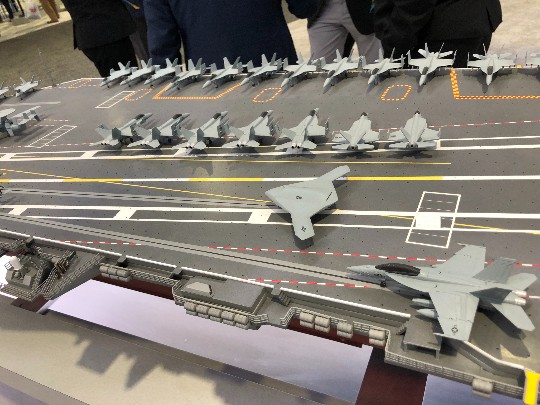 Scaled down for conference-floor presentation, not actual size [Byron King photo]
“No pilot: just electronics that can work under AI, or accept external control and be part of a flying package. If it looks ‘stealthy,’ that's because it is kinda stealthy; great design. Inside this bird are fuel tanks that can carry about 15,000 pounds of JP-5 jet juice, to transfer inflight to accompanying F/A-18s, F-35s, E-2s and more. Then it returns to the ship and lands automatically.
“By using a dedicated tanker drone, the Navy saves wear and tear on F/A-18s, which have long been tasked with that role. But now, planners can utilize those F/A-18s for other missions.”
Byron is posting regularly from the conference to the Paradigm mobile app. If you haven’t downloaded it yet, it’s a great source for exclusive app-only content — as well as the easiest way to keep up with the buy and sell alerts from your paid subscriptions. (No sifting through email!) Download here.
 And Finally…
No comic relief today — just a reminder of what happened 251 years ago yesterday…