
36 Days (Musk World Domination Plan)
 36 Days (Musk World Domination Plan)
 It’s as certain as anything can be in finance: 36 days from now, markets will never be the same.
We should back up a bit. Last month in a guest essay, Paradigm tech investing specialist Ray Blanco spotlighted how “compute” — a noun meaning computing/processing power — has become a “secret currency” of sorts.
And Elon Musk has a plan to become the dominant player in it.
Ray likened Musk’s plan to how John D. Rockefeller came to dominate the oil business 150 years earlier. “Rockefeller realized the money wasn't really just in the oil itself. It was in controlling the whole chain — the refineries that turned crude into something useful, the pipelines that moved it, the distribution that put it everywhere.”
In that vein, Musk is planning something very similar to the old Standard Oil — SpaceX rockets that hoist Starlink satellites into space… Starlink satellites that provide connectivity… his Terafab project that will manufacture chips… and data centers with their own on-site electricity.
(And later, data centers in space itself, again lifted by SpaceX rockets.)
What’s coming in 36 days is also comparable to something in the oil business.
Ray explains: “CME Group runs the markets where oil, gold and wheat get priced. On Aug. 11 they announced a new product, and this is how the head of their energy desk described it:
‘Compute has become the currency of the AI age.’”
With that in mind, CME will launch a futures contract for compute — and it will start trading on Monday, Oct. 5.
But there’s a key difference between oil and compute, says Ray: “Standard Oil was founded in 1870. Crude oil futures didn't start trading on NYMEX until March of 1983.
“One hundred and thirteen years. That's how long it took the world's most important commodity to go from 'this is the strategic resource' to 'here's a listed contract you can trade.'
“Compute is making the same trip in roughly three years — and landing on the same exchange.”
So here’s the “plumbing” of what takes place on Oct. 5: “Pending regulatory review, CME will list two new futures contracts,” says Ray.
“One tracks the hourly rental cost of Nvidia's H100 — the 2022-vintage workhorse behind most of what you think of as AI. The other tracks the newer Blackwell B200.
“Each contract represents roughly a month's worth of rent for one of those chips.
“They settle in cash against an index published by a firm called Silicon Data, which is backed by the Chicago trading house DRW.
“Just as almost no oil contract ends with someone hauling away a barrel, nobody takes delivery of a server rack either.
“Right now the market is a black box. Two companies buying the exact same GPU capacity could pay wildly different prices, with no way to know who got the better deal.
“That's the world we've been living in. Enormous sums, negotiated privately, disclosed to nobody.
“There has never been a public price for the most strategically important resource of this decade. Not a bad one — none. No screen to check, no benchmark to argue with, no number in the newspaper.
“In six weeks we’ll have one.”
So what will change after Oct. 5? Ray identifies three things…
- “It puts a number on obsolescence.” That is, we’ll have real-time knowledge of how the market values Nvidia’s older chips versus its state of the art
- “It exposes the middlemen.” We’re talking about the AI cloud companies that rent out GPU capacity. Right now, their pricing is opaque. “From October,” Ray says, “anyone can compare what they charge to a published benchmark. That's wonderful for operators who are truly efficient”
- Finally, “It tells you when you’re wrong. Every argument for owning AI infrastructure rests on compute being scarce and staying scarce. Until now, that's been a judgment call. Starting in October there's a forward curve that tells you what the market actually thinks.
“Even if you never place a trade, that curve is a free research tool. I'll be reading it.”
As for Musk, he’s still “building the compute,” Ray says. “He's building Terafab to make the chips. He's growing Colossus to put the chips to use on Earth. He owns the rockets to put them to work in space. Musk is minting this currency…
“A currency without a public price is a private arrangement. A currency with one is an asset class — which is precisely what the largest pools of capital in the world need to commit at scale.
“Musk spent the last year building the mint. On Oct. 5, somebody hands him a market.”
Stay tuned…
 A Monolithic Market? No More…
With a week before the Labor Day weekend, “the market has continued shifting away from moving as a single block,” says Paradigm analyst Zach Scheidt.
“For a while, everything rose and fell together on the AI headline of the day. That's breaking down now. The gap between the market's winners and losers is wider, and the tie that binds individual stocks together has come loose.”
But that doesn’t mean money is exiting the stock market. It’s just moving to other sectors.
“While tech had to take its summer lumps, the leadership has quietly broadened out,” Zach wrote Friday for Altucher’s True Alpha. “Value stocks have been grinding steadily higher for months without so much as a real pullback. Financials keep printing record after record. Health care has come back to life. Energy is still sitting near the top of the board for the year.
“Even the average stock is doing better than the headline indexes let on, with the equal-weight version of the market pushing to fresh highs while the crowd frets over a handful of megacaps.
“A couple of beaten-down corners are showing signs of life too. Precious metals have started to wake up after a long grind lower, and the crypto-linked names are perking back up after a cold stretch.”
More about crypto in Bullet No. 3…
As for today’s market action, the major U.S. indexes are in the red — but they’re on track for a positive month of August.
The S&P 500 is down just under a half percent as we write at 7,676. We’re seeing similar moves in the Nasdaq and the Dow.
Bonds are selling off as well as stocks — pushing yields higher. At just under 4.76% the 10-year Treasury yield is the highest since early 2025.
Precious metals are licking their wounds after Friday’s beat-down — gold at $4,434 and silver at $66.18.
U.S. oil futures are up nearly two bucks to $85.28 after back-and-forth airstrikes between U.S. and Iranian forces. Whether they escalate from here is anyone’s guess.
Tomorrow Donald Trump is set to meet with representatives from at least 10 U.S. fuel producers and distributors. What’s he going to tell them? Produce more? U.S. refineries are producing flat-out right now — in some cases, at the cost of routine maintenance and the preparations to switch to winter blends of fuel…
 Crypto Awakens
Bitcoin has awakened from a slumber — but for how long?
From a low near $63,000 on Aug. 17, the flagship crypto staged a furious five-day rally. Then last week, it topped $80,000. Checking our screens, it’s consolidating at $78,616.
“It’s easy to look at Bitcoin’s 25%-plus rally off its August lows and assume the easy money has been made. But you shouldn’t lose too much sleep if you missed this initial move,” says Paradigm chart hound Greg Guenthner.
“I believe this is just the start of another Bitcoin bull market cycle. There will be plenty of opportunities to profit as crypto climbs out of the abyss over the ensuing weeks and months.”
After its October 2025 peak over $120,000, many investors left Bitcoin for dead during 2026. Why bother when semiconductors and AI plays were ripping higher?
“Zooming out for a longer-term view,” Greg says, “we’re also seeing old resistance levels from the 2021 peak acting as a floor where buyers are stepping in.”
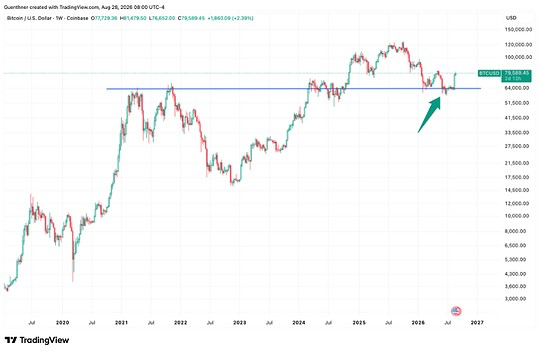
What’s more, “the current Bitcoin breakout also perfectly aligns with its longer-term bull/bear cycles. All Star Charts analyst Alfonso De Pablos points out that major Bitcoin lows have been spaced almost exactly 3.91 years apart (January 2015, December 2018, November 2022).
“This points directly to August/September 2026 as the next major turning point. We are smack in the middle of that window today.”
So where does it go from here?
“A Bitcoin breakout above $82K likely launches the flagship crypto above $100K for the first time this year,” Greg says. “Then, new highs are within reach. Meanwhile, Ethereum has already broken above its April–May highs. A resolution higher from this current consolidation pattern targets $3,000-plus.”
 Comic Relief
I mean, this one’s too easy, right?
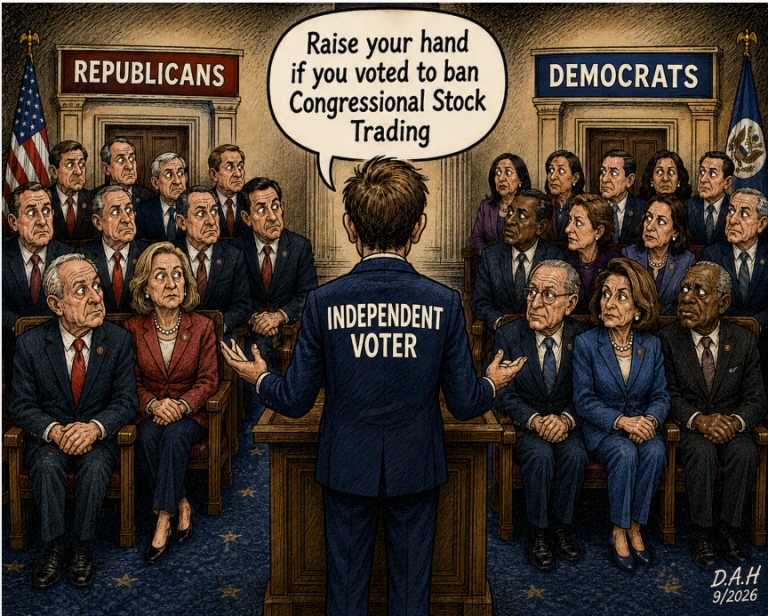
Now, we should clarify: Last month, the House passed something called the Stop Insider Trading Act by a mostly party-line vote of 232-198. (Thirteen Democrats joined all Republicans to vote “yea.”)
Generally speaking, the measure forbids members, their spouses and dependent children from buying “covered publicly traded investments” and they must provide public notice before selling.
It does not, however, require them to divest stocks they already own.
And in any event, passage in the Senate will be nearly impossible because a voter-ID provision was tacked onto the bill last-minute.
(Gee, you don’t think all those Republicans voted for it knowing it would never become law, do you?)
 Mailbag: Iran
I fully expected some hostile reaction after last Thursday’s Bullet No. 1. But there’s still something I can’t figure out.
First, a sampling…
Iran, says one, “will never recover to the status of unchecked regional bad boy who got away with literal murder for 47 years. Their relationships with their Gulf neighbors which previously survived largely on loose Islamic religious affiliation have been irreparably broken after Iran lashed out at them simultaneously proving that they are dangerous and bad for business. Iran's claims over controlling the Strait of Hormuz will become increasingly irrelevant as oil, gas and other products find alternate routes.”
Another: “Arguments against regime change are extremely convincing, but so is the concept of ‘existential threat.’ Iran is led by extremists who weaponize a radical version of Islam to indoctrinate their people and suppress and shame any rational voices that might dissent. It is this extremism that leads me to believe conflict with Iran was inevitable. Or are we going to allow them to fund radical terror groups unchecked for decades to come? I don’t see an out, but I see people turning a blind eye.”
And then there was the reader who thought our assessment was “a disservice to the president, the military, Americans, but even worse, demoralizing to Iranian citizens caught in the brutal, oppressive grip of the IRGC.”
OK, you get the idea. There’s no point trying to rebut anyone here. The roughly one-third of the country who still thinks the war was a good idea are dug in.
Here’s what I don’t get. I’m assuming most of these critics are Jim Rickards subscribers. But Jim has dismissed the easy-victory rhetoric from the beginning.
I mean, it’s right there again this morning in his weekly “Five Links” email to Strategic Intelligence readers. “[Trump] said the U.S. controlled the Strait of Hormuz. That’s nonsense. We operate a blockade out in the Arabian Sea beyond the mouth of the Strait, but that’s not the same as controlling the Strait.
“Then Trump published a map showing the Strait as ‘NEW U.S. Territory.’ More nonsense. Iran has continued to exercise substantial control over traffic through the Strait despite U.S. efforts to clear shipping lanes…
“We’ve said since early March that Iran was winning the war and the U.S. had failed to achieve its major goals, including regime change, financial collapse and the elimination of Iran’s stock of highly enriched uranium (HEU). We also said Iran would continue to use the Strait of Hormuz as its most powerful bargaining chip.
“And that’s exactly what’s happened.”
All of which has been duly noticed in Beijing and Moscow, by the way.
“We are teetering at the edge of major escalations in both our war against Iran and our proxy war against Russia in Ukraine,” warns a recent social media post from Joe Kent — who resigned in protest as director of the National Counterterrorism Center 18 days into the war.
“President Trump needs to look at who he’s surrounded by — who he’s taking advice from, who got him into these messes — and make major changes now, before it’s too late.”


