
The SPCX Casino
 The SPCX Casino
 "We've all been forced into a giant casino," says Tim — a sixtysomething engineer from the Silicon Valley region.
Asked by The Guardian how he feels about the SpaceX IPO and how it might affect him, he replied, "I've never wanted to participate in the so-called AI bubble. Basically my entire retirement is in the S&P 500. Not out of choice, but if you don't have investments in the stock market, you're losing ground compared to everybody who does.
“That's the pernicious thing about it. There's really no way for the average person to diversify."
Lurking in the background of Tim’s concerns is this: SpaceX is being added to major stock market indexes well ahead of the usual schedule for newly public companies. It joins the Nasdaq-100 tomorrow.
“If you own a Nasdaq index fund — in your 401(k), your IRA, your kid's college account — you're about to become a SpaceX shareholder,” says Paradigm tech investing specialist Ray Blanco. “Nobody asked you. That's how index inclusion works: Trillions in passive money is now mandated to buy SPCX.
“And the circumstances are unusual. The Nasdaq wrote special rules just to get SpaceX in early after the record IPO.
“Here's what makes the timing interesting. SPCX closed Thursday at $162 — about 20% below its June high. The retail euphoria came and went. The rotation traders came and went. And now the most patient, price-insensitive buyers on Earth — index funds that never sell — start accumulating.”
So… will index investors like Tim be left holding the bag?
Maybe not — not if Elon Musk moves ahead and merges SpaceX with Tesla.
Ray is among the Paradigm experts along with James Altucher and Davis Wilson who are convinced it’s going to happen.
“The signals are already there,” Ray says. “For example, Terafab isn't a SpaceX venture. It's a formally joint initiative spanning both Tesla and SpaceX. Tesla builds the $3 billion pilot line. SpaceX owns the full-scale fab. Two shareholder bases, one project.
“And we have the Elon pattern. X folded into xAI in March 2025. xAI folded into SpaceX this February. Exactly one major piece remains outside SpaceX.”
But the most compelling rationale for a SpaceX-Tesla tie-up is the calendar.
“The SpaceX IPO lockup expires in December,” Ray says. “Up to 20 years of paper gains — early funds, employees, institutions with LPs demanding distributions — become sellable in a single window.
“There is exactly one announcement that turns December's sellers into December's holders: Your shares are about to become part of something far bigger.
“To be clear, the two sides of the combination need to legally sort things out and get shareholder approval.
“So the deal announced this year likely closes next year. But I'm betting on the announcement.
“If it comes, it creates something without precedent: rockets, satellites, AI, robots, energy, chips, and self-driving cars inside one company. A company assembled to mint the currency of the next century from a place no competitor can follow.
“This will be the greatest moonshot in the history of capitalism,” Ray concludes.
To be clear, that doesn’t make SpaceX a buy right now. SPCX is not a recommendation in any paid Paradigm publication. Most of the time, there’s too much noise and not enough signal amid the price action in an IPO — and that’s doubly true for a company with as much hype as SPCX.
But if the pre-IPO shareholders have an incentive to hold on beyond this year… maybe the folks who are about to involuntarily own shares through index funds can rest a little easier.
 Stock Market Shift
It’s been nearly five weeks since the S&P 500 notched an all-time high. But don’t confuse that with weakness in “the market.”
A shift took place during June: “After months of the rally being concentrated in a handful of semiconductor stocks,” colleague Davis Wilson writes at The Million Mission, “market leadership finally began to broaden. Financials started participating. Health care joined the rally.
“Small caps surged too. The Russell 2000 ended the first half more than 21% higher, putting the index on pace for its best first-half performance since 1991.
“Granted, even that small-cap rally was heavily influenced by AI. Nine of the 10 best-performing stocks in the Russell 2000 are tied to artificial intelligence or semiconductors.
“But investors are no longer just buying just the Magnificent Seven and a handful of chipmakers.
They're buying the broader AI ecosystem.
“That's a much healthier market than the one we started the year with.”
“The average stock is now starting to carry its weight,” concurs Zach Schiedt — analyst for Altucher’s True Alpha and Rickards’ Insider Intel.
Evidence shows up in RSP — the ETF in which all the S&P 500 stocks comprise 0.2% of the holdings. RSP logged several all-time highs during the final days of June and first days of July.
“When the average stock wins while the giants stall,” says Zach, “that tells you money is spreading out across the whole market instead of crowding into the same five names.
“The mega-caps that carried this thing for years are cracking, with several slipping below key support. That money has to go somewhere, and right now it's fanning out into the rest of the market.”
Of course, we mention all of this on a day when the price action is an exception to the recent rule.
As we check our screens, the S&P 500 is up nearly three-quarters of a percent at 7,537. Meanwhile, RSP is flat on the day.
The Nasdaq Composite has powered 1.4% higher, back over 26,000. But the Dow is slightly in the red.
Precious metals are losing ground — gold at $4,147 and silver at $61.39. But crypto is showing renewed signs of life — Bitcoin over $63,000 and Ethereum in striking distance of $1,800.
U.S. oil futures are flat at $68.76 — about where they were during the Iran war’s early days four months ago.
That said, we’re hearing rumblings that China’s oil imports are starting to pick up again. As we chronicled here last month, China slashed its crude imports by 40% year-over-year and stopped adding to its strategic petroleum reserve. But the country’s small, semi-independent “teapot” refineries are starting to load up again.
 AI Data Centers and Heat Waves
Amid a heat wave, it was a lucky break the Eastern Seaboard didn’t experience widespread power outages over the holiday weekend.
On Friday, PJM — the country’s biggest regional grid operator — said it was under federal orders to cut power consumption across its territory, covering 13 states stretching from New Jersey west to Illinois.
PJM was under assault from “generator outages, massive overloading on its transmission lines and a surge in air conditioning use from prolonged sweltering heat,” per a CNBC report.
And if you suspect data centers were a factor, you’d be correct: Spot wholesale power prices in northern Virginia — home to “Data Center Alley,” the highest concentration of data centers in the world — surged past $2,000 per megawatt hour. That compares with $40 during normal times.
“The surge in prices is mostly because it has become expensive to provide power across congested high-voltage power lines, according to industry analysts and PJM’s operations data.”
We warned at this time two years ago that AI was becoming “the monster that ate the power grid.” During 2025, Paradigm readers prospered from investing in companies like Vistra and Talen — “independent power producers” that aren’t regulated utilities.
Turns out there’s an ETF packed with these companies — the Virtus Reaves Utilities ETF (UTES). The share price has gone nowhere for nearly a year, but it might simply be digesting massive gains from 2024 and the first half of 2025. Worth a look…
 Comic Relief
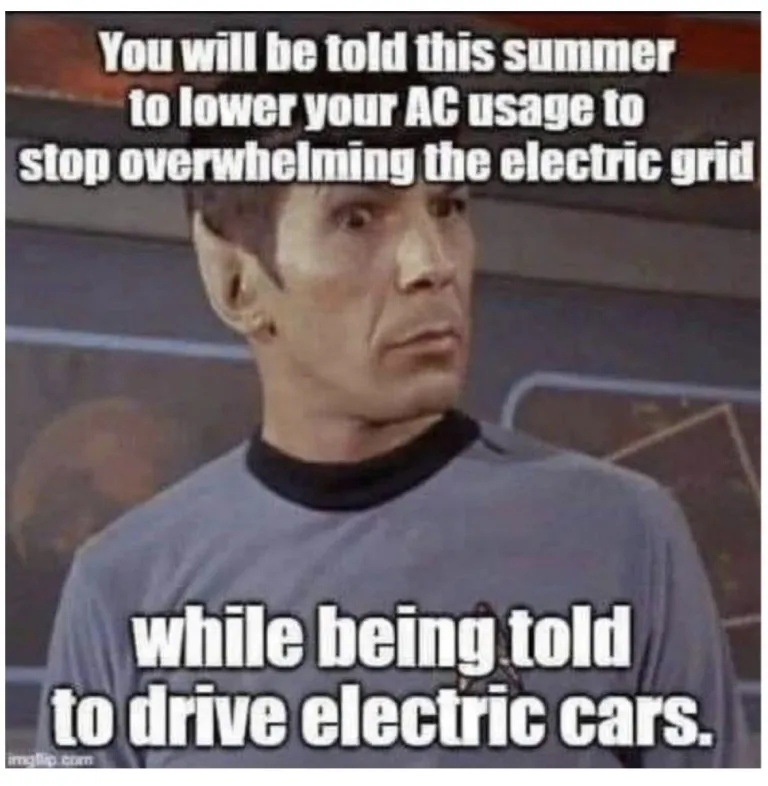
Speaking of heat waves and stress on the power grid…
 Mailbag: OpenAI Bailout, National Debt, “Inalienable” Rights
“The bailout of Altman’s OpenAI has been telegraphed for a long time,” a reader writes after we took note last week of OpenAI’s pitch for the federal government to take a 5% stake in the firm.
“The only way this works for him is to have the taxpayer foot the bill. Now with the chief inside trader in charge, it will be much easier for him to get his wish.
“As far as pushing the IPO out to ’27, perhaps he is getting a little nervous about having to actually open his books. Pretty sure when this bubble is over, the emperor will indeed be buck naked.
“Thank you for all you do!”
Dave responds: Hard not to wonder whether Anthropic, the company behind Claude, might make the same pitch soon.
About a month ago, Anthropic called on the AI industry to slow its pace of development. The company’s rationale was this: The state of the art was advancing so quickly that AI models would soon be able to improve themselves without human intervention, touching off all manner of unintended consequences for society.
(Again, as with Altman, notice the humanitarian appeal.)
As one skeptic put it on X, “Translation: People can’t afford our models and our AI bags are about to blow up.”
“Any ideas on how to reduce the national debt?” a reader inquires after Sean Ring’s guest edition we published while the markets were closed Friday.
Another reader already has an idea: “I believe what is always ignored is the waste, fraud and abuse of taxpayer funds.
“Elon tried to correct the matter with the DOGE program but was shot down or ignored. I believe that if the waste, fraud and abuse of the taxpayer funds were eliminated, the debt would drop to one half of what it is; the problem, of course is that the present representatives and Senate are on the take as much as the normal crooks and that has to do with the elections and noncitizens voting.
“A long time ago The 5 asked how does one become a millionaire and I answered by running for political office in D.C. and that still holds true today — a sad commentary on today's politicians (it may have always been that way from the beginning)!”
Dave: Sorry, but “waste, fraud and abuse” are part and parcel of the system. If you want to reduce it, you have to reduce the size and scope of government first.
On that score, and to tackle the original question, nothing gets better until two things happen: the health care cartel is smashed and the military-industrial complex is dismantled.
Neither of those things is likely to happen without a sovereign debt crisis forcing the issue. Which is why your editor is partial to investments geared toward tangible wealth — precious metals, base metals, energy, agriculture. People want real stuff when paper promises blow up.
OK, we’re going to put the whole inalienable/unalienable thing to bed for good today.
“Haven’t you ever accidentally hit a ‘u’ when reaching for an ‘i’?” a reader writes with tongue firmly in cheek.
(The QWERTY keyboard didn’t come along until a century after the Declaration of Independence.)
More seriously he says, “Obviously the discrepancy between Jefferson and the Declaration was a typo!”
Meanwhile, the original reader who touched off the controversy wrote back: “So it's ‘tomato — tomato.’ My sincere apologies — to me it sounded like a David Hume/John Locke-type distinction.
“I did find a source that opined that the i- form pretty much replaced the u-form during the 1830s. Again, sorry for the distraction. Thank you for filling up the rabbit hole.”
Dave: Looks as if you found the same article I did, complete with a graph showing how indeed the usage shifted nearly 200 years ago.
No apologies necessary — you’ve been around long enough to know that I’ll make a conscious decision now and then to let the mailbag go off on a tangent!


