
The Thief in Your Portfolio
 The Thief in Your Portfolio
 “Let me tell you why you’re bleeding cash in the markets,” says acclaimed trader JC Parets, the newest editor in the Paradigm Press stable.
JC formally joined our crew yesterday during an exclusive streaming event with James Altucher titled The 100X AI Window — in which he detailed a lucrative near-term market opportunity. (You can watch a replay at this link.)
But for today’s Bullet No. 1, JC joins us with some timeless wisdom.
If you feel as if your portfolio isn’t up to snuff, JC says the reason is not “commissions, high-frequency traders or even bad luck.”
Rather, he says, “it’s your own brain, silently murdering your trades.”
What JC is about to describe applies no matter your time horizon — short-term trading or long-term buy-and-hold: “Every trader rides two destructive emotional cycles that feed off each other.”
The first is FOMO — that ever-present fear of missing out. A stock you’ve been watching suddenly surges. You wish you’d pulled the trigger sooner. Your brain races to justify buying now. It’s not too late.
If you buy and the price rises further, “dopamine locks in the habit,” JC warns.
But if it flops, a second destructive cycle kicks in — hope and denial. “Now you’re trapped in a loser, clinging to breakeven.”
This is especially ruinous for traders. You average down. You break your rules. “Small losses balloon into account killers.”
And no, you can’t train your brain to overcome these tendencies — they’re “hardwired into your head, JC says. “Your brain hates missing out and fears losses more than it loves wins.”
So here’s your only remedy: “You can’t kill emotions — use them,” JC says.
Get comfortable missing trades. “Know the traps, then build habits to dodge them.”
What follows now applies most to trading…
- Before any trade, run through a mental checklist.
- Where exactly am I entering?
- Where is my stop?
- What's my target?
- How much am I risking?
- Does this trade align with the higher timeframe trend?
If you can't answer any of these clearly, the trade doesn't happen. It's that simple. “First,” JC says, “get comfortable with missing out.”
- After a loss — and there will be losses — have a shutdown ritual.
- Turn off your trading platform. Get up from your desk
- Go for a walk. Grab a bite to eat. Take a shower or exercise.
“Implement a mandatory 24-hour cooling off period after any significant loss.”
- Finally, make weekly reviews non-negotiable. Every Sunday, go through your trades with a cold, objective eye.
“Grade yourself not on profitability, but on discipline,” says JC. “Did you follow your rules?
“Trading boils down to two things,” he concludes — “managing risk and yourself.” Treat losses as a cost of doing business.
“Markets shift; human nature doesn’t.” That’s the edge JC brings to Paradigm — spotting patterns you can use instead of letting your emotions use you.
Because that thief in your portfolio — your own brain — will never leave!
We hope you enjoyed this exercise in investor education today. It’s this mindset that’s made JC such a success in the markets over the decades — anticipating the onset of the 2008 financial crisis as well as the COVID crash of 2020. And he nailed the start of the current bull market in October 2022, almost to the day.
Now he wants to show you how an obscure government document is about to unleash a massive profit opportunity in the next six days.
We’re talking the potential for gains of 10X, 50X and even 100X in a matter of weeks. (And it has nothing to do with earnings announcements, mergers or FDA trials.)
 Beneath the Surface…
Beneath the surface of the major averages, a shift is taking place in the U.S. stock market.
“For a long stretch, everything moved together on the AI headline of the day. Now fewer names are doing the heavy lifting, breadth has thinned out and lately more stocks are sliding than rising,” Paradigm analyst Zach Scheidt writes today for Altucher’s True Alpha.
Only a few weeks ago, more than 70% of stocks were trading over their 50-day moving average. Now it’s just a third.
“One bright spot worth noting is that the market just printed its first oversold reading in months,” Zach says. “The added volatility is helping to shake out the weak hands.
“That kind of washout has often pointed to better returns down the road, so it's worth watching rather than fearing. Don't mistake any of this for capital heading for the exits. It's simply moving around inside the market.
“Across tech, leadership is quietly handing off from the semiconductor trade to software. Outside of it, the groups that tend to hold up when yields rise have been doing exactly that, while the rate-sensitive and defensive corners lag.
“Even a few beaten-down areas, precious metals among them, are showing the first signs of life after a long grind.”
As for today, all the major indexes are in the red — though not by much.
At last check the S&P 500 is down less than a quarter-percent on the day at 7,623. It’s been over a month since the index notched its record close of 7,798.
The Nasdaq is down only fractionally, while the Dow is down close to a half-percent.
Precious metals are staging a respectable comeback after their beatdown on Wednesday — gold now only $16 away from $4,500 and silver up another $1.50 on the day at $66.59.
And crypto is on a tear: Bitcoin back over $80,000 and Ethereum approaching $2,600. Paradigm trading pro Enrique Abeyta says if Bitcoin can push over $85,000, the path is clear for a return to $100K and beyond.
One economic number of note today and it delivered a nasty surprise: The Federal Reserve says industrial production was flat between July and August — in contrast with Wall Street’s expectations for a 0.3% gain.
Worse, manufacturing shrank 0.3% for the month. No one among dozens of Wall Street economists surveyed by Econoday saw that coming.
 Not Quiet on the Western Front
The oil market is getting tighter and tighter as the weekend approaches.
Bloomberg reports that Saudi Aramco, Saudi Arabia’s state-owned oil firm, has informed “at least two oil refining customers in Europe that they will be allocated no crude next month under long-term agreements after the kingdom’s key pipeline to the Red Sea was attacked.”
The news comes hours after another Bloomberg scoop that Aramco is bidding for diesel cargoes in Europe. That’s right, one of the world’s top three oil producers doesn’t have enough diesel to supply its own needs because of attacks on its refineries.
While the U.S.-Iranian theater of the war is mostly quiet at the moment, the “western front” is red-hot with fighting between Saudi Arabia and the Houthi faction of Yemen, which is aligned with Iran.
And red-hot could get even hotter if Pakistan gets involved.
Last month in Islam’s holiest city of Mecca, leaders of Saudi Arabia, Pakistan and Turkey signed a mutual defense agreement.
This week, Pakistani defense minister Khawaja Asif said his country is ready to fulfill its obligations under that agreement as the Saudi kingdom fights the Houthis. The Mecca agreement “applies to us,” he said, “and we will fulfill our duty.” He was careful not to say how.
But for the moment, none of this matters to U.S. oil futures — down about 75 cents to $101.12 as we write. Still, crude is on track to end the week slightly higher than it ended last week.
 The Broadcasters’ Lobby (and Emergency Preparedness)
Over-the-air broadcasting might be a dying business — but it sure has a powerful lobby.
On Tuesday, the House overwhelmingly passed something called the AM Radio for Every Vehicle Act. It was a voice vote; the measure had 317 sponsors. Passage in the Senate is guaranteed with 60 sponsors.
The measure will require automakers to continue furnishing AM radio in their new models.
In recent years, automakers including Tesla, Volvo and BMW dropped AM radio. Modern automotive electronics often generate buzzing noises and signal fading on AM frequencies. It’s especially bad in electric vehicles.
Fixing that with electronic shielding will be an added expense for automakers, which no doubt will be passed along to the consumer.
But the broadcasters marshaled a powerful argument, one that’s not well understood.
The Wall Street Journal tried to explain it like this in 2023: “More than 75 radio stations, most of which operate on the AM band and cover at least 90% of the U.S. population, are equipped with backup communications equipment and generators that allow them to continue broadcasting information to the public during and after an emergency.”
That doesn’t tell the whole story: These stations are outfitted for a true SHTF scenario, not just a natural disaster.
Like, if the internet and wireless networks go down.
In 2018, the trade publication Inside Radio reported on WLW Cincinnati’s hardened setup in the suburb of Mason: ”The fenced-in, shed-like 8-by-20-foot structures include all the things needed to broadcast remotely, including a studio, backup transmitter and generator as well as facilities for a two-person staff such as a 60-day supply of food and water, bunks and an air filtration system.” [Emphasis ours]
Pretty hardcore, huh? And FEMA foots most of the bill.
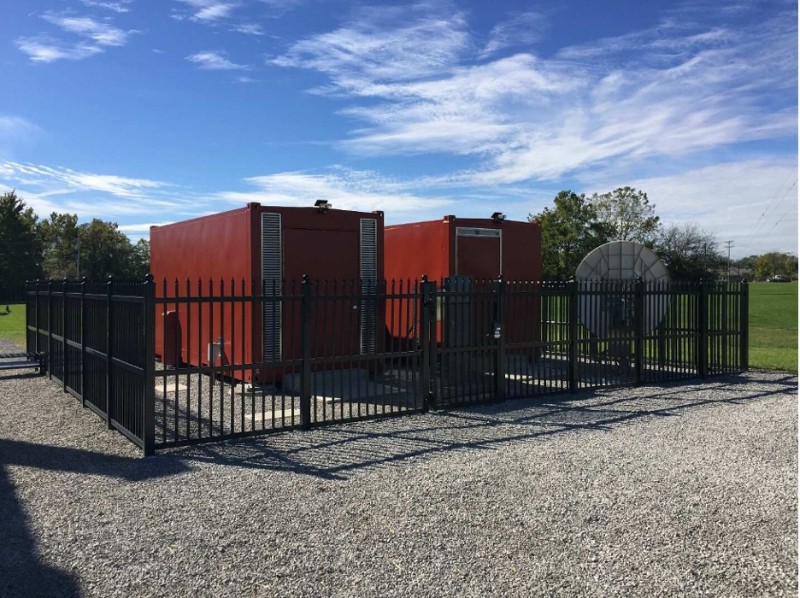 Ready for (nearly) anything: The SHTF studio at the transmitter site of WLW Cincinnati
[FEMA photo]
FEMA has a list of these stations on its website. Scroll down on the page and you can sort the list by state to find the one nearest you. Nearly all of those AM stations have wide coverage areas, especially at night.
If you live in the sticks like me, you might want to invest in a quality AM radio for the home instead of relying on whatever’s in your junk drawer.
An excellent choice is the Sangean PR-D4W. Unfortunately tariffs have raised the price big-time since I last recommended it 18 months ago — from under $75 then to over $100 now at both Amazon and Walmart. If you want to go all out for performance, the CCRadio 2E from the American firm C. Crane will set you back $199.
As a bonus, both models come with the NOAA Weather Radio band and can trip an alarm in the event of something like a tornado warning.
Look, your tax dollars are paying for all of this infrastructure: You might as well take advantage in case of the worst.
 Comic Relief (and Reading Recommendations)
This one making the rounds couldn’t possibly be more timely — or on the mark…
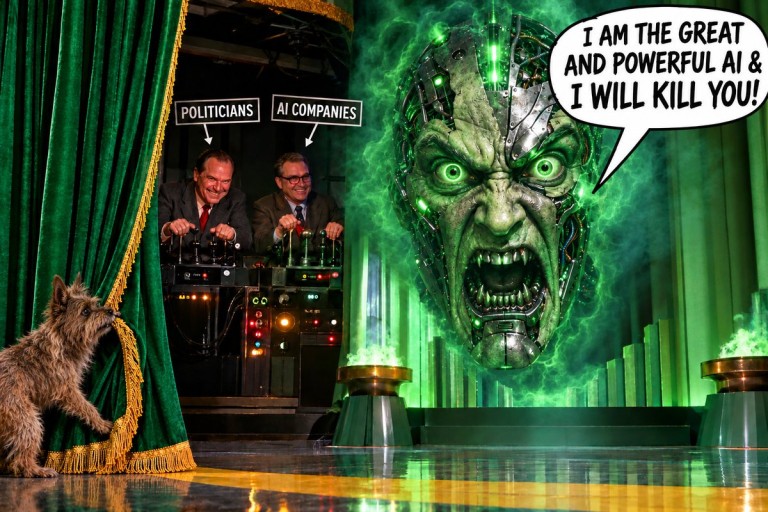
Really, the whole AI-is-gonna-kill-us-all narrative is getting out of hand.
And it is absolutely being ginned up by the incumbent “frontier” AI firms like Anthropic and OpenAI — begging the feds to “regulate me harder, Daddy” so as to throttle any upstart competitors.
That’s not a conspiracy theory. In recent days my colleagues Adam Sharp and Davis Wilson have followed the breadcrumbs.
The evidence is overwhelming. You don’t have to be pro-data center and you don’t have to buy into the argument that “we must win the AI race with China” to smell a rat here.
We’ll leave it there for the week. I’m sure the issue is going to come up again…


