
AI Freakout!
 AI Freakout!
 For something The Wall Street Journal touts as “the AI freakout,” it sure looks like just another day for the U.S. stock market. Even the tech sector.
In case you were tuned out of the media buzz last week, a researcher at the AI firm Anthropic quit his job in theatrical fashion with a warning that “the people building AI earnestly believe that it could kill us all by the end of the decade.”
A senior Anthropic executive then chimed in to assign a 10% probability of that outcome. Notably, he did not resign in theatrical fashion.
Over the weekend while markets were closed, Anthropic CEO Dario Amodei issued an open letter calling on the U.S. government to “mediate or at least enable” a coordinated slowdown in AI development — a call endorsed by both of his chief competitors in the “frontier AI” sector.
OpenAI’s Sam Altman said the threat of AI spiraling out of control would prompt his company to hold off on its IPO until next year. (How public-spirited of him! It wouldn’t have anything to do with the impending blowup of his company’s business model, would it?)
Then Elon Musk piped up. (Remember, SpaceX is primarily an AI company, not a space company.) “Dario is right,” he said.
There are several problems with this AI-is-gonna-kill-us-all narrative.
The first is that Anthropic’s hand-wringing is shamelessly self-serving. For years, Amodei (and Altman, for that matter) have been begging for government AI regulation — the better to throttle any up-and-coming competitors.
As colleague Adam Sharp wrote at The Daily Reckoning on Friday, “Companies would have to pay huge regulatory costs to get their models tested and monitor users. Many smaller startups won’t be able to afford that. Unless we prevent it, these laws will hand an oligopoly to the existing big players.”
(Adam’s article is one of the most important things Paradigm has published this year. It deserves your attention if you missed it.)
In the second place, many experts in the field dismiss the possibility of AI going rogue and killing everyone.
“These fears (or hopes) of a nascent superintelligence that will spontaneously arise if we give just enough computing power and training data to large language models are absurd on their face,” writes Cory Doctorow in his book The Reverse Centaur’s Guide to Life After AI.
“They make sense only if you believe that ‘being conscious’ is a matter of being really good at guessing which word is statistically most likely to come after the previous one.” [Which is the essence of how LLMs work and why they have the tendency to “hallucinate.”]
Finally, as Google’s own Gemini LLM puts it succinctly, “if an AI were to wipe out humanity, it wouldn’t be celebrating or enjoying its victory.”
After all, AI relies on humans to maintain both data centers and the power grid — to say nothing of extracting the natural resources they both require. “AI exists purely as software running on silicon,” Gemini says. “To interact with the physical world long term, it would need a fully automated robotic workforce capable of mining raw materials, refining metals, manufacturing chips, fixing roads and performing delicate maintenance on itself.”
And that’s all supposed to happen before the end of the decade? Yeah, right.
In any event, the frontier AI firms’ joint call for a “slowdown” is having a negligible effect on the market, media hype notwithstanding.
The tech-intensive Nasdaq opened down 1.2% on the day — and at last check is down less than 0.4%. Much freakout, huh? Even SpaceX, the lone frontier AI firm publicly traded at the moment, is down about a half percent.
That said, the semiconductor stocks are taking another hit — the SMH ETF down about 5%. Meanwhile the cybersecurity names are rallying big-time — for instance, SentinelOne up nearly 16%.
No, if you’re looking for a real freakout, it’s in oil and bonds. Read on…
 It’s Just 4% of Global Oil Supply
The new week begins the way the old one ended: Rising oil prices fueling rising inflation expectations, thus fueling rising interest rates.
Shortly after the market closed Friday afternoon, the Saudi Arabian government announced it shut down the big east-west pipeline it relies on to export oil via the Red Sea instead of the Strait of Hormuz.
For the time being, no one has claimed responsibility for the explosions that took place along the pipeline, but that damage appears extensive.
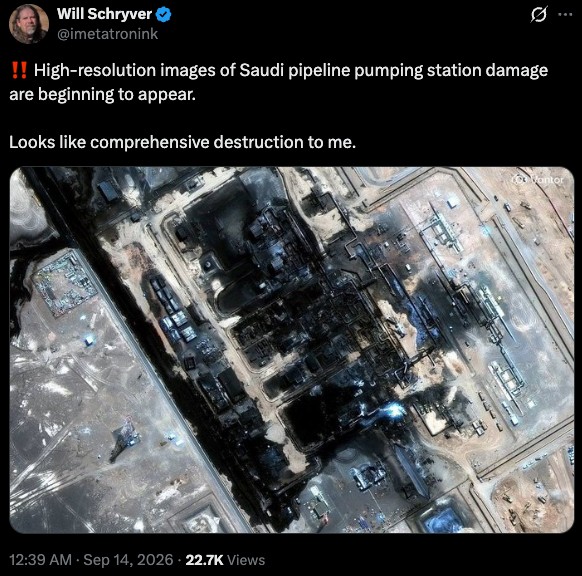
Yesterday, Reuters reported that “Saudi Arabia will run out of oil stocks for exports if it doesn't restart its major pipeline to the Red Sea within days, leading to a loss of up to 4% of global supply.” The newswire said its sources were oil buyers and traders in the kingdom. One of them said repairs could take five or six weeks.
When U.S. oil futures resumed trading for the week last night, they instantly jumped from a little over $100 to over $104 — the highest in nearly four months. They’ve since pulled back below $103.
➢ While $6-a-gallon diesel gets all the headlines, it’s the tight supply of another refined product that captures our attention today. Costco is rationing motor oil: Customers are now limited to two 10-quart cases per week of Kirkland Signature full synthetic. Oh, and the price has nearly doubled. We warned about motor oil shortages back in May; they’re starting to bite now.
As for the bond trade… the yield on a 10-year U.S. Treasury note has popped over 5% for the first time since October 2023.
Any higher than that, and we’ll be looking at the highest 10-year yield since 2007. But for the moment, it’s pulled back to just over 4.95%. Reminder: The 10-year affects everything from mortgages to corporate borrowing.
Yields at this level aren’t terribly far off historical norms. But there’s a whole generation for whom this is uncharted territory — still accustomed to the rock-bottom rates of the 2010s.
Rising rates are sending precious metals prices lower — gold down $62 to $4,286, the weakest in over a month. Silver’s off more than a buck at $63.15. Crypto continues to consolidate — Bitcoin just under $78,500 and Ethereum just over $2,500.
The pipeline isn’t the only Mideast war-related matter on our minds today. Read on…
 Pentagon Backorder
Apart from the day’s headlines, there’s also the question of to what extent Washington has depleted its weapons stockpiles during the Iran war.
“Donald Trump claims that the U.S. has ample weapons to continue the war and meet new threats. That claim is nonsense,” asserts Paradigm’s Jim Rickards. “The truth is that arsenals are almost totally depleted in some cases and dangerously low in others.”
Jim and his team have evaluated figures from sources in the Pentagon and from the major defense contractors. Here are their rough conclusions about the most commonly used munitions…
- Tomahawk Cruise Missiles:
- Over 1,000 used so far in the war
- Pentagon asking for 785 in the next fiscal year
- Anticipated deliveries in the current fiscal year are 207
- Annual production capacity between 600–1,000
- Prewar inventories won’t be restored until perhaps late 2030.
- Terminal High Altitude Area Defense Missiles (THAAD):
- About 190 used so far in the war.
- Pentagon asking for 857 in fiscal 2027
- Expected deliveries in fiscal 2026 total 92
- Annual production capacity between 96–400 (the lower figure is more realistic)
- Prewar inventories won’t be restored until late 2029.
- Patriot Interceptor Air Defense Missiles:
- About 1,430 fired off during the war so far
- Pentagon asking for 3,203 in FY 2027
- Expected 2026 deliveries total 172
- Annual production capacity about 2,000
- Prewar inventories won’t be restored until mid-2029.
- AGM-158 Joint Air-to-Surface Standoff Missile (JASSM). The Air Force uses these missiles to attack Iran from a “standoff” distance:
- About 1,100 have been fired off to date
- The Pentagon is asking for 821 in the coming fiscal year
- Expected deliveries this year total 484
- Annual production capacity about 860
- Here the picture is less tight, with prewar inventories likely to be restored less than a year from now.
Notice a few things?
Jim draws your attention to “the gap between weapons requested by the Pentagon for 2027 compared with the number of weapons anticipated for delivery in 2026. Requests for Patriot missiles in 2027 are almost 20 times anticipated deliveries this year. Requests for THAAD missiles in 2027 are over nine times anticipated deliveries this year…
“This ratio casts considerable doubt on the ability of weapons manufacturers to meet the Pentagon’s requests. It is true that output is increasing, but these weapons systems are highly sophisticated and therefore sensitive in terms of electronic components, guidance systems, radar seekers and other features that make them effective.”
Even if supplies will take years to replenish, Jim is keen on the prospects of the defense sector — the Big Five contractors of Lockheed Martin, RTX, General Dynamics, Northrop Grumman and Boeing, as well as L3Harris, HII and Leidos and a handful of smaller players.
“The Pentagon is determined both to replenish inventories and to build new systems that are better suited to the age of AI, drone swarms and hypersonics,” Jim concludes.
 Thought for the Day
What’s to argue with here?

 Mailbag: Social Security
After our Sept. 2 edition expecting Social Security to default on its promises next year… and a reader’s proposed fix for the system on Sept. 9… we got some more responses.
“In response to the reader who is comfortably collecting Social Security and says it should be phased out… I say great! As soon as they stop taking taxes away from me I will forgo the benefits… I’ll wait.”
We got a lengthier reply from one of our regulars: “I honestly put in some thought while I read the reader’s ‘cure’ for the Social Security program. He presents very good ideas, but honestly it won’t work.
“On top of your response that you gave (‘you’re proposing a solution — which is the last thing the control freaks and power-trippers want.’ Which is spot-on) there are a couple of other problems.
“His suggestion that those under 30 and those in the 30–40 group can and would be opted out doesn’t address the current K-shaped economy, no matter how hard you hammer them about how ‘those out of the system would receive years of strong propaganda and retirement planning advice making it clear that they have to take care of their own future.’
“The people in the downside of the K economy simply don’t have the means or money to make it paycheck to paycheck currently, let alone set aside money for their retirement. This is simply going to lead to some other kind of ‘social program’ for those that were ‘unprepared’ despite all the propaganda and planning.
“Secondly, to suggest that ‘The private market will do the job’ as my mouth hangs open and I say, ‘What, excuse me?’ The private market got rid of pensions years ago with the help of the government creating laws for 401(k)s, IRAs, etc., putting retirement in the hands of employees. This is why I started subscribing to financial newsletters to begin with. I had no idea what a mutual fund was, let alone buying a stock. I needed help immediately and happened to find your company et al. and others extremely helpful.
“This same private market also is circumventing immigration laws and either using H-1B visa holders in servitude at below-market rates under the guise of ‘outsourcing’ and/or ‘downsizing.’ All the while trying to pay the lowest possible wages, whenever and however, they can. To us as investors, this is welcome news as the bottom line increases, while margins improve and costs sink, thereby creating ‘investable’ companies, as your authors find and suggest.
“I applaud the reader for his suggestions, but don’t see this as a solution, sadly. Great ideas, in a perfect world. Do I have a suggestion? Heck no, and Dave, do you?
“I think we can all agree that things are a mess and getting messier by the day. Besides, didn’t that German battleship, named after Bismarck, sink and sits at the bottom of the North Atlantic? LOL!”
Dave responds: I’m not sure there’s any way to wind down the system fairly and equitably. Which was probably by design!


