
Buy NVDA, Avoid ANT
 Buy NVDA
 OK, I’m calling an audible for today’s edition.
I know I promised an exploration of how the Democrats intend to address "affordability," since that was the issue on which they won a thumping victory in the midterms.
But there will be ample time to do that between now and the time the new Congress is seated in January. I’m chucking my original plan to bring you a timely one-two punch of market insights courtesy of Paradigm hedge fund veteran Enrique Abeyta.
As you likely know, Nvidia reported its quarterly numbers late yesterday, reflecting Jensen Huang’s final full quarter at the helm…
- Revenue: NVDA logged record-breaking sales of $115.8 billion — more than double the year-ago figure and 6.3% higher than the Wall Street consensus
- Earnings: $2.68 per share adjusted, 15% higher than what Wall Street analysts were counting on
- Guidance: Q4 revenue now estimated at $130 billion, up 90% from a year earlier and 4% above the Wall Street consensus.
Oh, and the company authorized $150 billion in share buybacks.
The share price jumped in after-hours trading. But an hour into regular trading today, NVDA was down 1% from yesterday’s close.
Which makes NVDA an even better buy now than it was when Enrique Abeyta talked it up yesterday in his Truth & Trends e-letter.
No, not for the long haul — just as a trade. “I believe investors who buy today could be rewarded over the next six days or six weeks.”
More than a month ago, Enrique told us that the days “when you could buy just about any AI-related stock and watch it go up” are over and done. Now he’s increasingly convinced the AI bull market is over.
“But even when the broader market is heading lower, individual stocks can deliver tremendous gains. This is especially true when panic sends shares of great companies tumbling. And that's exactly what I believe has happened to Nvidia.”
“Jensen Huang isn’t Nvidia,” Enrique asserts. It’s just that the share price has been reacting to recent events as if he is.
“Nvidia shares have plunged more than 30% from their October peak, wiping roughly $2 trillion from the company's market value!
“Think about that. Has Nvidia lost a third of its customers? Have its chips become obsolete? Has the company stopped making money?
“Of course not. Its business remains an extraordinary profit machine.”
[Indeed, see the latest quarterly figures above.]
“Will there be challenges ahead? Absolutely.
“But the idea that Nvidia's business suddenly became a disaster because its founder made some terrible personal decisions strikes me as absurd. Wall Street is confusing a leadership crisis with a business crisis.”
Therein lies the opportunity. “Investors have spent weeks selling shares amid fears about AI spending, and Huang's scandal has only added fuel to the fire.
“At some point, the selling becomes excessive. I believe we've reached that point.”
Again, this is a six-day or six-week proposition. Not even six months.
“After this extraordinary sell-off,” Enrique concludes, “I believe the potential reward justifies the risk.”
 Avoid ANT
Meanwhile, when it comes to Anthropic’s stock market debut tomorrow, “stay as far away from this IPO as possible,” Enrique advises.
The company behind the Claude AI engine will trade under the ticker ANT at a valuation of up to $1.4 trillion.
“But here's something that should set off alarm bells,” Enrique says. “According to CNBC, Anthropic wants retail investors to receive roughly 20% of its IPO shares. That's two–four times the normal share.
“Why is a company supposedly sitting on one of history's greatest business opportunities so eager to sell stock to ordinary investors? And why now, just as the AI boom faces serious financial and political trouble?”
We’ll circle back to those two questions shortly. But first, three reasons Enrique says ANT is setting up retail investors for a world of hurt…
- The shaky finances: Not only did Anthropic lose $104 billion in the first nine months of this year but “according to its IPO filings, Anthropic has computing and infrastructure commitments totaling roughly $900 billion,” Enrique says. “So even the tens of billions Anthropic expects to raise in its IPO would cover only a fraction of those future commitments.”
- The fantasy valuation: At $1.4 trillion, ANT will be hypothetically worth more than Eli Lilly, Berkshire Hathaway or Walmart. “A five-year-old company without a proven record of lasting profits could be worth more than businesses that have spent decades building global operations.” And Claude has competition from the likes of OpenAI, Google and Meta.
- Two ways the story ends badly: Enrique sees ANT possibly going the way of SpaceX — a rocket ride the first few days, only to trade near its IPO price five months later. Alternatively, ANT could go the way of chipmaker Cerebras Systems, which went public in May. Its day-one close was as good as it ever got, and it’s down 69% from there.
Enrique’s conclusion: “I believe Wall Street is preparing to pass enormous risks to the public at what could be the worst possible time…
“At best, I believe this IPO could become another monument to Silicon Valley's hubris, fueled by hype and plain-old greed. At worst, we may someday look back on Anthropic's debut as one of the events that marked the beginning of the great AI crash.”
➢ For more insights like these… you owe it to yourself to sign up for our sister e-letter Truth & Trends. Enrique’s NVDA recommendation and ANT warning both made their initial appearance in Truth & Trends this week. Enrique heads up a list of marquee contributors including JC Parets, Zach Scheidt and Greg Guenthner. Sign up in the right-hand column of the Truth & Trends homepage.
Post-NVDA earnings and pre-ANT IPO, the major U.S. indexes are a mixed bag today.
At last check, the Nasdaq is flat… while the “old economy” Dow is down over 1%. The S&P 500 has shed 0.4% at 7,310 — down 6.5% from its Oct. 6 peak.
Non-dollar assets are getting clobbered across the board: Gold is down nearly $100 to $3,755. Silver is down 4.75% and clinging to the $45 handle. Bitcoin is sinking toward $63,000 and Ethereum has slid to $1,764.
U.S. oil futures are below $85 for only the second time since August. That’s even though it now appears the White House is trying to get everyday Americans to start rallying around a resumption of the Iran war, per a Bloomberg story: “The Iranian government and Tehran-backed actors have targeted U.S. critical infrastructure, Homeland Security Secretary Markwayne Mullin said in written testimony ahead of Congress’s annual worldwide threats hearing.”
Meanwhile, back to Nvidia for Bullet No. 3…
 Nvidia: Call It a Coup
The takedown of Jensen Huang is nothing less than “a coup targeting AI leadership,” writes John Robb, author of Brave New War.
Robb’s latest post on his Global Guerrillas Substack page fleshes out a few of the things your editor explored in the wake of Huang’s ouster on Friday and Monday.
He’s less interested in whether Huang’s paramour Alice Huang was a Chinese spy than he is in the people and institutions who have an interest in dethroning Jensen Huang. His list lines up fairly neatly with my own — the national security establishment, the frontier AI companies led by Anthropic and the center-left leadership of the Democratic Party.
From Robb’s perspective, these forces see the story as something way more than the smuggling of Nvidia chips to China in defiance of a U.S. export ban: “If this were the only worry about Jensen, the U.S. would likely have informed him that his affair partner was potentially compromised. They did not.
“This suggests that the national security establishment didn’t want to fix the problem; they wanted to remove Jensen based on his position on three key issues.”
We’ve touched on those issues before — Jensen Huang’s vocal resistance to U.S. export controls on Nvidia chips… his advocacy of open-source AIs instead of centralized models like Anthropic’s and OpenAI’s… and his opposition to a slowdown of AI development as championed by Anthropic’s Dario Amodei.
“The coup against Jensen wasn’t just about removing a tech CEO with some significant personal problems,” Robb writes.
“It was a power move by those who want to centralize AI to control us and usher in the first phase of The Long Night.”
The Long Night is a nightmare scenario Mr. Robb has spun for a few years now, captured in this meme…
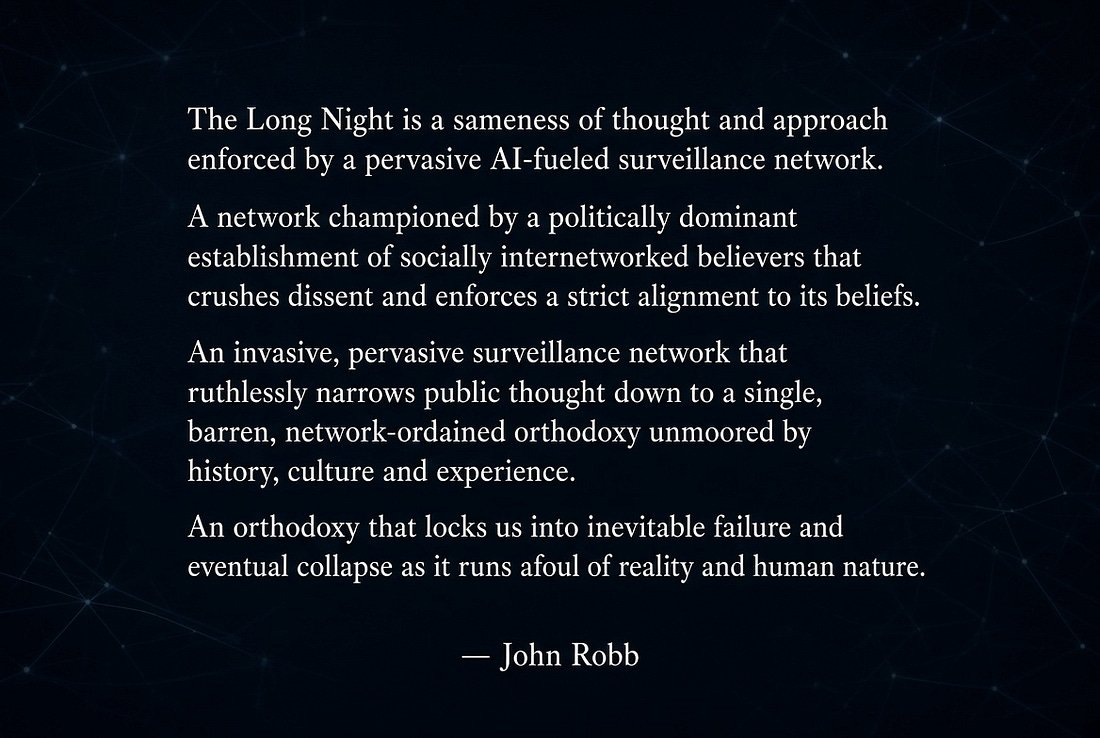
In this regard, Robb says the center-left Dems are feeling their oats after the midterm elections. “Goal: to control AI alignment (the values baked into AIs during training) by restricting AI development to a few big, controlled companies with similar alignment.”
This centralization of AI “would allow the establishment (political, academic, etc.) to:
- “Narrow the permitted band of political discussion
- “Limit how much academic exploration can deviate from established interpretations
- “Establish strict controls over social conventions and conversations.”
Robb’s post concludes with this disquieting thought: “If Jensen is blocked from returning, Musk is next. Despite his numerous flaws, he’s the only tech leader left standing in the way of an AI-fueled long night.”
[Gee, I hope Donald Trump thinks this is all a price worth paying because “you can’t let Iran have a nuclear weapon.”]
 Your Government in Action, Pentagon Edition
For the record: The Pentagon has failed an audit for the ninth-straight year.
Not that you’d know it from reading the Pentagon’s press release: “For the first time in Department history, clean audit opinions will cover more than 56% of DoW assets.”
Golly, what an accomplishment. Given that the Pentagon has $4.8 trillion in assets, that means “more than $2 trillion in assets do not have clean audits,” writes Ben Freeman at the Responsible Statecraft website. The Pentagon is the only federal agency that’s never had a “clean” audit department-wide.
Reminder: The Pentagon budget surpassed $1 trillion for the first time this year. Donald Trump wants to up it to $1.5 trillion — even more than Washington spent at the height of World War II, and yes that is adjusting for inflation.
As we’ve chronicled before, efforts to audit the Pentagon go back more than 30 years now. And they’ve never gone anywhere.
“If the Pentagon can’t tell us where our money has gone,” Freeman asks rhetorically, “why should we give them more money?”
Here, we can’t resist revisiting our 2013 writeup about how the Pentagon’s bookkeeping practices contrast with that of… Osama bin Laden and al-Qaida.
Really, they brought new meaning to the word meticulous.
The Associated Press described how al-Qaida’s faction in West Africa tracked the tiniest expenses — soap, macaroni, superglue — on scraps of paper and Post-it notes. “For the smallest thing, they wanted a receipt,” recalled a storekeeper in Timbuktu, Mali.
"This habit,” said the article, “can be traced back more than three decades to when a young Osama bin Laden entered King Abdulaziz University in Saudi Arabia in 1976 to study economics, and went on to run part of his millionaire father's construction company."
Back in present-day Washington, the Government Accountability Office reminds us that the Pentagon’s sloppy bookkeeping is bad not just for taxpayers, but also the troops…
“Without having sound financial management practices and reliable, useful and timely financial information routinely available,” says a report issued in May, “DOD risks being unable to effectively and efficiently manage its budgets and assets for the benefit of the warfighter.”
 Mailbag: Huang and Huang (Cont’d.)
A reader writes to add some color to the history of Alice Huang. I haven’t verified this myself, but if true it further undercuts the Chinese-spy narrative…
“She paid up to $50,000 to take the same French cooking class Jensen Huang’s daughter took.
She paid $11,000 to learn how to flirt and seduce men. She loves to talk technicals of chips.
“If she was a CCP honeypot, the CCP would have trained her behind the scenes. She probably was an independent business woman working in her own self-interest.
“Singapore held her passport for eight months. That would end most spies’ careers.”
“Without getting into the moral implications of having an affair with a subordinate, what is the PRIMARY job of a board member of a large company?” another reader writes.
“Making money for the shareholders, something clearly at odds with losing Huang.
“What I would have done (considering Huang alone is probably worth close to at least $600 billion in market cap) - suspend the guy for a month or so and call it a day. He's not your ordinary CEO.
“If people are outraged over his affairs that's fine. In the real world of big-time Fortune 500 companies (having been there as a PR guy) lots of CEOs and VPs are having affairs, often with subordinates. I won't argue it's not a good decision but it happens, frequently.
“The problem is those folks aren't worth hundreds of billions in market cap.”
Dave responds: Our Davis Wilson concurs with you — Jim Rickards’ objections in Monday’s edition notwithstanding.
“At the end of the day, the board of directors’ job is to do what’s best for shareholders,” Davis writes in today’s Million Mission. “And do you know what’s not good for shareholders?
“Jensen starting another company to compete with Nvidia. Or joining forces with Elon Musk to build a rival AI chip business.
“Maybe Jensen doesn’t return as CEO. Maybe Nvidia brings him back as chief technology officer, president or some newly created position that allows him to steer the company’s long-term direction.
“I don't know what that arrangement would look like. But I have a hard time believing Nvidia's board will let the man who built the company into an AI powerhouse walk away and potentially become its biggest competitor.”
We shall see. As noted above, a lot of powerful forces seem to be arrayed against Huang. And Musk. Dicey times these are…


