
A Recipe for “Immediate” Civil War
 “The Great Taking"
 “Hi Dave, I'd like someone to write about this,” says a reader’s email.
The reader links to a recent opinion piece on the Fox News website by Justin Haskins of the Heartland Institute with the provocative headline: “Wall Street Could Seize Your Retirement Savings In the Next Financial Crash — and It’s Perfectly Legal.”
Here’s the essence of the piece…
Beginning in the 1970s, at the request of powerful Wall Street and banking institutions, state lawmakers quietly adopted a series of changes to the Uniform Commercial Code, a body of law enacted in all 50 states. These changes effectively allowed financial institutions to reassign direct ownership of most securities away from individual investors, including those holding retirement accounts and traditional brokerage accounts…
Under Article 8 of the Uniform Commercial Code, if a brokerage firm collapses during a financial crisis, secured creditors, including banks, may seize securities used as collateral in lending arrangements with broker-dealers. This can include customer securities, such as stocks and bonds, if they were pledged as collateral for those loans.
As a result, during the next major crash, investors could lose their entire portfolios if their broker-dealer pledged customer assets to obtain financing.
Back to the reader: “My concern is even if my Roth or trading accounts were entirely in cash that Schwab might try and not give me access to funds in the event of a crash. Is this an accurate statement, or is this not possible?”
And down the rabbit hole we go…
Haskins is flogging a new book that — unless I’m missing something — appears to be a ripoff of The Great Taking.
Published in 2023 by a former hedge fund manager named David Rogers Webb, The Great Taking lays out more or less the same dire possibility that Haskins is now: Because the stocks you own aren’t legally held in your name, you’re at risk of losing them amid a financial crisis if your broker owes a bunch of money to a counterparty and doesn’t have the ready funds to pay up.
(And yes, your cash instruments like T-bills and money-market funds would also be at risk…)
As doomy as my outlook can be at times, I’m not hugely concerned about this.
I think Karl Denninger of the Market Ticker blog has it right: “If you did this you’d get an immediate dirty civil war.”
Every bank, every financial institution and all of their employees and families, every lawmaker and their families, every cop who tried to get in the way and everyone else from rich to poor would be targeted and everyone would be shooting, stabbing, looting, burning, raping and similar.
Infrastructure would be attacked… nobody would have power within hours or days and all supply chains would collapse since all firms hold said securities and bank deposits too and their operating capital would go ‘poof’ — thus they could pay neither suppliers or employees. There would be no gas at the local station, no food in the store within hours and every truck would stop when it ran out of the fuel in its tank. Everyone, everywhere, would get in on robbing or whacking someone simply because they'd have to in order to survive…
All government funding goes to zero instantly as no bond auction can be paid nor can any refunding be completed — and since employers can't pay employees there are no tax deposits either — and every business shuts down immediately as it has no employees showing up when they can't be paid.
Never mind that the cops would instantly turn on said politicians because their pensions and similar retirement will be stolen just like everyone else's and the agencies would be unable to pay them thus they'd be rather likely to either sit at home trying to defend their own or turn on the people they allegedly "protect"...
Politicians and central bankers aren’t the sharpest knives in the drawer — but presumably they’re capable of seeing one or two steps ahead when their own personal safety is potentially at risk.
So The Great Taking doesn’t particularly keep me up at night.
But as long as the reader brought up Roth IRAs…
 The Trouble With Roth IRAs
When it comes to Roths, there’s a greater-than-zero likelihood the feds will change the rules to your disadvantage sooner or later. I’ve been writing about this for over a decade, though not recently.
“Holders of Roth IRAs may be in for a rude shock,” warned Steve Forbes in 2013.
“Their contributions have been made with after-tax dollars, with the promise that the ensuing benefits would be exempt from federal income tax. Slapping a special ‘emergency’ levy on these assets will become an irresistible temptation for politicians as the pot of assets gets bigger.”
In 2019, a Democratic Congress passed and Donald Trump signed something called the SECURE Act. One of its key provisions did away with the “stretch IRA.”
Under the old rules, your kids could inherit your IRA and “stretch” out the withdrawals over many, many years — even as the nest egg would keep compounding tax-free. But under the SECURE Act, they have to clean out the account within 10 years of your death.
Uncle Sugar wants his revenue and he doesn’t want to wait around.
(And to be clear, these new rules apply to both traditional and Roth IRAs.)
So chew on these possibilities specifically for Roths, hypothesized a few years ago by former colleague Nilus Mattive: Perhaps “politicians will eventually remove the tax-free benefit on earnings within Roth IRAs… at least for wealthier Americans.” Or they could impose “a limit as to how much of a balance can be maintained before taxes kick in again.”
I get the appeal of Roths, and I get the appeal of converting traditional IRAs to Roths as you get older: Pay the taxes up-front to minimize your taxable income in retirement. But I don’t trust anyone in the Beltway to keep up their end of the bargain. For better or worse, only a small portion of my and my wife’s retirement funds are in Roths. Your mileage may vary.
Anyway, these Roth scenarios seem a lot more plausible than All your stonks are belong to us.
On to the markets today…
 Countdown to NVDA
The software scare might not be over — but for the moment it’s no longer a drag on the broad market.
Yesterday the headlines shifted back to hardware: Meta announced it’s buying six gigawatts’ worth of AI computing power from AMD. The deal is valued at over $100 billion and could lead to META owning up to 10% of AMD shares. That was enough to lift the S&P 500 by 0.8% and the Nasdaq even more.
Today the hardware vibes continue: Nvidia reports its much-awaited earnings after the closing bell. At last check, the S&P is up nearly a half percent to 6,919 and the Nasdaq is up nearly 1%.
“I expect another beat-and-raise quarter from Nvidia,” says Paradigm analyst Davis Wilson.
“Nvidia still trades around 24X forward earnings — a multiple you’d expect for a mature consumer brand, not the backbone of global AI infrastructure. Hyperscalers are still spending. Supply is still constrained.”
From today’s share price of $195, Davis expects a post-earnings bounce to $205. “A shot in the dark,” he concedes, “but with all the negative sentiment already baked in, I believe a move to the upside is more likely.”
Don’t look now but silver has recovered a $90 handle for the first time since its sickening plunge from $120 at the end of January.
The white metal is up over $3 to $90.39 as we write. But don’t get too excited yet: As we’ve said more than once, $90 is the resistance level Paradigm options analyst Nick Riso believes will stay in place for a while.
Gold keeps backing and filling, meanwhile — up $46 to $5,188. Crude continues to hover over $65. Crypto is trying to stage a rally but Bitcoin remains under $67,000 and Ethereum under $2,000.
Not much market reaction to the State of the Union speech that we can see. Then again, it didn’t make much news.
The president rehashed a few of his previously announced economic initiatives. Democrats sat on their hands throughout until it was time for the Two Minutes Hate against Iran, then they clapped like trained seals. Erika Kirk looked on approvingly as the president threatened to wage a war that her deceased husband vehemently opposed. Axios and Politico pimped fake news about how Rep. Thomas Massie (R-Kentucky) was going to sit with the Democrats. (He did not.) The Democrats trotted out another ex-CIA officer for their party’s response to the speech — same as last year.
 JPM and Epstein
Does Bloomberg think it has some sort of huge scoop here?
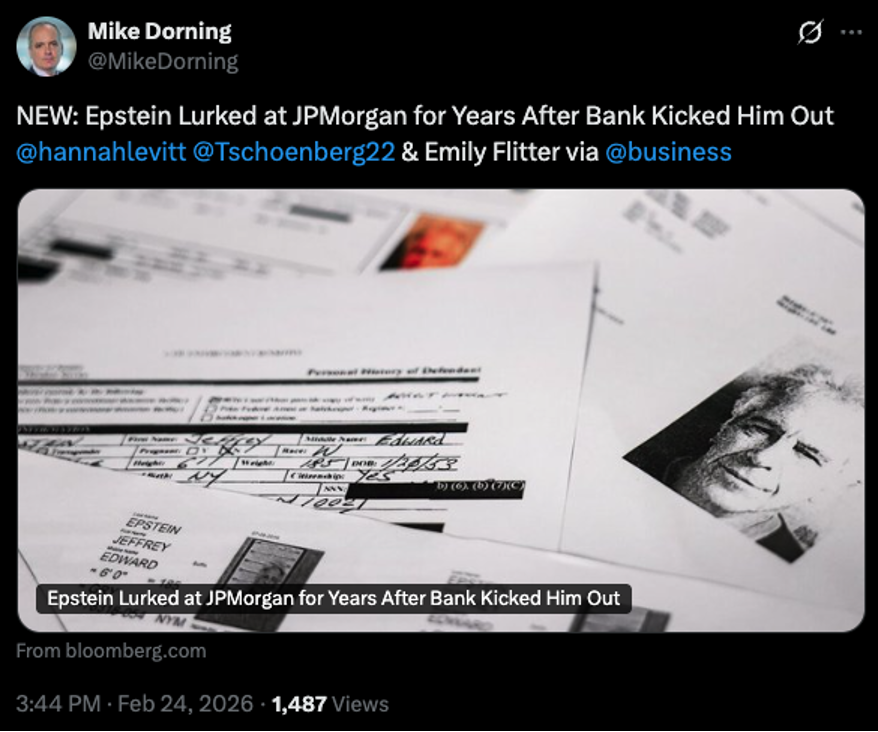
“Five years after JPMorgan Chase & Co. sought to rid itself of Jeffrey Epstein,” the story begins, “the convicted sex offender was once again moving money into the bank.
“In February 2019 — six months before he died in a New York jail cell — Epstein used one of his trusts that had been kicked out of JPMorgan half a decade earlier to wire $150,000 to his girlfriend’s brokerage account at the bank. After it landed, the money made up the bulk of the funding in the account.
“The transfer is just one example of the myriad ways Epstein stayed connected to the biggest U.S. bank after it dropped him as a client in 2013, dozens of emails and other documents recently released by the U.S. Department of Justice show.”
Whatever. We already knew JPM continued playing footsie with Epstein after supposedly washing its hands of him in 2013.
As we chronicled throughout 2023, the government of the U.S. Virgin Islands sued JPM — asserting that the bank not only “turned a blind eye” to Epstein’s activities on Little Saint James but that it “actively participated in Epstein’s sex-trafficking venture from 2006–2019.”
The pretrial documents also alleged JPM facilitated Epstein’s withdrawals of physical cash — far beyond the $10,000 threshold that banks are required to report to the U.S. Treasury — “while also being aware that Epstein paid his underage sexual assault victims in cash.”
And the whole thing got swept under the rug when the Virgin Islands government agreed to settle the case for a $75 million payment from JPM — about 0.18% of the bank’s revenue the previous quarter.
(Given everything we subsequently learned about Epstein’s relationship with leading Virgin Islands politicians, it was no surprise.)
Bloomberg’s review of the latest Justice Department document dump does reveal that JPM filed suspicious activity reports on more than $1 billion in transactions between Epstein and “current, former and non-JPMC” customers between 2003–2019.
Alas we still don’t know what came of those reports. Probably the circular file or the electronic equivalent…
 AI and Electricity (Continued)
“Funny you mention it,” a reader says after our Stargate update in yesterday’s edition.
“I was just at an energy conference in San Diego last week. One of the seminars about energy and AI highlighted Stargate, specifically a site under development in New Mexico called ‘Project Jupiter.’
“Since most of the ‘hyperscaler’ data centers can't get gigawatts of energy fast enough — and it could take YEARS to connect to the grid — they're now going ‘behind the meter’ (BTM). That means generating their own power on site, typically with natgas turbines mounted on flatbed trucks and some lithium-ion batteries for backup power/peak shaving. Elon's xAI was the first to do it as the ‘Colossus’ site near Memphis. Took FOUR MONTHS to get up and running!
“50 GW of these BTM projects were announced last year.
“Anyway, Project Jupiter is estimated to cost $165 billion. But it's also expected to generate 14 million tons of CO2 per year with the natgas turbines. Which would erase ALL of New Mexico's ‘emissions’ cuts over the last 20 years.
“I guess ‘climate change’ isn't that big of a deal anymore? Funny how it fell out of the headlines as soon as AI came along…”
Dave responds: Pretty much. For years, Silicon Valley flattered itself with delusions that its growing data-center energy needs could be met by “renewables.”
The delusion persisted throughout the 2010s even as video streaming, hard-core gaming and crypto mining added more and more electric demand.
Nobody noticed at the time because as Mark Mills of the National Center for Energy Analytics has pointed out, that new demand was offset by energy-efficient light bulbs and refrigerators.
But those were one-time savings. Once people started using AI in earnest, there was nothing to offset the skyrocketing demand. By 2024, we screamed from the rooftops that AI was the monster that ate the power grid even as the mainstream remained clueless.
And so Big Tech’s best and brightest had to start accommodating nuclear power — consoling themselves that at least it didn’t generate any of those dreaded “carbon emissions.”
But the required nuclear buildout is going to take years, and AI can’t wait that long. As you point out, Elon has settled on natural gas as a speedy solution. Others will soon follow suit.
Yes, investment implications abound. We’ll be eyeing them in the weeks and months ahead…


