
39 Days Before NVDA Tips Its Hand
 39 Days Before NVDA Tips Its Hand
 I’m still shaking my head over what happened yesterday during the Paradigm All-In Summit featuring Jim Rickards, James Altucher and Enrique Abeyta.
There they were — our three most high-profile gurus, guys who frequently disagree about the direction of the market, the direction of the economy, even what to have for lunch.
But they were “all in” on a single big theme.
And I do mean big — the imminent convergence of AI, advanced robotics and the revival of U.S. manufacturing. “It’s going to be the biggest transformation to America’s economy in 50 years,” said Jim.
They were also all-in on a tiny software company partnering with Nvidia to make it all happen.
But at the same moment 20,000 of your fellow readers were being clued in to this transformational wonder, mainstream financial media were zeroed in on near-term noise…
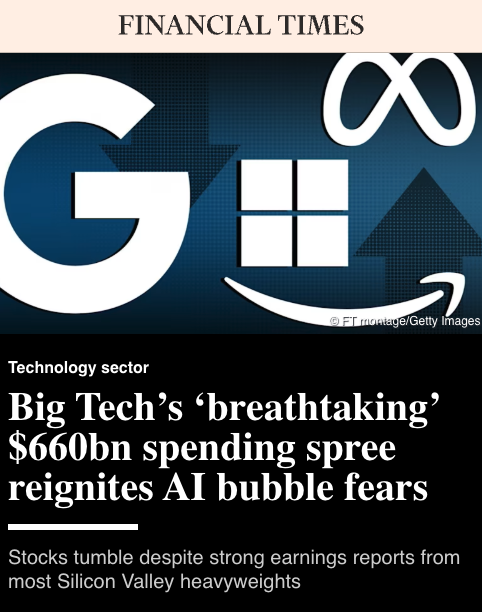
“Big Tech stocks have sold off heavily,” said the Financial Times, “after the companies unveiled plans to spend $660 billion this year on AI, as investors fret that the ‘breathtaking’ capital expenditures are outpacing the earnings potential of the new technology.
“Amazon, Google and Microsoft are set to lose a combined $900 billion in market value since filing their quarterly earnings over the past week.”
Perspective, please: The Nasdaq Composite is down a not-so-whopping 6% from its late-October peak. If it were at all-time highs, no one in the media would be carping about an “AI bubble.”
“Look, I know a thing or two about bubbles,” Enrique said during the summit yesterday. “I was managing money when the dot-com bubble burst. I shorted it on the way down and made lots of money for my clients.
“What we’re seeing today in AI is not how bubbles peak.”
Which brings us to an eye-opening chart Enrique shared during the event. We’ve shown it in the past here in 5 Bullets as well — comparing the Nasdaq Composite’s performance during the dot-com boom and the current AI-fueled boom.
It sets the starting point of the dot-com boom with the launch of the Netscape web browser in December 1994. And it sets the start of the current boom with the launch of ChatGPT 3.5 in November 2022…
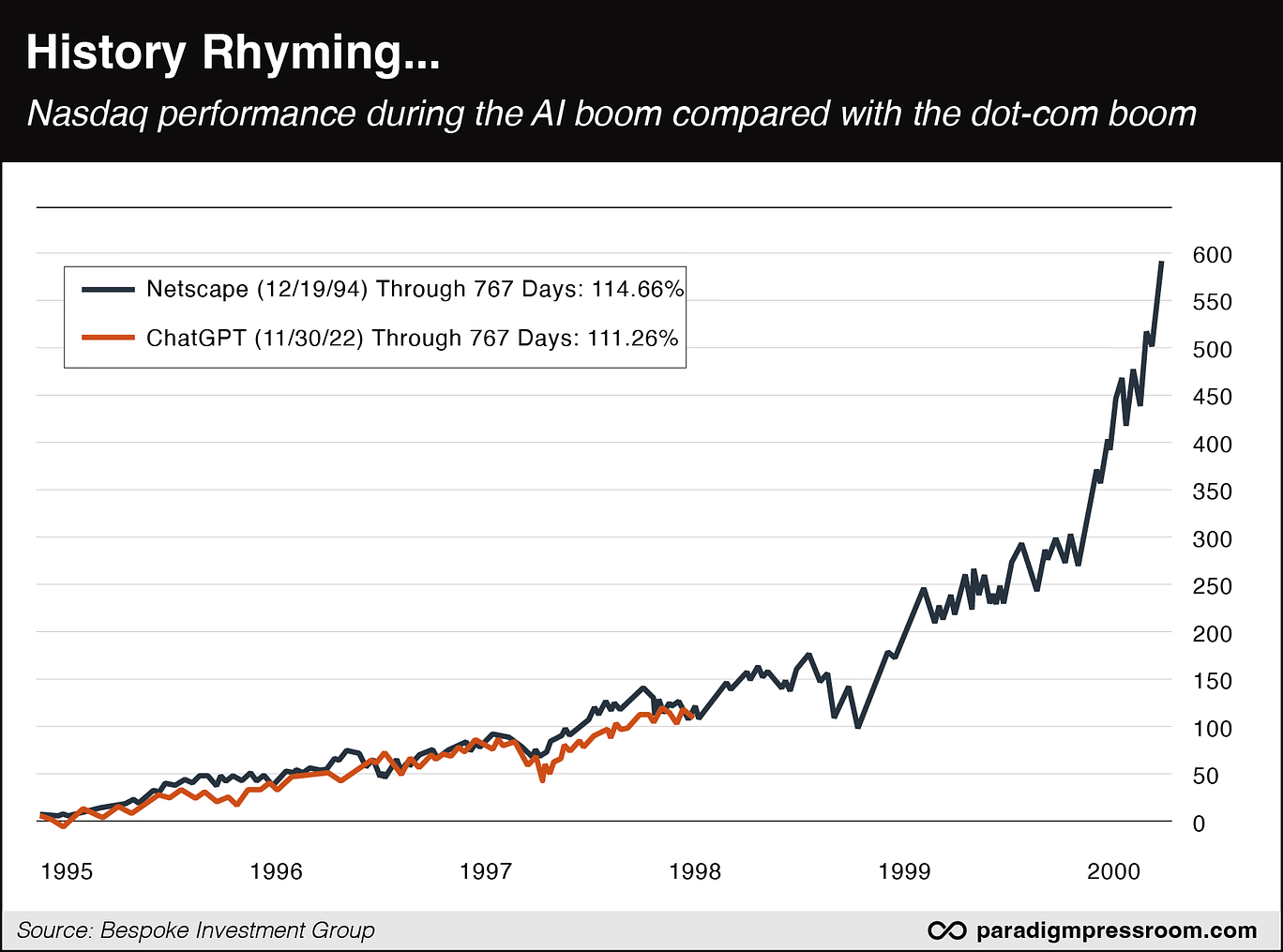
In both cases, we’re looking at a gain of over 100% in a little over three years.
“Notice how much this bull run compares to the one 30 years ago,” said Enrique. “Imagine if this same situation plays out over the next handful of years.”
If AI were nothing more than chatbots like ChatGPT, then yes — AI would be due for a hard reset.
But as our trio of experts took pains to point out yesterday, AI is about much more than chatbots.
“We’re really talking about the next wave of AI — and that’s robotics and automation,” said James Altucher.
Call it “aAI” or autonomous AI.
To some extent, aAI already happening. Here’s a startling stat we learned during the All-In Summit: A decade ago, the typical Amazon worker handled about 175 packages. Last year, the total was 3,870. That’s AI solving real-world practical problems.
But with a new aAI effort called Project Trinity, those leaps in productivity are coming to every industry — again, AI melding with automation melding with a revival of the U.S. factory sector.
And our experts all agree it’s got the backing of three powerful forces…
- Donald Trump, set to sign an executive order any day now
- Elon Musk, set to roll out his Optimus autonomous robots by the end of this quarter
- Jensen Huang, the Nvidia CEO, set to unveil the company’s newest superchip that will power aAI on March 16.
That’s just 39 days from now. Oh, and Huang is also set to name the tiny software company Nvidia is partnering with to make it all possible.
So you have 39 days to position yourself for the biggest economic transformation in 50 years.
Profit potential, you ask? Perhaps 2,566% — unfolding in a matter of weeks.
If you’re a Paradigm Mastermind Group member, you have full access to a suite of special reports released yesterday — naming this company and laying out a host of other lucrative aAI plays. Access here.
 About the AI Spending Spree…
Life comes at you fast, doesn’t it, Financial Times?
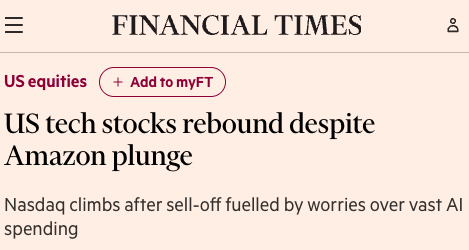
Amazon is down 8% today because its AI spending plans are more ambitious than Wall Street analysts are counting on. But the gloom is not extending to the tech sector as a whole, as the Nasdaq is up nearly 1.2% at last check.
The S&P is up nearly 1.3% to 6,885 and the Dow has rallied 1.8%.
Actually, just about every asset class that took a beating this week is rallying into the weekend…
- Gold is up 3.5% to $4,944
- Silver is up 7.8% to $76.38
- Bitcoin is back over $68,000
- Ethereum is within sight of $2,000 again.
Let’s return to the AI spending spree before we move on…
Four of the “Magnificent 7” stocks are the hyperscalers pouring money into data centers (and the electricity to run them and the water to cool them).
A year ago we tried to label them the MAMA stocks — Microsoft, Alphabet, Meta and Amazon — but it didn’t catch on. All four of them have now reported their quarterly numbers. Looking at the reaction in each of their share prices, only Meta was rewarded by Wall Street for its spending plans. Hence the doomy headlines of the sort we mentioned in Bullet No. 1.
On the Paradigm Press mobile app, trading pro Enrique Abeyta posted the following yesterday…
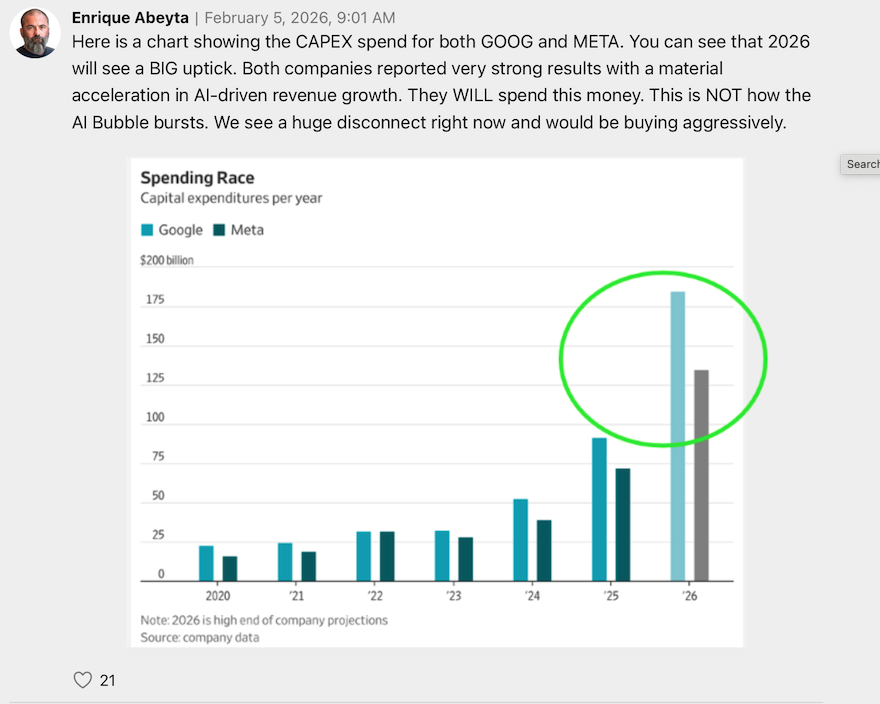
He also pointed out a major difference between today’s hyperscalers and the dot-com darlings of the late 1990s: The MAMA stocks generate profits hand-over-fist. The most buzzy dot-coms like Global Crossing and Level 3 had way more publicity than profits.
And even if the Street continues to punish the hyperscalers, all that money they’re spending will flow toward companies like Nvidia, Broadcom and Credo.
Enrique’s bottom line: “This is NOT how the AI bubble bursts. We see a huge disconnect right now and would be buying aggressively.”
 War Drums
For the second Friday in a row, traders are bidding up oil in the event of a U.S. attack on Iran while markets are closed for the weekend.
Checking our screens, a barrel of West Texas Intermediate is up 1.2% and back above $64.
As we’ve mentioned more than once, there’s been a pattern during both the Biden and Trump 47 administrations — big military action launched during the weekend, when U.S. markets are closed.
In one instance, U.S. forces launched airstrikes against “Iran-linked” targets in Iraq and Syria as soon as the stock market closed on a Friday at 4:00 p.m. Eastern.
The idea is to short-circuit any instant market freakout. By the time trading reopens Monday morning, everyone’s had a chance to catch their breath and they’re less inclined to react with extreme buy or sell orders.
Today, “indirect” talks between American and Iranian envoys are underway in Oman. But any talks will go nowhere as long as Washington dictates terms that Tehran views as suicidal.
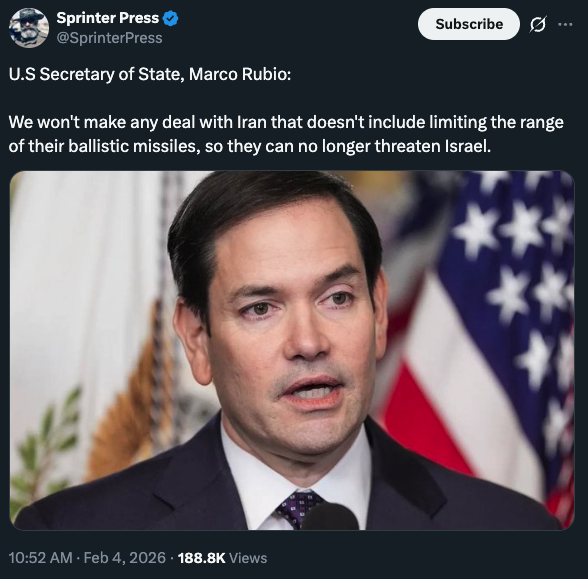
“They should know that if they start a war this time, it will be a regional war,” Iran’s supreme leader Ayatollah Ali Khamenei said last Sunday.
“Sounds bad, but you can’t exactly blame Tehran for threatening to set the Middle East ablaze,” writes Andrew Day at The American Conservative.
“Trump has demonstrated a strong preference for military action to be quick and achieve specific objectives so he can avoid American casualties and long, chaotic wars. The Iranians know this, and their provocative rhetoric is meant to prevent another attack on their country, not to antagonize Washington.”
Amid that backdrop, “It’s really the Israelis who want a strike,” a U.S. official tells the Axios site. “The president is just not there.”
He’s probably “not there” because of these poll numbers. Even Republican support for military intervention in Iran is barely 50%...
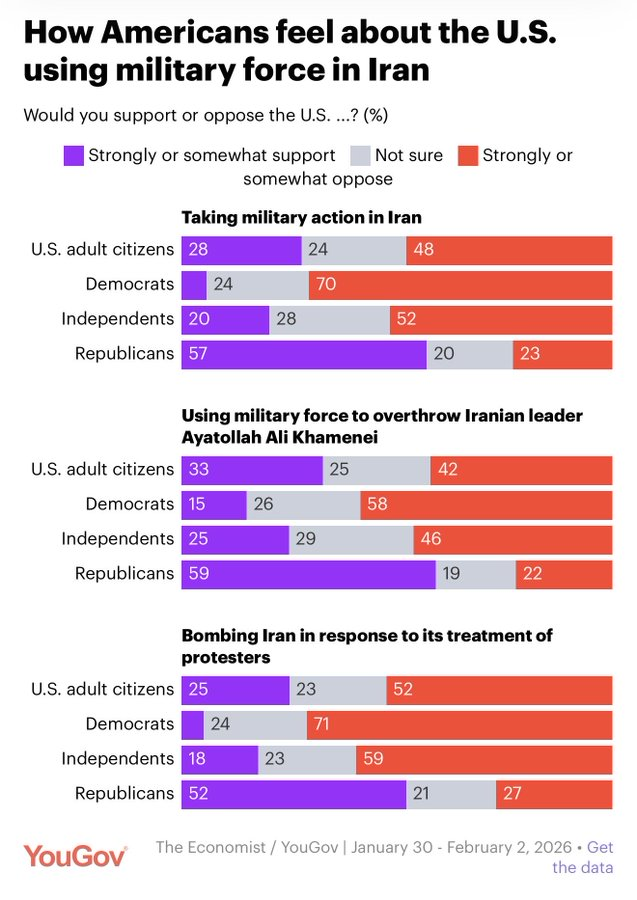
On the one hand, it seems unlikely the Trump administration would order an attack on Super Bowl weekend, right?
On the other hand, the Winter Olympics open tonight — and Washington has a habit of instigating geopolitical trouble around the Olympics, as we’ve chronicled previously…
- Summer 2008: Shortly before the Games opened in Beijing, Washington’s puppet leader in the former Soviet republic of Georgia invaded a rebel province, hoping to re-annex it. Georgian forces killed and wounded scores of Russian peacekeepers. As the games began, Russian tanks rolled into Georgia and quickly restored the status quo ante
- Winter 2014: As the Games were underway in Sochi, Russia, the Obama administration engineered a coup in Ukraine — ousting a democratically elected pro-Russian leader. From there, a low-grade civil war raged in Ukraine for eight years until…
- Winter 2022: During the games in Beijing, the Biden administration blew off Moscow’s demands that Ukraine never join NATO and that U.S. weapons systems targeting Russia never be deployed in Ukraine. Moscow launched its “special military operation” four days after the closing ceremonies.
Yes, all of those examples involved Russia. Then again, an extended U.S.-Iran conflict might well draw in Moscow (and Beijing) on the side of Tehran.
Russian and Chinese leaders might tolerate the toppling of Venezuela’s strongman Maduro. In contrast, “Russia and China simply cannot permit Iran to fall,” writes the military analyst William Schryver.
For them, Iran possesses “inherent geostrategic importance” as well as “strategic importance to the emergence of the multipolar world for which Russia and China are the vanguards and strongest components.”
On that less-than-cheery thought, we move on…
 Comic Relief
Wow, and people call me cynical. Here’s Ryan McMaken from the Mises Institute…

 Mailbag: Silver Smash
“Thank you, Nick Riso, for the great article,” a reader enthuses after we spotlighted our able colleague’s deep dive into the meltdown in silver a week ago today. “It was both informative and educational!
“One question: Is there not an ability to stop trading in a particular stock or the entire exchange similar to the financial markets? Should there be (you will always have events that can crush a market be they internal or external)?”
Dave responds: Well, there are “circuit breakers” — a specific crash band for individual stocks. Typically it’s a 10% or greater move in five minutes, although that can vary from one exchange to another.
“But I can't say intelligently whether that's ‘right’ or ‘wrong,’ Nick tells us via email.
"It's a metaethical question there. Maybe it will be in the future with more automated trading, but maybe not. It's complicated.”
You didn’t get an easy answer, dear reader, but you got an honest one! As purveyors of investment recommendations we must deal with the world as it is, not as we might wish it to be.


